
Most people who visit Thailand never make it to Buriram. Most people who make it to Buriram never make it up the hill. That is their loss — and, quietly, your gain.
Prasat Hin Phanom Rung sits 383 metres above the Khorat plateau on the rim of an extinct volcano, looking south across the flat agricultural plain toward Cambodia. On a clear morning the view alone is worth the journey. The temple complex itself is something else entirely.
Built primarily between the 10th and 13th centuries during the height of the Khmer Empire, Phanom Rung is one of the finest examples of Khmer architecture outside Cambodia. It predates much of Angkor Wat in its current form. It was built as a Hindu temple dedicated to Shiva, later converted to Buddhism, then abandoned, then — in one of Thailand’s great restoration stories — painstakingly reconstructed over several decades in the twentieth century.
The result is a temple that feels genuinely complete. Not a ruin. Not a collection of interesting stones with explanatory signs. A real building, with real presence, in a real landscape.
What Makes Phanom Rung Special
Several things set it apart from other ancient sites in the region, and from most temples in Thailand.
The approach. The processional walkway leading to the main sanctuary is one of the longest of any Khmer temple — 160 metres of naga-flanked promenade, crossing a cruciform terrace and ascending through a series of galleries before arriving at the main tower. You don’t arrive at Phanom Rung. You are received by it.
The alignment. Phanom Rung is one of only a handful of temples in the world precisely aligned so that, on four specific days each year, the rising sun shines directly through all fifteen of its doorways in a perfect line of light. These dates — around the 3rd, 4th and 5th of April and again in September — draw crowds. Every other day, you will almost certainly have the place largely to yourself.
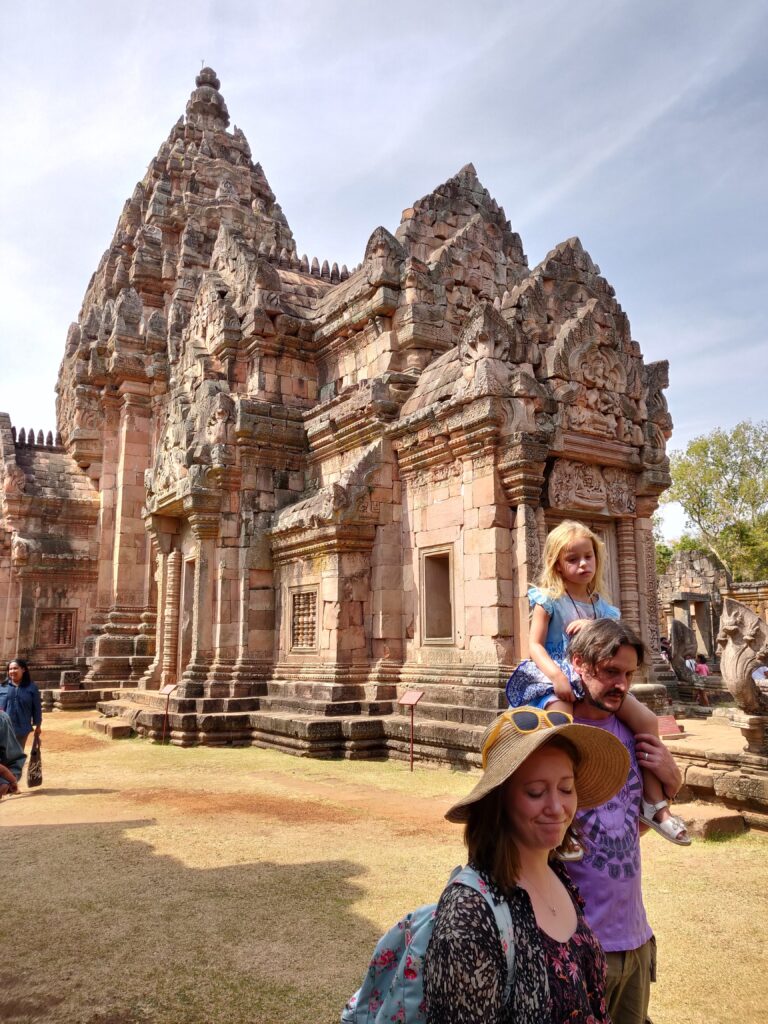
The carved stonework. Standing beneath the main tower for the first time, most visitors simply stop and stare upward. The density and quality of the carving — figures, foliage, mythological scenes stacked from base to tip — is extraordinary. Every surface has been worked. Even after a thousand years of weathering, the detail is remarkable.
The lintel. The Phanom Rung lintel — depicting Vishnu reclining on the serpent Ananta — is famous throughout the archaeological world, partly for its exceptional quality and partly because it was stolen in the 1960s and ended up in the Art Institute of Chicago, where it remained for twenty-three years before international pressure finally brought it home in 1988. It now sits in its original position above the eastern portico of the main sanctuary. It is extraordinary.
The setting. Unlike many historical sites in Thailand, Phanom Rung sits in genuine countryside, with agricultural land stretching to the horizon on all sides. There is no town immediately around it, no street food vendors crowding the entrance (a small market sits at the bottom of the hill), no tuk-tuks. Just the temple, the hill, and the sky.
Getting There
Phanom Rung is located in Chaloem Phrakiat district, approximately 50 kilometres south of Buriram city. There is no public transport that goes directly to the temple, which is part of why visitor numbers remain relatively low.
By car or motorbike is the most practical option for independent travellers. From Buriram city, take Route 219 south toward Nang Rong, then follow signs for Phanom Rung. The drive takes around an hour and the road is straightforward. Car hire in Buriram is available through several local agencies, and motorbikes can be rented cheaply in town.
By taxi or songthaew from Nang Rong town (roughly 14 kilometres from the site) is possible, though you will need to negotiate. Nang Rong itself is reached by bus from Buriram city.
Organised day trips from Buriram are available through guesthouses and local tour operators, and typically combine Phanom Rung with the nearby Mueang Tam temple complex, which makes for a very full and worthwhile day.
Visiting Practically
Opening hours: 6am to 6pm daily.
Entrance fee: 100 Thai Baht for foreign visitors (approximately £2.20 at current rates). Free for Thai nationals. This is genuinely one of the great bargains in Southeast Asian tourism.
Time needed: Allow a minimum of two hours to do it justice. Three hours is better if you want to explore properly, read the interpretive signs, and sit quietly in the main sanctuary for a while. Four hours if you combine it with Mueang Tam.
What to wear: Shoulders and knees should be covered as a matter of respect. Sarongs are available to borrow at the entrance if needed. Comfortable shoes with grip are advisable — the stone surfaces can be uneven and the climb, while not demanding, involves steps.
Best time to visit: Early morning on a weekday, outside of the solar alignment dates in April, is the quietest. Arriving at opening time (6am) on a clear morning, with the light low and the air cool, is an experience worth setting an alarm for. The site is busiest on Thai public holidays and during the April alignment event, when it becomes genuinely crowded.
Facilities: There is a small museum at the base of the hill which provides useful historical context and is worth visiting either before or after the temple itself. A car park, toilets, and a handful of food stalls are also at the base. There are no facilities at the top.
A Family Visit
Phanom Rung is manageable with children, though the uneven stone steps and the climb to the top require some thought. Young children will need carrying or close supervision on the steeper sections. The site is open enough that there is plenty of space, and the sheer visual spectacle — the towers, the carvings, the views — tends to hold children’s attention more than most temples.
Buriram families visit regularly, and you are as likely to encounter Thai day-trippers as foreign tourists on a typical weekend. That mix is part of what makes it feel like a living place rather than a preserved exhibit.
Combining with Mueang Tam
Fourteen kilometres northwest of Phanom Rung lies Prasat Mueang Tam, a smaller Khmer complex of the same era that is almost entirely overlooked by visitors. Where Phanom Rung draws modest crowds, Mueang Tam is almost always empty. The restoration is less complete and the setting less dramatic, but the L-shaped ponds (baray) surrounding it have an extraordinary stillness, and the quality of the carved stonework is equal to anything at Phanom Rung.
If you are making the journey south from Buriram, visiting both sites in the same day adds very little extra distance and makes for a genuinely rounded picture of Khmer civilisation in this part of Thailand.
A Note on the Wider Khmer Heritage of This Region
Phanom Rung is the most famous, but not the only, Khmer site in the Buriram and Surin area. The region sits on what was once the northwestern frontier of the Khmer Empire, and ancient temples, prangs and sanctuary ruins are scattered across it in considerable number — many barely signed, some on private agricultural land, most visited only by the occasional local or serious enthusiast.
This is one of the things that makes the area so interesting to explore, and so different from the well-trodden tourist circuits of central Thailand. The history here is real and largely unprocessed. It rewards curiosity.