
Most visitors to southern Buriram make a beeline for Phanom Rung and head straight home. Twenty kilometres away, on a different extinct volcano, Wat Khao Angkhan sits in near-total quiet.
Wat Khao Angkhan is not hidden exactly — it appears in guidebooks, it has a signposted road, and it gets a handful of visitors most days. But by the standards of anywhere with this much to offer, it is one of the most overlooked places in Thailand.
On a single hilltop you get: boundary stones carved 1,300 years ago that are unlike anything else found in the country, flamboyant 1980s architecture that somehow works, Jataka murals painted by Burmese monks, a 29-metre reclining Buddha, a Chinese-style pagoda, and views across the flat Isaan plain that stretch to the horizon. All of it free. Almost always quiet.
Wat Khao Angkhan: Sacred for 1,300 Years
The hill itself is an extinct volcanic plug in Chaloem Phra Kiat District, similar in geological character to the one Phanom Rung stands on — though lower and less dramatic. The name Khao Angkhan simply means “charcoal hill,” a reference to the dark basalt rock that distinguishes this volcanic outcrop from the sandstone landscape around it.
That basalt matters more than it sounds. When archaeologists found the ancient sema stones here, they were made not of sandstone — the material used for virtually every other set of sema stones in Thailand — but of local basalt. That makes them unique. Nowhere else in the country have Dvaravati-period sema stones been made from this material, and that singularity tells you something about how seriously this hill was regarded by the people who lived here in the 8th and 9th centuries.
The Dvaravati civilisation was Buddhist, pre-Khmer, and deeply rooted in the region centuries before Phanom Rung’s Hindu temples were built. Carved with bas-reliefs of human figures, stupas, lotus flowers, and Dharma wheels, the sema stones here are physical evidence that this volcanic hill served as a sacred Buddhist site over 1,300 years ago, long before the modern temple existed.
The modern chapter began in 1977 when a monk named Phra Archan Panyawutthitho established a temple on the hilltop, drawn by local tradition connecting the site to the Buddha’s ashes. Construction began in earnest in 1982, and it is those buildings that give Wat Khao Angkhan its distinctive character today.
What to see at Wat Khao Angkhan
The climb to the summit is not strenuous — the temple is accessible to most visitors on foot up a staircase lined with naga balustrades. At the top, the complex unfolds across the hilltop in a way that feels genuinely unlike anywhere else in Buriram.
The sema stones
Look for the ancient basalt boundary stones surrounding the ubosoth — the ordination hall at the heart of the complex. They are unassuming in size but remarkable in what they represent: a direct, physical link to Dvaravati Buddhism more than a millennium ago. The carved reliefs are weathered but legible if you look closely: stupas, lotus motifs, Dharma wheels, human figures. Take a moment with them. Most visitors walk straight past.
The ubosoth and its murals
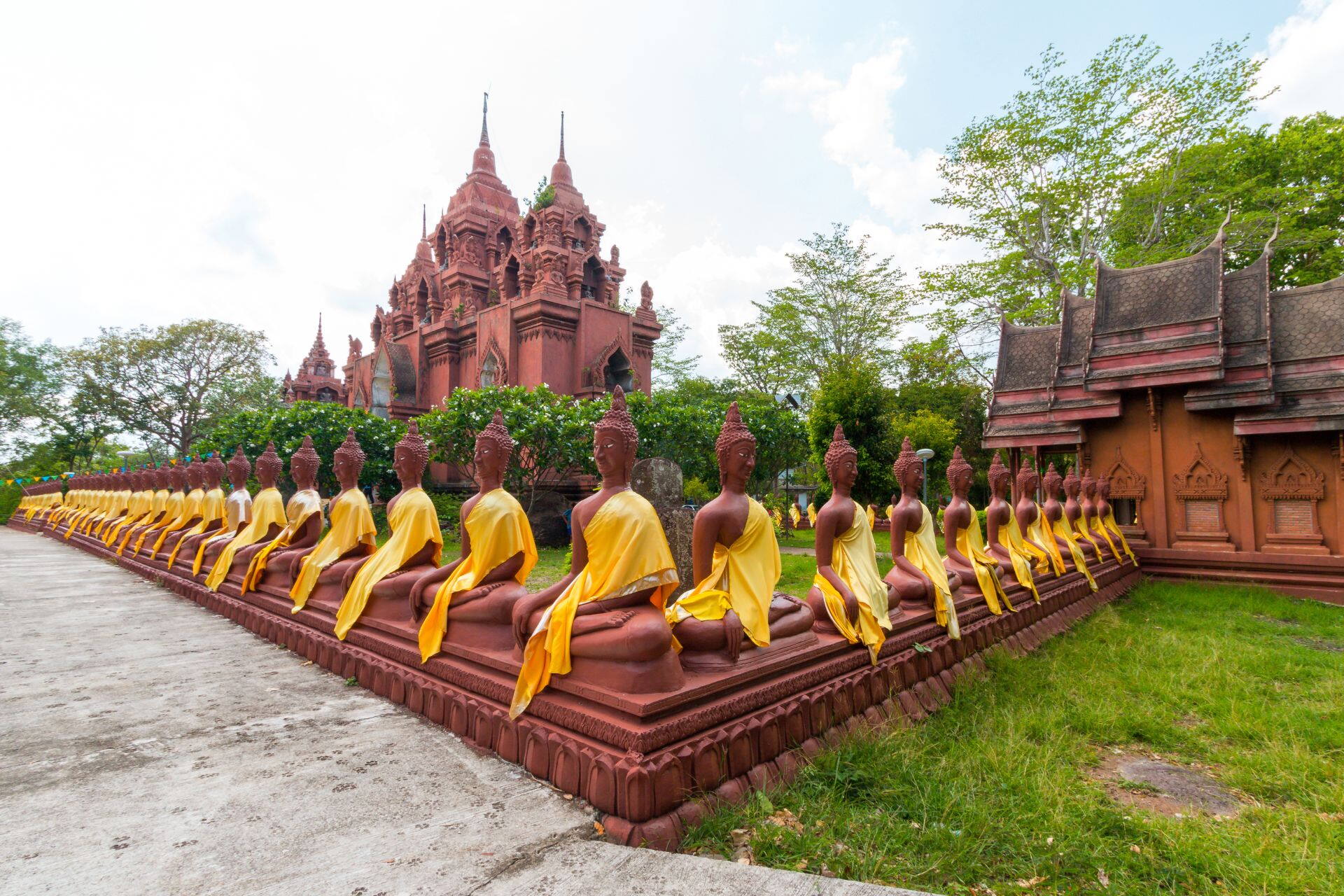
The ordination hall was built in 1982 in what can only be called nouveau-Khmer style — red-brick towers and spires that reference the Angkor aesthetic with a flamboyance that makes no apology for being contemporary. It is emphatically not ancient, and it doesn’t try to pretend otherwise.
Inside, the walls are covered in Jataka murals — scenes from the Buddha’s previous lives — painted by Burmese artists. Unusually, they come with English captions, which makes them far more accessible than most Thai temple murals. Remove your shoes before entering.
The row of golden Buddhas
Running along the perimeter path is a long procession of seated golden Buddha statues draped in saffron yellow robes, each facing outward across the Isaan plain. The perspective down the row — dozens of identical figures diminishing into the distance, the red temple towers rising behind — is the image most photographers reach for, and for good reason. It is genuinely striking.
The reclining Buddha
The temple’s largest structure is a 29-metre reclining Buddha, golden and serene, lying in the classic Mahaparinirvana pose. A recent addition to the complex, it is well-constructed and placed to make the most of the elevated setting.
The Chinese pagoda
A multi-tiered Chinese-style pagoda sits within the complex, a reminder that Buriram’s Buddhist heritage encompasses more than one tradition. It stands in pleasing contrast to the Khmer-influenced architecture around it.
The views
Stand at the edge of the hilltop and you are looking out across one of the flattest landscapes in Thailand. The Khorat Plateau stretches to the horizon in every direction — green paddyfields, scattered villages, the occasional temple roof catching the light. On a clear day the scale is extraordinary. This is what the Isaan plain actually looks like from above, and very few viewpoints in the region give you this.
Getting to Wat Khao Angkhan
GPS coordinates: 14.4349023, 102.283032
The temple is in Chaloem Phra Kiat District, approximately 70 kilometres south of Buriram city — around an hour by car. There is no public transport; you need your own vehicle.
From Buriram city: Take the road south toward Nang Rong, the same route used for Phanom Rung. Continue through Nang Rong and on to Ban Ta Pek. At Ban Ta Pek, turn right in the direction of Lahan Sai District and continue for approximately 13 kilometres. At the fork, turn right again and follow the signs for a further 7 kilometres to the temple. The route is well-signposted throughout.
From Phanom Rung: The temples are roughly 20 kilometres apart and easily combined in a single day. From Phanom Rung, head back toward Ban Ta Pek and follow the signs to Wat Khao Angkhan — around 30 minutes.
Nang Rong: Around 20 kilometres and 25 minutes by car or motorbike. It is the natural base if you are covering multiple sites in this part of the province.
If you are travelling without a car, hiring a vehicle from Buriram Airport gives you the flexibility to cover Wat Khao Angkhan, Phanom Rung and Prasat Mueang Tam in one unhurried day. Search for car hire from Buriram Airport before you travel.
Combining with other southern Buriram temples
Southern Buriram rewards a day or two of exploration. From a base in Buriram city or Nang Rong, you can cover:
- Phanom Rung Historical Park — the great Khmer mountaintop temple, 20km away
- Prasat Mueang Tam — a lesser-visited Khmer temple in a valley setting, with beautiful lotus ponds
- Buriram’s other Khmer ruins — smaller prasat scattered across the province, most free to enter and rarely visited
Wat Khao Angkhan combines well with any of the above for a long day from Buriram city; covering everything comfortably takes two days.
Where to stay
Most visitors base themselves in Buriram city and make the drive south for the day. The city has a good range of accommodation from budget guesthouses to the Amari and Modena by Fraser for something more comfortable. Where to stay in Buriram — the full guide to accommodation across all budgets.
Nang Rong town has guesthouses if you want to base yourself closer to the southern temples, though options are limited and Buriram city is only an hour away.
Practical information
| Location | Charoen Suk Subdistrict, Chaloem Phra Kiat District, Buriram Province |
| GPS | 14.4349023, 102.283032 |
| Opening hours | 8am–5pm daily |
| Entrance fee | Free |
| Getting there | Own vehicle only — no public transport. ~70km south of Buriram city (~1 hour). ~20km from Phanom Rung. |
| Dress code | Covered knees and shoulders required. Remove shoes inside buildings. |
| Time needed | 1–1.5 hours |
| Best combined with | Phanom Rung, Prasat Mueang Tam, Khmer ruins day trip |
Before you visit Wat Khao Angkhan
The road in from the Lahan Sai junction is quiet and the temple has ample parking. There is no entrance gate or ticket booth — just drive up and walk in. A small refreshment stand sometimes operates at the base, but don’t rely on it; bring water, particularly in hot season.
Dress appropriately before you arrive rather than fumbling with scarves at the entrance. A single layer covering your knees and shoulders is all that’s required, and the monks and caretakers will visibly appreciate the respect.
Early morning is the best time to visit — the light on the seated Buddha row is excellent, the hilltop is cool, and you will almost certainly have it to yourself. By mid-morning tour groups from Phanom Rung occasionally pass through, but they rarely stay long.
Feature image: © Somyot Pikoon-ngoen / Dreamstime
Buriram Live is a free, independent guide to Buriram province and the wider Isaan region of Northeast Thailand.
Some links on this page are affiliate links — if you book or buy through them, we may earn a small commission at no extra cost to you. This never affects our editorial judgement.
Get Buriram updates by email
Occasional emails when there is something worth knowing: new guides, festival and MotoGP dates, and Buriram United news. No spam, and you can unsubscribe at any time.
We will email you a link to confirm. See our privacy policy.