
Most places in Thailand come with a ready-made image. Bangkok is traffic and temples and gold. Chiang Mai is cool hills and night markets. Phuket is beaches you’ve seen on a screensaver. Buriram doesn’t come with an image. Most people who have heard of it know it only because of the football club or the MotoGP race. Everyone else draws a blank.
That is, in many ways, the point.
This is a guide to what Buriram is actually like — not the highlights reel, but the real thing. The landscape and the noise and the food and the people. Some of it will surprise you. None of it will show up in any tourist brochure, because it is simply what life here looks like.
Is Buriram in Isaan? Yes. Buriram is one of the twenty provinces of Isaan, Thailand’s northeast, and sits on the Cambodian border between Nakhon Ratchasima (Korat) to the west and Surin to the east.
The Landscape
Buriram province sits on the Khorat Plateau in Northeast Thailand — a vast, flat, largely agricultural plain that rolls south toward the Cambodian border. There are no mountains here, no coastline, no dramatic scenery in the conventional sense. What there is, in abundance, is space.
Rice fields stretch to the horizon in every direction. In the growing season they are a vivid, almost unreal green. In the dry months the paddies are brown and cracked and the haze sits heavy on the air. At harvest — roughly October and November — the landscape transforms into something you have to see to understand. Every road, every temple courtyard, every spare square metre of flat ground is covered with rice laid out to dry. Trucks loaded with sacks queue for kilometres on the main roads, waiting to deliver to the mills. It is an entire province organised around a single crop, and for a few weeks each year that is completely visible.
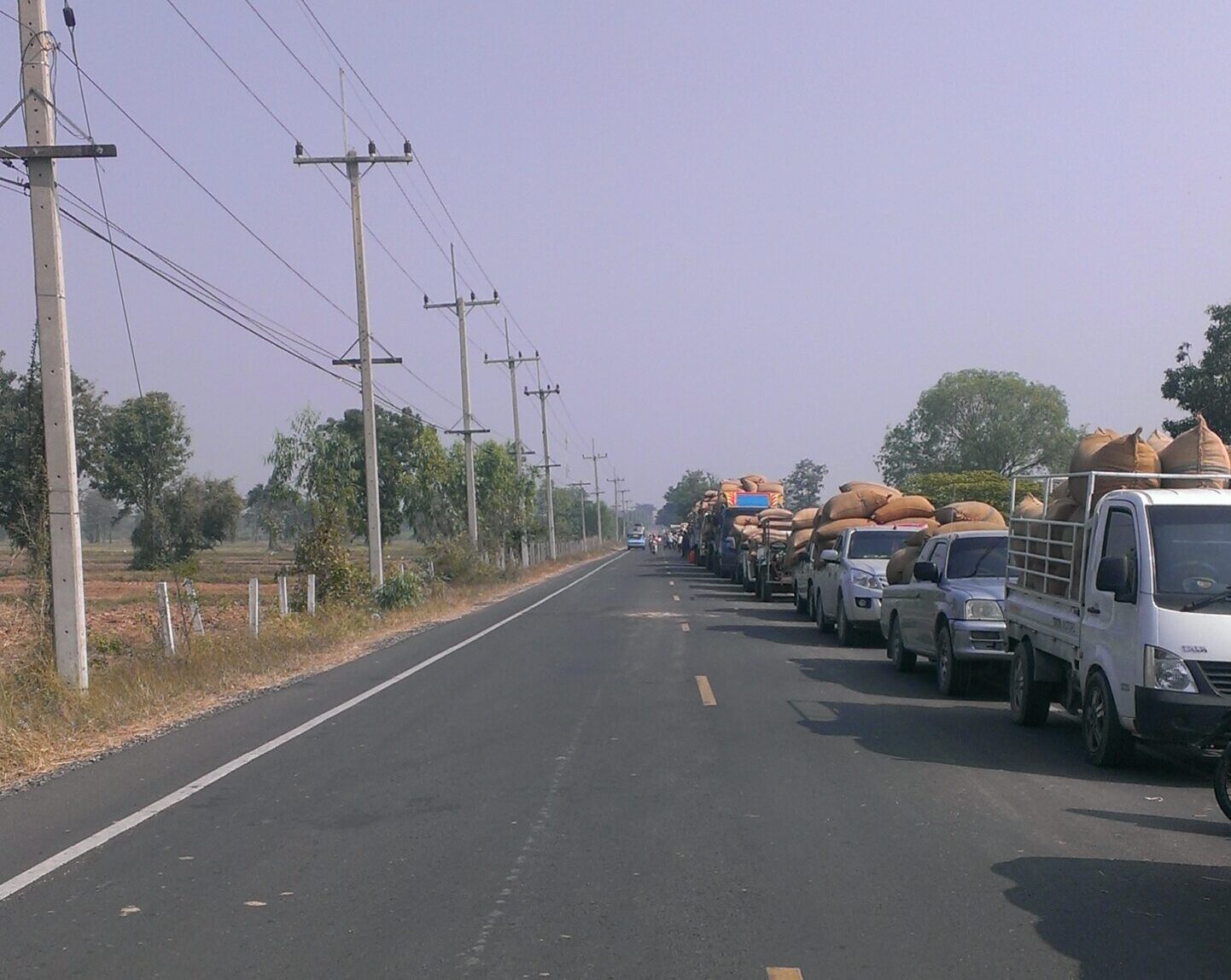
The roads themselves are worth mentioning. By the standards of rural Thailand, Buriram is well connected. The main highways are wide, smooth, and relatively uncrowded outside of harvest. You can cover ground quickly and easily. Getting lost is difficult. Getting somewhere is not.
The Villages
Step off the main road into any village and the pace drops immediately. Life here is organised around the family compound — multiple generations living together on shared land, grandparents raising grandchildren while parents work in the city or the fields, aunts and uncles and cousins in the houses on either side. There is no real equivalent in most of the western world. The social safety net is not a government programme; it is the family.
The result is a community that feels genuinely intact. People know each other. They look out for each other. A stranger turning up in a village — particularly one accompanied by a Thai family member — will be fed, invited to sit down, offered things, looked after. The warmth is not performed for tourists because there are no tourists. It is simply how people behave.
The older women — the yai’s, the grandmothers — are a permanent fixture of village life, sitting in the shade with their betelnut-stained red teeth and their commentary on everything, chewing and watching and knowing everything that is happening for three villages in each direction. The older men gather over rice whisky — lao khao, a fierce clear spirit that costs almost nothing and is consumed with cheerful seriousness. Nobody is in a particular hurry. Time works differently here.
The Noise
Do not come to a rural Isaan village expecting peace and quiet. You will be wrong.
The morning starts with the cockerel — usually several, in rough competition with each other — followed by the temple PA system, which has no volume setting below very loud and broadcasts morning announcements, monks chanting, and the occasional Thai pop song across the surrounding fields. Soi dogs bark at motorbikes. Children shout. A truck with a particularly enthusiastic horn passes on the road. By 6am the village is fully operational.
Then there are the events. Somebody’s grandmother has died, and the wake will run for three, four, five nights — marquees in the road, hired sound equipment, mor lam music until the early hours, neighbours arriving at all times. A young man from the village is being ordained as a monk, and the procession and celebrations will fill the compound for a day and a night. Temple fairs, football tournaments, bun bung fai rocket festivals — the calendar never runs dry. Buddhist holidays bring activity to the wat that spills onto the street. There is always something.
This is not a complaint. The noise is evidence of a community that is genuinely alive. Temples here are not quiet places of contemplation — they are the centre of social life, and the activity around them reflects that.
Daily Life in Buriram
The motorbike is the basic unit of transport. A single motorbike will carry a family of four without anyone thinking twice about it. Children go to school this way — some perched in front of the driver, some on the back, some, on market days, in the back of a pickup truck that would not pass any road safety assessment in Europe but gets everyone there without incident. Dogs sprawl in the road and move when something approaches. There is an implicit negotiation happening at all times between vehicles, animals, and pedestrians, and it mostly works.
Food is everywhere and it costs almost nothing. Street vendors appear at dawn and dusk. Village markets — talat — run in the early morning and sell everything: fresh vegetables, grilled meats, sticky rice in little parcels of banana leaf, freshly made noodle soups, fruit, dried fish, pork crackling. Isaan food is its own subject — worth reading before you arrive. Local shops — the small family-run convenience stores that line every village road — stock everything else. You will not go hungry in Buriram. You will not spend much doing it.
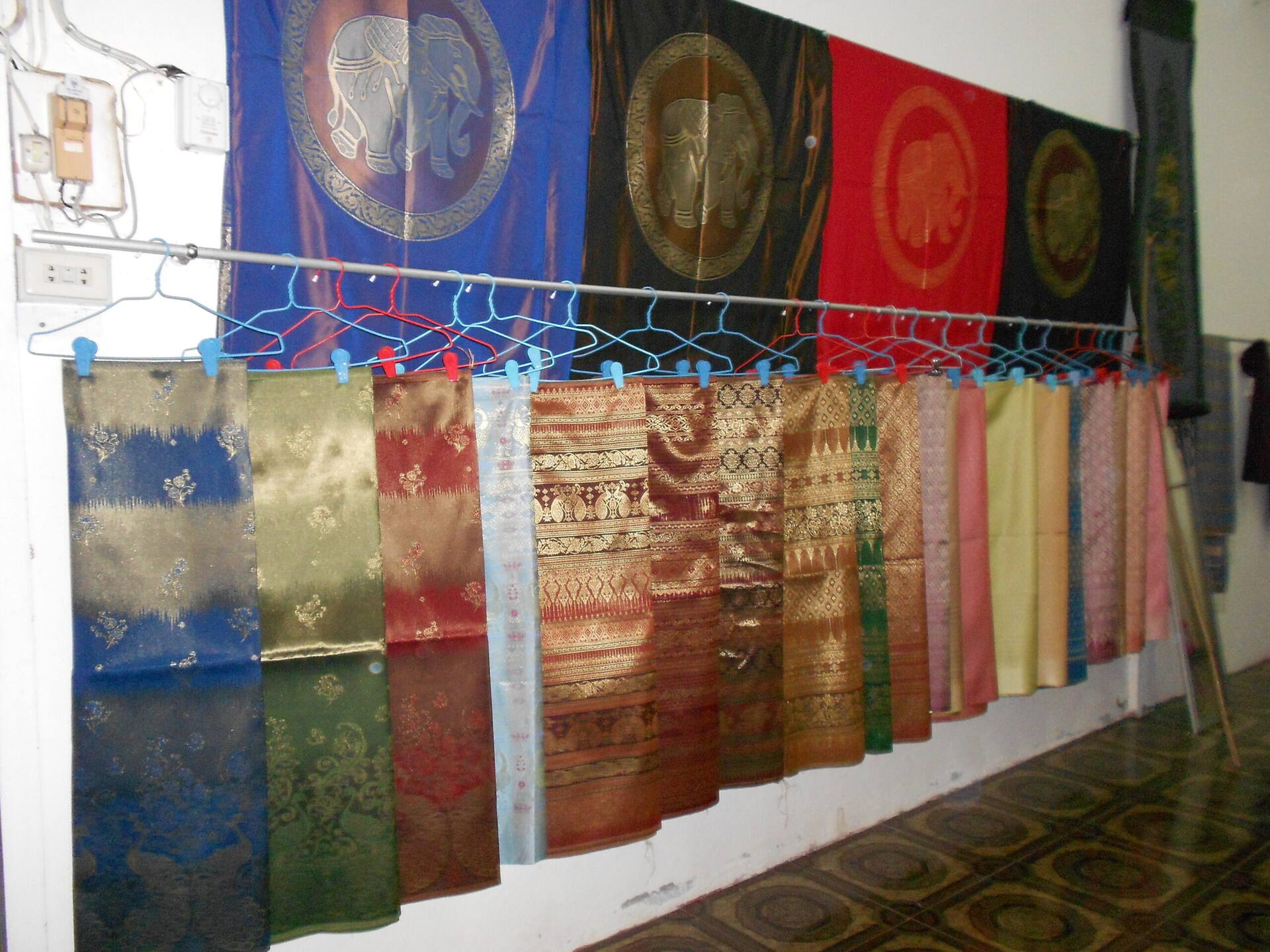
The larger city markets are worth a visit. The Night Bazaar on Romburi Road and the weekend Walking Street market are aimed at locals rather than tourists — which means the prices are real prices and the food is what people actually eat, not a curated version of Thai cuisine.
What Buriram City is Like
Buriram city itself — the provincial capital — is a modest, functional Thai provincial town with a population of around 50,000 since its municipality was enlarged in 2024, and the usual infrastructure: hospitals, government offices, shopping centres, restaurants, a railway station, an airport thirty-two kilometres out of town. This is not Bangkok. It is not a place that tries to impress you. But it works, and it works well.
The presence of Buriram United and Chang International Circuit has brought investment and infrastructure that most Thai provincial capitals cannot match. The sports complex on the south-west edge of the city is genuinely world-class — a 32,600-seat stadium attached to a Formula 1-grade racing circuit, with a shopping centre and hotel alongside. On match days and race weekends the city fills up in a way that feels surprising until you understand just how seriously this province takes its football.
Evenings in the city have more going on than Buriram’s reputation might suggest. The Night Bazaar and Walking Street market provide the relaxed end of the spectrum, but the city also has a genuine nightlife scene — Speed, Tawan Daeng, and Full House are among the clubs, alongside a selection of lively bars. For live music further afield, Neem Trees restaurant and venue on Highway 226 near Krasang — about 30 kilometres from the city — occasionally hosts major Thai music acts including some genuine superstars. Worth checking what’s on before you visit.
The Cost
This is one of the things visitors notice immediately and do not forget. Buriram is cheap in a way that the popular tourist destinations in Thailand no longer are. A full meal from a village stall costs thirty or forty baht. Beer at a local bar is fifty. Guesthouses in the city will not threaten your budget. Even the better hotels near the circuit are priced for domestic Thai tourism rather than international visitors.
The cost of living for those staying longer is similarly low. Rent, utilities, food, transport — all of it runs at a fraction of what equivalent standards would cost in Bangkok, let alone in Europe. This is not a secret that has been discovered and priced in. Buriram is simply inexpensive because it has not been positioned as a destination, and the locals buy and sell at local prices. Full figures in our cost of living guide.
Festivals and the Temple Calendar
The Thai Buddhist calendar shapes the rhythm of life here in ways that are not immediately obvious to visitors. There is always a festival approaching, or recently passed, or currently underway. Songkran in April brings water fights that last for days. Loy Krathong in November sends illuminated floats down every waterway. Bun Bung Fai — the rocket festival — is an Isaan speciality, celebrated in May with homemade rockets fired into the sky to encourage the rains.
But it is the smaller, unmarked occasions that give village life its particular texture: merit-making ceremonies at the local temple, monk ordinations that bring the entire extended family together, funerals that become, over several nights, a gathering of everyone who knew the person — which is everyone. The temple grounds absorb all of it. They are not museum pieces here. They are in constant use.
Wildlife
Buriram is Isaan, and Isaan has creatures. Monitor lizards — hia, as they are locally known, a word that doubles as a significant insult — are a common sight near water and around older buildings. They can reach two metres and are completely harmless unless threatened. Smaller geckos colonise every building and eat mosquitoes, which puts them firmly in the beneficial category.
Soi dogs are ubiquitous. Most are reasonably healthy and community-managed, if cautious around strangers. At night they are vocal. The general approach is to ignore them and they ignore you.
Elephant sightings — genuine wild or working elephants rather than tourist operations — are not impossible in the more rural south of the province near the Cambodian border, though uncommon. Buriram sits on the edge of a region that still has wild elephant populations. It is worth knowing.
Who Buriram is For
Buriram rewards a particular kind of traveller — someone with a genuine curiosity about how Thailand actually works rather than how it is presented. Someone prepared to move slowly, to accept that the temple PA will start at 6am, to eat from the roadside, to spend time in places that do not cater to visitors because visitors do not usually come.
In return, it offers something increasingly rare in Southeast Asian tourism: the real thing. An economy and a community and a way of life that are oriented toward the people who live there rather than the people passing through. A place where the smiles are not professional. Where the food is what people eat every day. Where the festivals are genuine celebrations rather than performances.
There is no polished version of Buriram. What Buriram is like is what you see.
Getting to Buriram
Buriram has good connections by rail and road, and a domestic airport with direct flights from Bangkok. See our complete transport guide for everything you need to know.
Where to Stay
A full range of accommodation is available, from guesthouses in the city to the internationally branded hotels near the stadium and circuit. See our accommodation guide.
Considering travel insurance for your trip? Get a travel insurance quote for Thailand — World Nomads covers more than 150 adventure activities as well as emergency medical, lost luggage, and trip cancellation. For flexible monthly cover from around $63, SafetyWing Nomad Insurance is popular with longer-stay visitors and digital nomads across Southeast Asia.

Buriram Live covers the real Buriram — temples, football, motorsport, rural life and practical information for visitors and those with deeper connections to the region. No fluff, no sponsored itineraries. Follow Buriram Live on Facebook for new articles and updates.
This article contains affiliate links. If you make a purchase through a link on this page, we may earn a small commission at no extra cost to you.
Get Buriram updates by email
Occasional emails when there is something worth knowing: new guides, festival and MotoGP dates, and Buriram United news. No spam, and you can unsubscribe at any time.
We will email you a link to confirm. See our privacy policy.