
Every May, the skies above Northeast Thailand fill with smoke trails. Villages across Buriram and the wider Isaan region fire homemade rockets hundreds of metres into the air, mor lam bands play until dawn, and anyone whose rocket misfires traditionally gets thrown into the nearest mud pit. Health and safety is, shall we say, a secondary concern. This is Bun Bang Fai — one of Isaan’s most exuberant celebrations, and unlike anything you’ll find on a standard Thailand itinerary.
What Is Bun Bang Fai?
Bun Bang Fai (บุญบั้งไฟ) — also written Bun Bung Fai — translates roughly as “rocket merit-making.” The name is straightforward: bun (บุญ) means merit or blessing, and bang fai (บั้งไฟ) is the bamboo rocket.
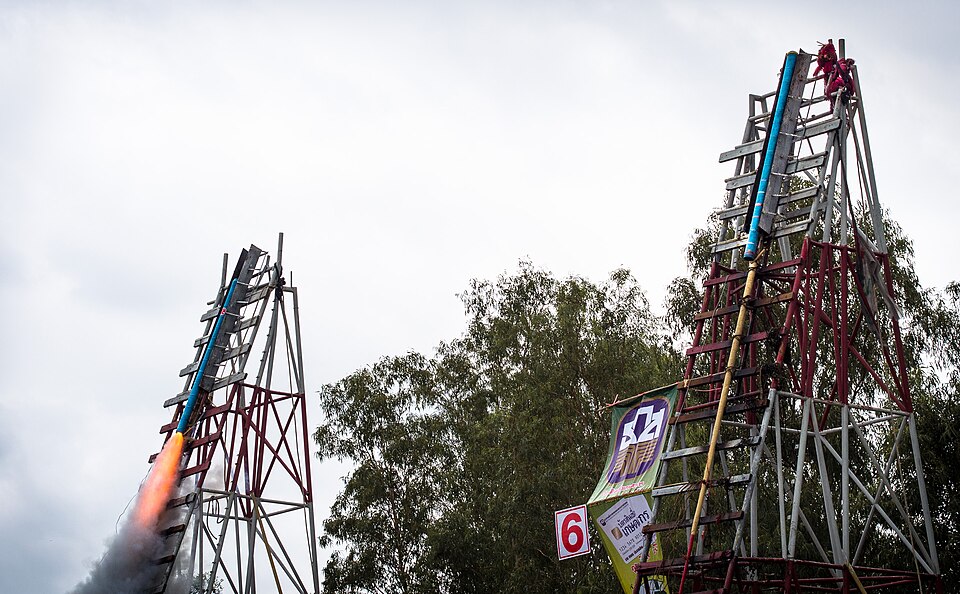
The festival’s origins predate Buddhism in this region by centuries. Its roots lie in animist beliefs centred on Phaya Thaen (พญาแถน), the sky deity who controls rain. Before the rice planting season each May, communities would fire rockets skyward as a petition — send us rain, or we will send fire to remind you. The message was direct, even by ancient standards.
In time, Buddhism absorbed the festival rather than replacing it. Today, Bun Bang Fai is simultaneously a religious merit-making event, a village competition, and a full-scale party. The monks bless the rockets. Then things get loud.
The Rockets
The bang fai themselves are not decorative fireworks. They are serious pieces of engineering, made from bamboo or PVC packed with black powder — a craft passed down through families over generations. At village level, rockets are typically a metre or two in length. At competition level, Bang Fai Lan rockets can reach nine metres and carry up to 120 kilograms of black powder.
They go very high, very fast, and occasionally not in the intended direction. The crowd understands this. This is, in the truest sense, the mai pen rai approach to public safety — and it is part of the appeal.
Rockets are scored on height, distance, and the beauty of their vapour trail. The maker of the winning rocket earns bragging rights for the year. The maker of a rocket that fails to launch earns something rather different.

The Mud Tradition
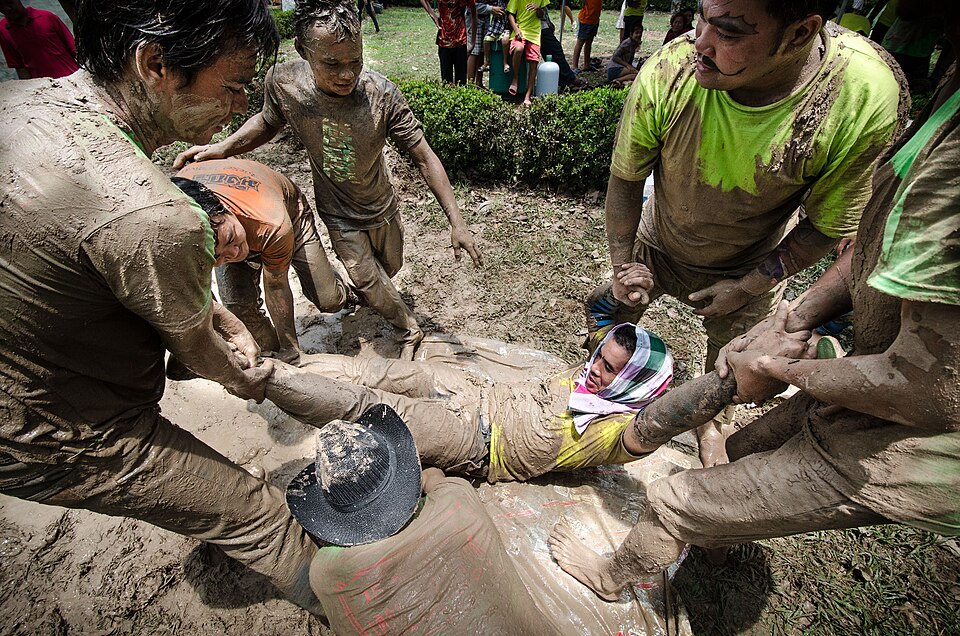
When a rocket misfires — and some always do — tradition dictates that its maker gets thrown into a mud pit by the crowd. This is not a punishment; it is part of the festival’s character, and participants take it in good spirit. Participants dress for the occasion. Spectators standing close to the launch area are not always safe either.

The Processions
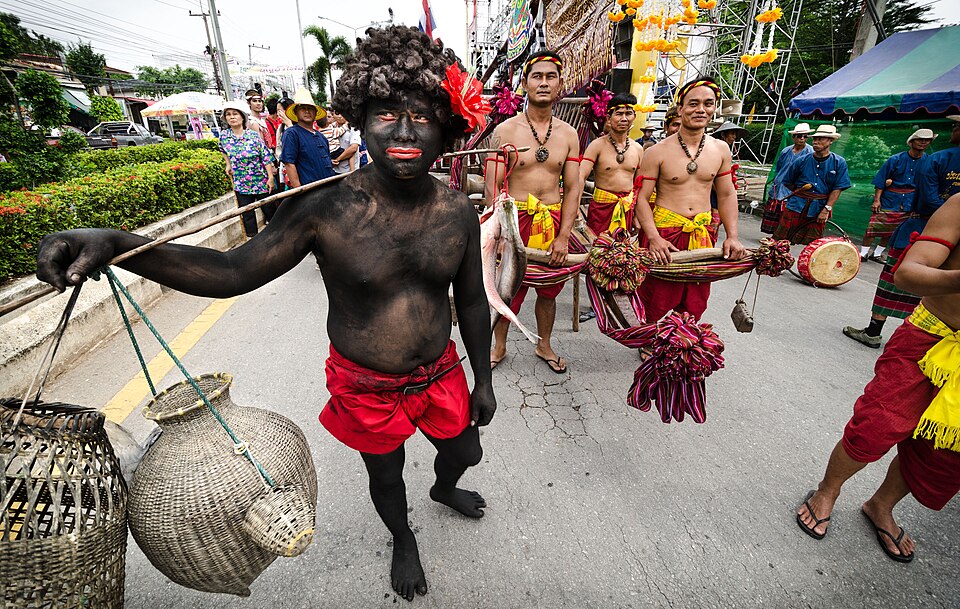
The days before the rocket launches are given over to village processions. Decorated floats, traditional costumes, mor lam musicians, and dancers move through the streets. The atmosphere has shifted firmly from ceremony to carnival by this point — food stalls line the routes and the noise announces the festival from several kilometres away.
In addition, most events include beauty pageants, traditional boxing, and concerts by regional mor lam artists. These run late.

Bun Bang Fai in Buriram
Buriram province holds around nine Bun Bang Fai celebrations spread across May, in different districts across the province. Villages and districts organise their own events, usually centred on the local wat (temple).
Notable locations include:
- Pak Kham District (Tai Charoen subdistrict) — multi-day event with mor lam concerts
- Chaloem Phra Kiat District (Charoen Suk and Thawon subdistricts)
- Nong Hong District (Wat Nong Samet) — rockets, fireworks, mor lam
- Ku Mueang District (Toom Yai subdistrict) — beauty pageants, boxing, traditional music
- Nong Kee District (Thung Kratae subdistrict)
- Ban Mai Chai Phot District — one of the larger Buriram celebrations, held at Prasat Ku Suan Taeng, a Khmer ruin site. Traditional dancers, light shows, and evening concerts combine with the rocket festival around the ancient temple grounds.
However, exact dates shift with the lunar calendar each year; local temples and district offices confirm them a few weeks before the festival. If you are in Buriram in May, ask at your accommodation — they will know what is happening nearby and when.
One note: not every celebration includes actual rocket launches. Some hold processions and festivities without competitive firing. If you specifically want to see rockets going up, it is worth confirming in advance.
What to Expect at a Bun Bang Fai
Dress for it. The mud tradition does not draw a clear line between participants and bystanders. Clothes you do not mind getting dirty are the right call.
Arrive for the processions. The parades are often more visually interesting than the launches — the costumes, the floats, and the music are where you see Isaan culture at its most exuberant.
Bring cash. Festival food stalls do not take cards. This is Isaan street food at its best and its cheapest.
Expect noise. A large bang fai is genuinely loud, with a trajectory that is not always predictable. Anyone sensitive to sudden loud sounds — children included — may find the launch area overwhelming.
Go with the spirit of it. Bun Bang Fai is not a spectator event with clearly defined boundaries between the audience and the participants. The mai pen rai attitude applies to everything: where you stand, when the schedule runs, and what happens when something goes sideways. Be flexible, be friendly, and you will have a good time.
Getting There
Buriram city is well connected by train and bus from Bangkok and other major cities, and makes a good base for visiting festival locations across the province. See our complete guide to getting to Buriram for all transport options.
For accommodation at all budgets, see where to stay in Buriram.
Travel Insurance for Festival Season
Festivals like Bun Bang Fai involve crowds, noise, and a certain amount of unpredictability. It is sensible to have travel insurance in place before you go — and to check that your policy covers the kind of activities you are likely to end up doing.
Considering travel insurance for your trip? Get a travel insurance quote for Thailand — World Nomads covers adventure activities and is designed for independent travellers.
Feature image: Takeaway, CC BY-SA 3.0 via Wikimedia Commons
Inline image 1: Takeaway, CC BY-SA 3.0 via Wikimedia Commons
Inline image 2: Takeaway, CC BY-SA 3.0 via Wikimedia Commons
Buriram Live covers the real Buriram — temples, football, motorsport, rural life and practical information for visitors and those with deeper connections to the region. No fluff, no sponsored itineraries. Follow Buriram Live on Facebook for new articles and updates.
This article contains affiliate links. If you make a purchase through a link on this page, we may earn a small commission at no extra cost to you.
Get Buriram updates by email
Occasional emails when there is something worth knowing: new guides, festival and MotoGP dates, and Buriram United news. No spam, and you can unsubscribe at any time.
We will email you a link to confirm. See our privacy policy.