
Learning Thai in Buriram comes with a twist that nobody in the language apps warns you about. You put in the hours, you master your tones, you order dinner without pointing, and then one evening at the family table the conversation slides effortlessly into a language you have never studied. Everyone laughs. Somebody glances at you. You will never know for sure what was said, and that is part of the fun. Welcome to learning Thai in Buriram, where the family can be fluent in two or three languages and you are working hard on one.
This guide is for anyone learning Thai with a Thai wife, husband or partner from Buriram, or settling in the province for long stretches: which language to learn first, why the script is worth the effort, how long it really takes, and why your partner may not be the best person to teach you.
If you are going to live here, even part of the year, we would gently say this: do learn at least some of the language. Nobody expects fluency, but making the effort is noticed and appreciated, by the family, the neighbours and the woman who sells you som tam. It shows respect for the place and the people who welcomed you, and life becomes far richer once you can talk to people directly rather than through your partner.
The short version
- Learn Central Thai first. It is the language of school, government, TV and every sign you will read, and everyone in Buriram understands it.
- Learn to read early. The script tells you the tone of every word, which is the hardest part of Thai to get right by ear alone.
- Expect Isaan and Khmer at home. Many families switch between them. That is normal, and it is not about you (usually).
- Learn the manners with the words. In Thai the two go hand in hand: the polite particles, the wai and keeping your cool are all part of speaking well.
- Don’t rely on your partner to teach you. It is very common for partners not to want the teacher role, and it is rarely personal.
- Use a structured course for the groundwork, and the family for practice. You can try the free Thai lessons before paying anything.
Three Languages, One Dinner Table
Buriram is in Isaan, the big north-eastern region of Thailand, and that matters for the languages you will hear. (If you have ever wondered whether Buriram is in Isaan, it is: we explain the region in what Buriram is actually like.) Depending on the family and the village, you are likely to meet three languages, sometimes in the same sentence.
Central Thai is the official language of Thailand and the language of school, government offices, television and the news. Everybody in Buriram understands it, and almost everything written you will see, from road signs to menus, is in Thai script. This is the language you learn first.
Isaan is the everyday language of much of the region, and it is, in effect, a Lao dialect: Isaan is essentially the same language as the Lao spoken across the Mekong in Laos, and if you have travelled there, much of it will sound familiar. It is written informally in Thai script, and officially it is classed as a dialect of Thai. That label undersells the gap: Isaan and Central Thai are only partly mutually intelligible, so a Thai learner can catch words and the drift of a conversation without following the detail. Many words are shared, but the vocabulary and the tones differ enough to throw you.
Northern Khmer is the twist. In many villages across southern Buriram and neighbouring Surin, Khmer is the language of home, as we explain in our guide to the Khmer dialect of Buriram and Surin. Around a quarter of Buriram’s people were recorded as Khmer speakers in the 2000 census. Northern Khmer belongs to a completely different language family from Thai, so your Thai lessons give you no help with it at all. Most speakers are bilingual in Khmer and Central Thai, switching easily between the two.
Some families in Nong Ki, Prakhon Chai, Lam Plai Mat and Nong Hong districts add a fourth language, Kuy (also called Suay), which is related to Khmer rather than Thai. If your partner’s family is Kuy, you have our sympathy and our admiration.
Put that together and the dinner-table experience makes sense. The family speaks Thai to you, Khmer or Isaan to each other, and switches back and forth without noticing. Learning Thai will not stop them talking about you in Khmer. It will, however, mean you understand everything they say to you, and that you can join in.
In my wife’s family, Thai and Northern Khmer are mixed all the time, often in the same sentence. That is simply how they talk, and I have never known it any other way.
Which Language Should You Learn First?
Central Thai, almost without exception. It works everywhere in the country, it is what the hospital, the bank, the immigration office and the land office use, and it is what your partner’s family will speak to you anyway. It is also the only one of the three with a full range of courses, apps and textbooks. Isaan and Khmer are worth picking up along the way, but there is very little teaching material for either, and Northern Khmer has no standard written form in daily use.
A few Isaan or Khmer words go a long way socially, though. Grandparents in particular tend to light up when a foreigner manages a greeting or a thank-you in the home language. Ask the family to teach you a handful of words; it is a much smaller favour than teaching you a whole language, and most people enjoy it.
Why Your Partner Might Not Want to Teach You
If your Thai partner isn’t keen to teach you, you are far from alone, and it isn’t personal. It is one of the most common experiences among foreigners with Thai families, and there are good reasons for it.
Teaching your own language is genuinely hard. Native speakers know what sounds right without knowing why, so explaining tones or grammar can be frustrating for both of you. It is usually quicker to translate, especially when you are in the middle of a day with things to get done. And correcting someone you love, over and over, feels awkward, so many partners simply let mistakes go, which is kind but does not help you improve.
The fix is to take the teacher role off their shoulders. Let a course do the groundwork, the alphabet, the tones, the grammar, and let your partner and the family be the people you practise with. That is a much easier job, and a much happier one.
Learn the Thai Script: It Unlocks the Tones
Plenty of people try to learn spoken Thai from transliteration, Thai words spelled out in English letters, and plenty of them stall. The reason is tones. Thai has five: mid, low, falling, high and rising. The same syllable said with a different tone is a different word, and English spelling has no good way to show which is which. Different books spell the same word in different ways, so you end up learning several systems and trusting none of them.
Small slips in sound can cause big embarrassment. The Thai word for a bottle, khuat (ขวด), is uncomfortably close to khuay (ควย), a very rude word for a part of the male anatomy. Ask for a khuat of water with the wrong ending and the wrong tone, and you will get a very different reaction from the one you wanted. It catches out plenty of beginners, and even very good language learners: the polyglot YouTuber Xiaomanyc, who speaks a long list of languages, makes exactly that slip ordering water in his video Locals Gossip About Me, But I Secretly Know Thai. The title alone will ring a bell for anyone with a Thai family, and it is well worth a watch. If someone who speaks that many languages can get it wrong, anyone can, so don’t be too hard on yourself when it happens to you. Learning the sounds properly from the start is the best protection.
The Thai script solves this, because it tells you the tone. Every consonant belongs to one of three classes, high, mid or low, and the tone of a syllable follows from the class of its first consonant, the length of the vowel, how the syllable ends, and any of the four tone marks written above it. It is a system, and once you know it you can read the tone of a word you have never seen before.
It looks daunting at first. There are 44 consonant letters (two no longer used), vowel symbols that sit before, after, above or below the consonant, and no spaces between words. But it is learnable in weeks, not years, and the payoff is huge: menus, road signs, shop fronts and the family’s LINE messages slowly start to make sense. A free chart such as the consonant table at thai-language.com is a good companion, and you can start with the free Thai alphabet lessons and worksheets.


Learning Thai in Buriram: What Actually Helps
A structured course for the groundwork. Apps that teach random phrases are fine for a holiday, but for living with a Thai family you need the system underneath: the script, the tones and how sentences fit together. We suggest ThaiPod101, which teaches Central Thai through short audio and video lessons from absolute beginner to advanced, with a phone app for practising in spare minutes. Two good places to start are Thai Alphabet Made Easy, 25 short video lessons that teach the letters a few at a time and work the tone rules in as they go, with a practice worksheet at the end, and the Level 1 Thai pathway for everyday conversation. There are no Isaan or Khmer lessons, so the family keeps the last word at dinner. The free account includes a survival-phrases course of more than 50 lessons, the first lessons of every course, word lists and a short Premium trial, so you can see whether it suits you before paying. Paid plans start at a few dollars a month, and the top plan adds one-to-one time with a Thai teacher. Try the free Thai lessons.
Polite words from day one. End your sentences with khrap if you are a man and kha if you are a woman. It depends on who is speaking, not who you are talking to, so a man always says khrap, even to a woman. It is the single easiest way to sound polite, and you will hear it everywhere.
The market and the menu. Food is the best classroom in Buriram, because you need it every day and people are patient with a customer. Learn the names of what you eat, numbers and prices, and you will use them within hours. Our guide to Isaan food in Buriram gives you the dishes to start with, and if someone offers you pla ra you will want to know what you are agreeing to.
The younger relatives. Nieces, nephews and teenagers often have some school English and endless patience for a foreigner’s mistakes, mainly because they find them hilarious. They are excellent practice partners, and they speak Central Thai with you without thinking about it.
Your phone. Set a few apps to Thai, read the family LINE group (slowly), and use a translation app as a backup rather than a crutch. Our digital toolkit for Buriram covers the apps that matter day to day.
Little and often. Fifteen minutes a day beats a three-hour session once a week, especially for tones, which need your ear more than your memory.
Speaking Thai and Behaving Thai Go Hand in Hand
Thai people are generous with foreigners who get the words wrong. They are less forgiving of bad manners, and in Thai the two are hard to separate, because so much of the politeness is built into the language itself. The polite khrap or kha at the end of a sentence, a soft voice rather than a loud one, and calling people by family terms, phi for someone older and nong for someone younger, even when they are strangers: all of that is manners and grammar at the same time. Learn them together, and the words and the body language reinforce each other.
Much of Thai communication also happens without words, so here are the basics worth knowing from day one.
The wai. The greeting with palms together and a slight bow of the head goes with the words: a wai with sawasdee khrap or sawasdee kha to say hello, and with khop khun to say thank you. It is also used for goodbye and sorry. The younger or junior person usually wais first, and it is polite to return a wai from an adult. Watch how the family does it with elders: the higher the hands and the lower the head, the more respect it shows.
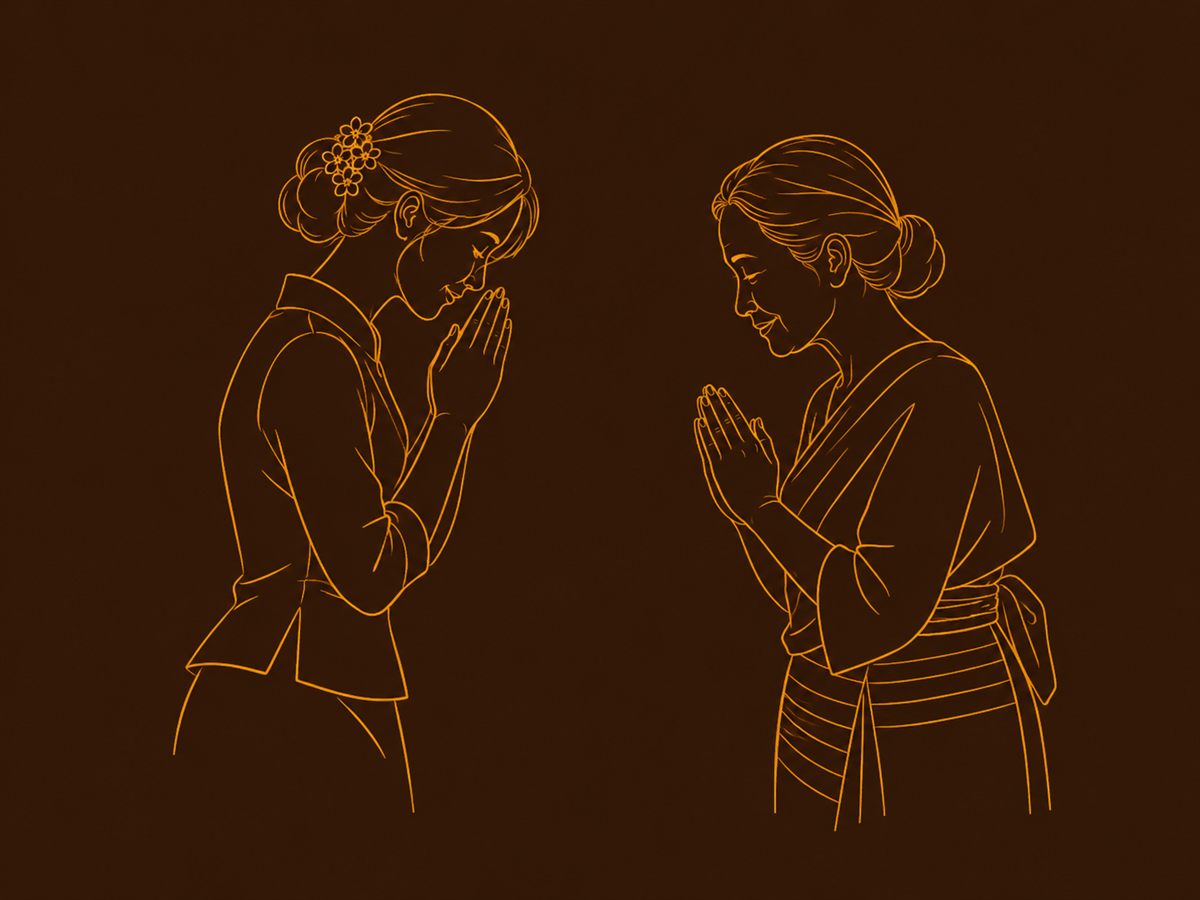
Keep your head low around elders. When you walk past or between people who are sitting, especially older relatives, lower your head and shoulders slightly as you pass. It looks small, but it is noticed.
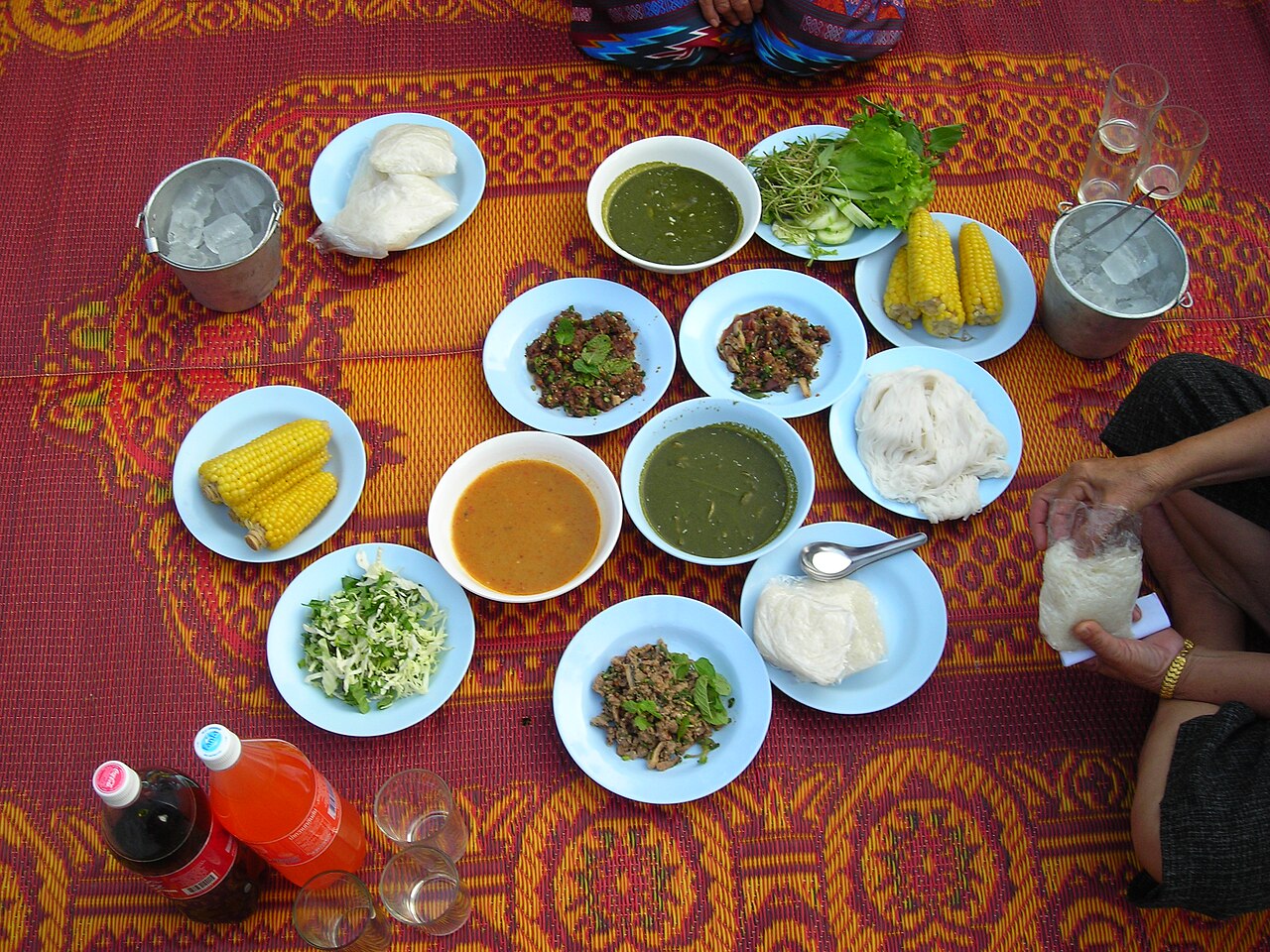
Heads and feet. The head is the most respected part of the body, so don’t touch anyone’s head, even a child’s in affection. Feet are the lowest, so don’t point them at people or at a Buddha image, don’t use them to move things, and don’t step over people sitting on the floor, or over the food when a meal is laid out on a mat. Take your shoes off before going into a home or a temple building.
Monks. Monks are shown deep respect. Give up your seat to them, keep your head lower than theirs where you can, and dress modestly at the temple. Women should not touch a monk or hand him something directly; an offering is passed via a man or placed down for him to take. Our guide to Buddhist temples in Buriram covers temple etiquette in more detail.
Keep your cool. Raising your voice is the fastest way to lose an argument in Thailand, even one you are right about. Shouting causes loss of face for everyone involved, and the person who loses their temper is usually seen as the one in the wrong, whatever the facts. Stay calm, smile, and sort it out quietly, through your partner or the family if need be. Thais call it jai yen, a cool heart, and it is worth learning early.
If that list looks daunting, don’t worry. Most foreigners who live here have got some of it wrong at some point, quite by accident, and Thai people generally understand that someone from another culture won’t know every custom. Nobody expects perfection. What people do notice is whether you are making an effort, and a genuine attempt at the language and the manners, mistakes and all, earns a lot of goodwill.
I certainly have. Family meals in the village happen on a mat in the middle of the floor, with the dishes spread out in the middle and family, friends and the odd neighbour who appears from nowhere the moment food is served sitting all around it. On one of my early visits I needed to get past, and there was no way round, so I stepped over the dishes and squeezed between people however I could. My wife told me off, and everyone else gave me a look that said “stupid farang” without anyone needing to say a word. I never did it again. If you need to get by, wait, ask, and go round behind people with your head low, never over the food.

How Long Does It Take to Learn Thai?
Longer than the app adverts suggest, and less than you might fear. The US Foreign Service Institute, which trains American diplomats, puts Thai in its Category III, “hard” languages with significant differences from English, and estimates around 44 weeks or 1,012 hours of full-time classroom study for professional working proficiency. Thai is often said to be one of the hardest languages of all, but it is not in FSI’s hardest group, alongside Mandarin, Japanese and Arabic.
You do not need diplomat-level Thai to have a good life in Buriram, though. A few months of steady study gets you greetings, food, numbers, directions and the polite basics. A year or two of regular practice, with the family on hand, gets you to real conversations. And if the family switches to Khmer when the conversation gets interesting, at least you will know it is interesting.
And What About Learning Khmer?
It is possible, and it would make you a legend in the village, but it is hard going. Northern Khmer has well over a million speakers across Buriram, Surin and Sisaket, yet only a tiny number can read or write it, and there are very few learning materials. Courses in Cambodian Khmer exist, and the two are closely related, but Northern Khmer has developed separately for centuries, and its speakers will spot the difference immediately.
The realistic approach is Central Thai first, then Khmer words and phrases learned from the family, one at a time. You may never follow the dinner-table gossip. But the day you understand a joke in Khmer, and laugh before anyone translates it, is a day worth working towards.
For more on settling into life here, read our guide to making a great life in Buriram, and if you are married to a Thai national, our Thai marriage visa guide covers the paperwork side. When you are ready to start on the language itself, try the free Thai lessons and give it fifteen minutes a day.
Images: family meal photo by Mattes and consonant chart by Serg!o, both public domain, via Wikimedia Commons.
Buriram Live covers the real Buriram — temples, football, motorsport, rural life and practical information for visitors and those with deeper connections to the region. No fluff, no sponsored itineraries. Follow Buriram Live on Facebook for new articles and updates.
This article contains affiliate links. If you make a purchase through a link on this page, we may earn a small commission at no extra cost to you.
Get Buriram updates by email
Occasional emails when there is something worth knowing: new guides, festival and MotoGP dates, and Buriram United news. No spam, and you can unsubscribe at any time.
We will email you a link to confirm. See our privacy policy.