
Planting trees in Isaan usually starts with a rice field. Most family land in Buriram has grown rice for generations, and when a corner of it is set aside for a house, a pond or a few trees, you inherit flat, heavy clay that floods in September and sets like brick by March. Put the wrong tree in the wrong place and it drowns in its first rainy season, or bakes in its first hot one. Get it right and, a few years later, you have shade, fruit and something growing that will still be there long after you.
This guide is for anyone with family land in Buriram or elsewhere in the north-east who wants to do more with it than rent it out for rice: what actually grows on old paddy, when to plant, how long timber really takes, and what the law now says about cutting your own teak. It draws on the planting plans we drew up for our own land, the mistakes and surprises so far, and what Thai forestry and land agencies advise.
The short version
- Raise the ground first. Old rice fields are waterlogged clay. Most trees, teak above all, need raised rows or mounds with drainage between them.
- Plant at the start of the rains unless you can water through the dry season. Seedlings planted in May to July have months of free water to get established.
- Timber is a long game. Farm teak in Isaan is typically harvested at around 20 years; rosewood takes 30 or more. Plant it for the next generation.
- Since 2019 you can cut your own teak on land with a proper title deed (chanote or NS3) without a permit. Land reform (SPK 4-01) land has different rules.
- Match the tree to the water. Teak on the high ground, rain trees and yang na where it stays wet, bananas by the pond.
- Plants don’t keep mosquitoes away. Lemongrass is lovely, and useful in the kitchen, but use repellent.

Start With the Ground: Old Rice Fields Are Heavy Clay
A rice field is built to hold water. The bunds keep it in, the clay underneath stops it draining away, and generations of ploughing in flood have made the soil dense and airless. That is perfect for rice and terrible for most trees, whose roots need air as much as water. Lowland paddy across the north-east is mostly heavy, poorly drained soil, and parts of Isaan also have salt in the ground, so if older relatives tell you a corner “never grows anything”, believe them.
The answer is to lift the trees above the water. Our plan, and what many Thai growers do, is to build raised rows or mounds about 30 to 50 cm high and a metre or so wide at the base. The soil you dig out between the rows becomes a shallow channel, and those channels should slope gently towards a pond or ditch so that rainy-season water has somewhere to go. Mix compost, manure or rotted rice straw into the mound, add some better topsoil if you can get it, and plant on top. If your land already has a pond, the spoil from digging it is ideal for raising the ground around it; our guide to whether foreigners can own land in Thailand has photos of exactly that.
Mulch is the other half of the job. A thick layer of cut grass, banana leaves or rice straw around each tree keeps the soil cool, holds moisture into the dry season and slowly feeds the ground. Keep a circle of about half a metre around young trees clear of weeds for the first couple of years, because grass competes hard for water.
When to Plant Trees in Isaan
Buriram has a long dry season. December, January and February bring almost no rain, March and April are hot, and the monsoon builds from May to a peak in September (our Buriram weather guide has the month-by-month picture). For tree seedlings on land without irrigation, the Royal Forest Department’s advice is to plant in the rainy season, when the rain does the watering for you and survival rates are highest. In practice that means May to July, early enough that roots are established before the dry months.
Our original plan said December to February, after the rice harvest, when the ground is workable and the weather is pleasant for digging. That only works if you can water every week through to the rains, which we can, because a drip line runs along the rows. Without water, a seedling planted in December has to survive four or five months of drought in its first year, and many won’t.
Two useful freebies, both of which need a Thai ID card, so your partner or a relative will have to apply. Royal Forest Department nurseries hand out free tree seedlings in the rainy season, in limited quantities. The Land Development Department gives away vetiver grass slips; ask at the Land Development Station in Buriram.
Timber Trees: Planting for the Next Generation
This is the part I care about most. Timber trees are slow, and there is a real chance I will never see ours harvested. That is rather the point. A row of teak planted now is something for the next generation of the family, and in the meantime it is shade, birdsong and a reason to walk the land every visit. Here is what is worth growing, and how long it honestly takes.
Teak
Teak (sak, สัก) is the classic Thai timber tree and still the one most people think of first. It grows well in the north-east, but it does not tolerate waterlogging at all, so it belongs on the highest, best-drained ground you have, on raised rows if the land is low. A study of farm teak in Isaan by Japanese and Thai forestry researchers found that a rotation of about 20 years generally worked better than 15, with trees spaced 2 by 4 metres on good sites and 4 by 4 metres on average ones. The same study is a useful warning: more than half of the farm teak plantations promoted in the region in the 1990s were later cleared for other crops, partly because the teak grew more slowly than people had hoped. Plant teak because you want teak, not as a quick investment.
Teak is deciduous. It drops its huge leaves for three or four months in the dry season, so a teak plot looks rather bare in March, and the fallen leaves make a crunchy, very flammable carpet. Keep a cleared firebreak around it in the burning season.
Rain Tree
The rain tree (chamchuri or kam pu, จามจุรี / ก้ามปู) is the enormous umbrella-shaped tree you see shading temple grounds and school yards across Isaan. It grows fast, copes with poor and waterlogged soil far better than teak, and its timber, sold abroad as monkeypod, is prized for carving, furniture and panelling. Under good conditions a rain tree can put on a trunk 18 cm across in five years. That makes it the natural choice for the wetter parts of the land and for anyone who wants to see a big tree in their own lifetime.
Two things to know. Its crown can spread 30 metres across, so give it room and keep it well away from buildings, power lines and the rice. And its trunk tends to be short and crooked, with huge low branches, which is lovely for shade but less so for sawing long, straight boards. Think of it as a shade tree that will also give useful wood, rather than a plantation timber.
Native Hardwoods: Yang Na, Pradu, Makha Mong and Rosewood
Isaan’s own forest trees are worth a place too. Yang na (ยางนา), the tall, straight dipterocarp of the region’s riverbanks and lowland forest, tolerates flooding, which makes it one of the few big timber trees that suits low, wet ground. Pradu (ประดู่), with its durable, termite-resistant wood, and makha mong (มะค่าโมง), with its beautifully figured timber, are trees of the region’s deciduous forests and are now endangered in the wild. Planting them is a small piece of conservation as well as an investment for the family. All three take decades.
Siamese rosewood (phayung, พะยูง) is the most valuable of all, and the slowest. In a Royal Forest Department trial, 30-year-old rosewood trees had trunks only 21 to 23 cm across. Its value is also its problem: rosewood is critically endangered and so sought-after that thieves have cut mature trees out of private orchards. One or two near the house, where people will notice, is a nice idea; a hidden plot at the far end of the land is an invitation.
Eucalyptus
Drive anywhere in Buriram and you will see rows of eucalyptus along the paddy bunds. It is the quick-money tree of Isaan: the poles can be cut and sold every four years or so, and the Land Development Department has promoted salt-tolerant eucalyptus on bunds to help with saline soil. The catch is that it is thirsty. Planted close together it competes with the rice for water, shades it, and in drought years the rice next to eucalyptus can do very badly. If the family still farms rice around your trees, ask before planting a eucalyptus row along their bund.
Can You Cut Your Own Teak? The 2019 Law Change
For decades, teak, rosewood and other valuable species were “reserved timber” in Thailand, even on private land, and cutting them meant permits and paperwork. That changed with an amendment to the Forest Act published in April 2019. Every species growing on land held under the Land Code is now free of the reserved-timber rules, which means that on land with a proper title, the owner can cut and sell their own teak or rosewood without a felling permit. The land documents reported to qualify include the chanote (โฉนด) and NS3 (น.ส.3) certificates.
Land reform land is different. Plots held on an SPK 4-01 (ส.ป.ก. 4-01) document are not covered by the Land Code, and under the Agricultural Land Reform Office’s guidance only valuable trees that were planted there qualify, not ones that grew naturally. A lot of family farmland in Isaan is SPK land, so check which document yours is held under before planning any timber.
Registration is now optional. The owner may apply for a timber certificate, which is useful if you later want to sell to a buyer who needs proof of origin, and a separate scheme allows trees on titled land to be used as collateral for a loan. Either way, keep simple records from day one: what you planted, where and when, with a few dated photos and a rough map. Our original plan said to register every hardwood with the district for future harvest rights; since 2019 that is no longer necessary on titled land, but a quick visit to the district forestry office is still the best way to confirm how the rules apply to your plot. This is general information, not legal advice. If you are a foreigner, remember the land itself will be in your Thai partner’s or family’s name; our guide to foreigners owning land in Thailand explains why.
Betel Nut Palms
The first trees to go in on our land were betel nut palms (mak, หมาก), and they have been a lovely surprise. They grow as a single slender trunk topped with a neat crown of fronds, eventually reaching 12 metres or more, and a row of them along a path gives the land an elegant, tropical look long before anything else has grown. They start to fruit after about five years.
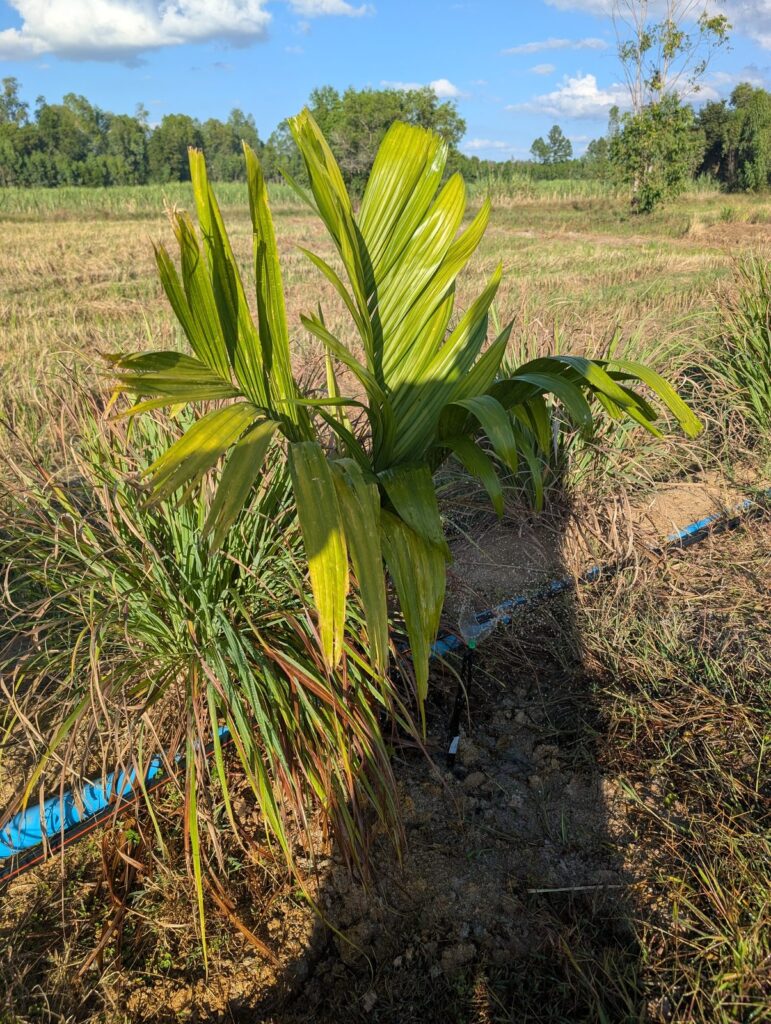
They need deep soil and they do not like drought: in a long dry season they need water, which is why ours sit on a drip line. Betel nut is still chewed in Isaan, mostly by older women. A study in Khon Kaen found almost all chewers were women, with an average age in their late fifties, and you will see the red-stained smiles in many villages. It is also a recognised cause of mouth cancer, so this is one harvest best left to the grandmothers’ tradition rather than taken up yourself.
Fruit Trees for Isaan
Fruit trees are where most families start, and the reliable ones are well known for a reason. On our land my mother-in-law got there first, and bananas and mangoes are already growing. A simple way to lay them out is from high ground to low: the big, long-lived trees on the driest ground, and the thirsty, short-lived ones nearest the water.
- Mango, tamarind and jackfruit on the highest ground. Mango and tamarind are hardy, drought-tolerant and long-lived, and tamarind makes a good boundary tree; the sweet kind is famous from Phetchabun but is grown in parts of Isaan too. Jackfruit needs the high ground for a different reason: despite its tough reputation it copes with neither drought nor flooding, so water it in the dry season and keep its roots well out of standing water. It can take anywhere from two to eight years to fruit. Give all three 6 to 8 metres.
- Lime, guava and dragon fruit in the middle. Lime is used in almost every Isaan meal; guava fruits within a couple of years; dragon fruit is a climbing cactus that needs a post and full sun but very little water.
- Banana and papaya on the lower, moister ground towards the pond, papaya on a small mound because it hates wet feet. Papaya can be ready to pick about nine or ten months after planting and bananas give their first bunch after about a year, sometimes nearer 14 months, which makes them the perfect stopgap while the slow trees grow. Banana leaves make excellent mulch, too.
- Coconut. Dwarf coconuts are the sensible choice for a family plot: they start fruiting young, while the bunches are still within easy reach, and they suit slightly higher ground back from the pond edge. They do keep growing slowly, though, and a coconut dropping from even a few metres hurts, so don’t hang the hammock underneath. Full-size coconut palms are another matter: they grow to 24 to 30 metres, and falling coconuts genuinely put people in hospital in the tropics, so keep tall palms well away from paths, seating and anywhere children play.
Lychee is on many wish lists, ours included, but it needs a spell of cool weather to flower well, and Buriram’s winters are often too mild. There are varieties bred for the north-east, but treat lychee as a gamble rather than a staple.
Durian is the one everyone asks about. It is hard work in Isaan: it needs plenty of rain spread through the year, so it has to be watered through the dry season, its roots rot in waterlogged soil, and a grafted tree takes five or six years to fruit. But it can be done. Sisaket’s volcanic-soil durian, grown in Kantharalak, Khun Han and Si Rattana districts, has protected geographical status, and Buriram has growers of its own in Non Suwan, Pakham, Lahan Sai and Ban Kruat; in Non Suwan the land reform office has promoted durian in place of cassava and maize since 2017. Even there, the drought and heat of 2024 cracked fruit and made it drop. On rice-field clay, only try durian on well-raised ground with reliable water.
The reward for all this is fruit that goes straight from the tree to the table. Green papaya picked in the morning can be pounded into som tam by lunchtime, a ripe mango eaten in the shade of the tree it grew on is a different fruit from anything in a supermarket, and green mango dipped in chilli salt is the snack every Thai child grows up on. Add a hand of bananas, a few limes for the cooking and lemongrass for the soup, and a well-planted plot starts to feed the family.
Bamboo: Clumping Kinds Only
Bamboo grows in two ways. Running bamboos send underground shoots far from the parent plant and can take over a field; clumping bamboos grow in a tight, slowly widening clump and stay where you put them. Stick to clumping kinds, which are what Thai farmers grow anyway. Pai tong (ไผ่ตง, Dendrocalamus asper) is a giant clumping bamboo with thick poles and some of the most popular edible shoots in Asia; if you like bamboo shoot dishes from our guide to Isaan food, this is where they come from. Pai ruak (ไผ่รวก, Thyrsostachys siamensis), a native Thai bamboo with dense, thin poles, makes a good screen or hedge.
Bamboo is one of the quickest ways to get shade on bare land: a new pai tong culm reaches its full height within a year, and the clump thickens every rainy season. Some kinds are beautiful in their own right, such as golden striped bamboo or Buddha’s belly bamboo with its swollen joints, which make a striking feature at an entrance. It is useful, too. Culms mature in three or four years and are best cut at five to seven, and they are strong enough to build with: pai tong is used for houses, sheds, fences and even bridges. Its dense, shallow root mat and constant leaf fall help hold the soil in place and build up organic matter, which is why bamboo is widely used to restore eroded land.
It is good for the climate as well, with a caveat. Well-managed bamboo pulls carbon out of the air quickly in its early years, and studies in China find it can match or beat fast-growing plantation trees, but only if mature culms are regularly cut and turned into long-lasting things such as buildings and furniture. Left alone, a clump levels off and stores less carbon than a forest. Happily, cutting and using it is exactly what you would want to do anyway.
Plant bamboo on raised mounds along boundaries and at entrances, not next to the pond, where its constant leaf fall ends up in the water, and not between tree rows, where it competes. The true giant bamboo, Dendrocalamus giganteus, can reach 30 metres, which is spectacular in a park and overwhelming on a family plot.
Vetiver: The King’s Grass
If there is one plant every piece of Isaan land should have, it is vetiver (ya faek, หญ้าแฝก). King Bhumibol championed it from 1991 onwards to stop soil erosion and repair worn-out land, and the Land Development Department still promotes it today. Its roots grow two to four metres almost straight down, so a vetiver hedge holds a bank together without competing with the trees beside it. Plant it in a continuous line, slips about 20 cm apart, along the edges of raised rows, the tops of drainage channels and around the pond. Trim it once or twice a year and use the cuttings as mulch. The slips are free from the Land Development Department, and the vetiver used in Thailand comes from native strains rather than an imported plant. If the paperwork is more trouble than it is worth, slips are also sold cheaply in bundles on Thai shopping apps such as Lazada and Shopee; check the photos and description before you order, because other long-rooted plants are sometimes passed off as vetiver.
Planting Around the Pond
Most family plots in Buriram have a pond, dug for fish, for irrigation and for the soil to raise the house site. Planting around it well keeps the banks from collapsing, shades the water and helps keep it clear. Work outwards from the water: vetiver at the waterline, lemongrass just above it, then bananas and dwarf coconuts a couple of metres back, and fruit trees beyond.
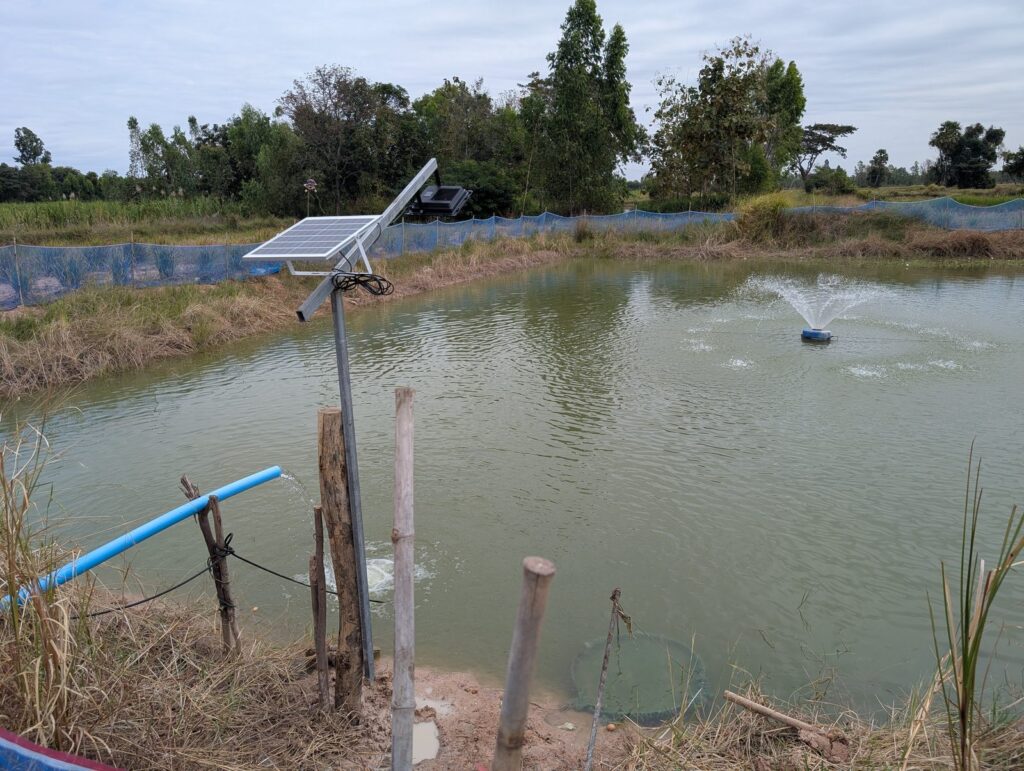
In the water itself, lotus and water lilies are the classic Thai choice. Grow them in large clay pots sunk into the shallows, so they cannot take over, and aim to cover no more than about a quarter to a third of the surface with plants, leaving the rest open. Avoid water hyacinth at all costs: it is an invasive weed that can cover a pond in a season. Fish help keep mosquito larvae down, and frogs and dragonflies arrive on their own. The pond also becomes a magnet for wildlife; our guide to wildlife in Isaan covers what you might see.
Flowering Trees for Colour and Shade
A few flowering trees along the entrance or the path to the pond make the land feel like a place rather than a plot. The best-known is the golden shower tree (ratchaphruek, ราชพฤกษ์), Thailand’s national tree, which hangs with long chains of yellow flowers from March to May. The flame tree turns scarlet in April and May, and the pink trumpet tree (ชมพูพันธุ์ทิพย์) has a short, spectacular show of pink blossom between February and April. Plant them 6 to 8 metres apart along a path and alternate them so something is in flower through the hot season.
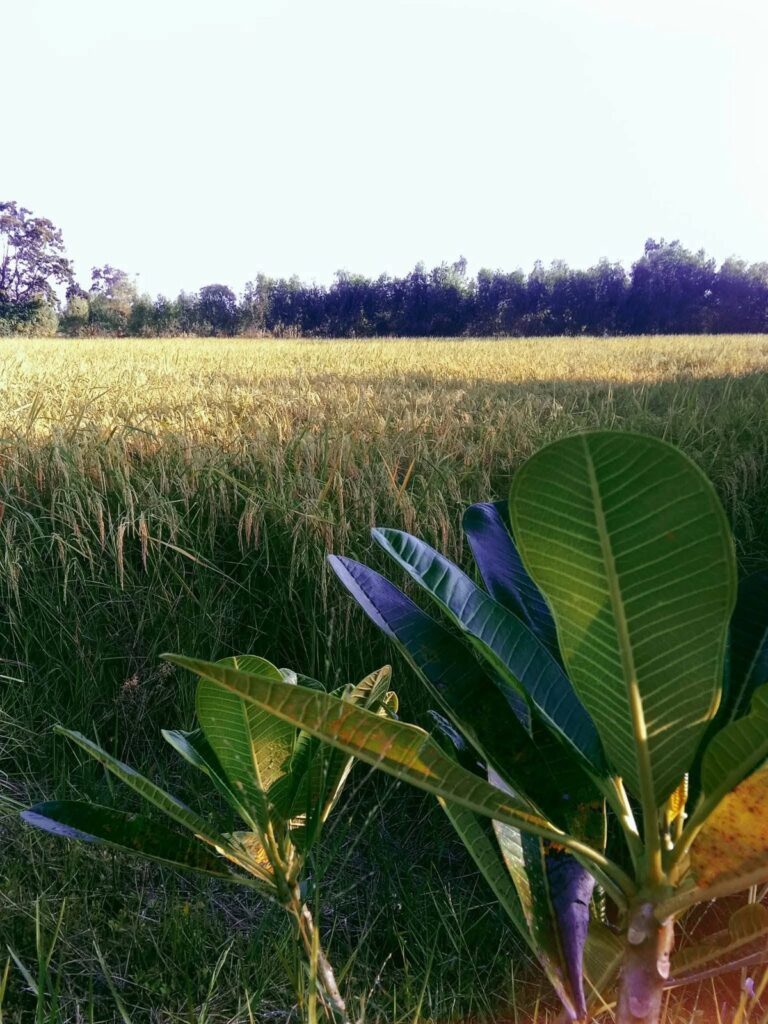
Frangipani (lantom or leelawadee), with its scented white and yellow flowers, is compact enough for beside a house or a seating area. Some trees that appear on garden lists are better avoided here: jacaranda tends to flower poorly in the humid lowland tropics, and Mediterranean herbs such as lavender and rosemary struggle in wet, heavy soil and monsoon rain.
Banyan and bodhi trees are better admired than planted. Big fig trees such as the banyan (sai, ไทร) and the bodhi tree (pho, โพธิ์), the tree under which the Buddha attained enlightenment, grow enormous, and their roots lift paths and crack foundations. Many Thai families also see them as belonging to temples and the spirit world rather than to a home, and an old one is often treated with real respect, with offerings left at its foot. If there is one on the family land already, ask before you so much as prune it.
Lemongrass and the Mosquito Myth
Our planting plan had a whole sheet on mosquito-repellent plants: lemongrass, citronella grass, basil, marigolds and neem, carefully placed around the pond and the paths. My mother-in-law, who is out on the land every day planting and tending, took a more direct approach. Alongside the bananas, the mangoes and a growing list of everything else, she planted lemongrass. A great deal of lemongrass: rows of it along the paths, clumps around the pond and more beside the betel nut palms, and by now much of it is rather tall. Lemongrass doesn’t actually spread on its own, since it grows in clumps and rarely sets seed, but it doesn’t need to when someone keeps planting more. Our land will never be short of it, and neither will the kitchens of half the village.
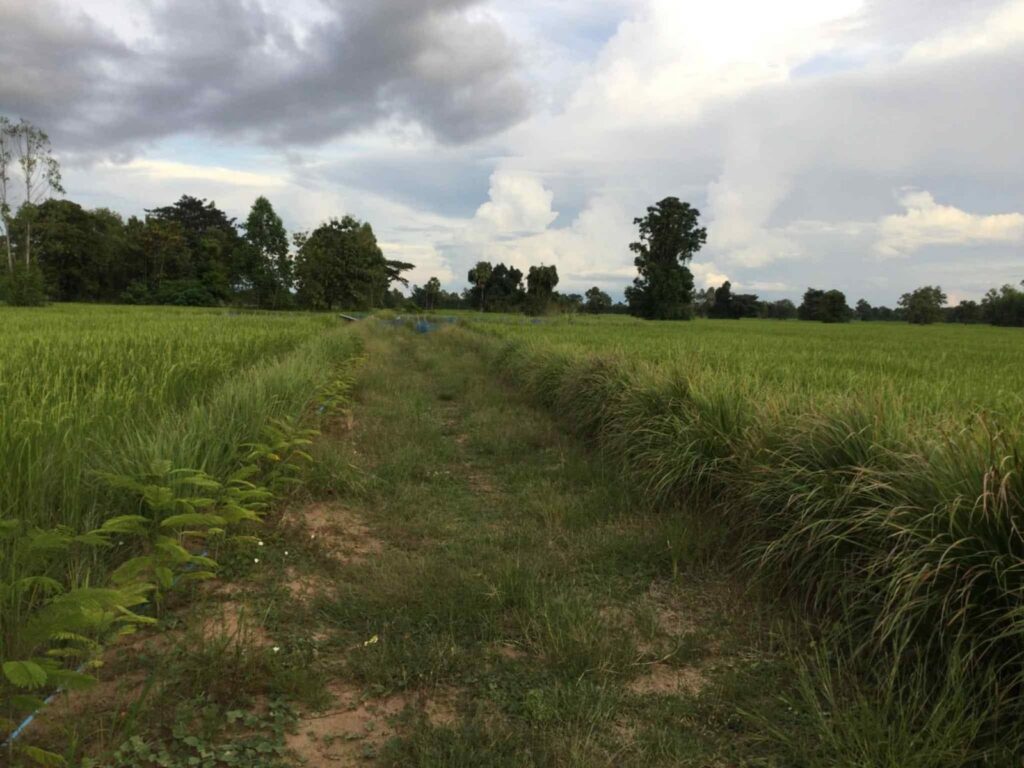
Here is the honest bit, though. Growing these plants does very little to keep mosquitoes away. In a field trial, live neem and marigold plants did not significantly repel mosquitoes, and the “mosquito plant” sold as citronella gave no protection at all in two separate trials. The repellent effect people talk about comes from the oils, extracted and applied, not from the plant sitting in the garden. So grow lemongrass for tom yum, for soil and for the smell when you brush past it, and keep a bottle of proper repellent in your pocket, especially in the rainy season, when dengue is about.
Planting Trees in Isaan Takes Patience
Much of our written plan is still on paper, but the land itself is far from idle. My mother-in-law is out there every day, and bananas, mangoes, betel nut palms and a great deal of lemongrass are already growing. The pond has its fountain, and the timber trees are next. The lesson so far is that the slow work comes first: raising the ground, getting water to where it is needed and putting the right tree in the right place. Everything after that is mostly waiting, which is the best part. A tree planted this rainy season will be shading somebody long after we have stopped visiting, and there are worse things to leave behind.
For more on life on the land, read our guides to making a great life in Buriram, the sarus cranes that have returned to Buriram’s rice fields and what Buriram is actually like.
Frequently Asked Questions
At the start of the rainy season, roughly May to July, unless you can water through the dry season. The Royal Forest Department recommends rainy-season planting because the rain keeps seedlings alive while their roots establish. December to February works only with regular watering until the rains arrive.
Since an amendment to the Forest Act published in April 2019, trees growing on land held under the Land Code, such as land with a chanote or NS3 title, are no longer reserved timber, so the owner can cut them without a felling permit. Land reform (SPK 4-01) land follows different rules. Check with the district forestry office for your plot.
Farm teak in north-east Thailand is usually harvested at around 20 years; a study of Isaan farm plantations found a 20-year rotation generally worked better than 15. Teak needs well-drained ground and does not tolerate waterlogging.
Rain trees and yang na tolerate waterlogged ground far better than teak, and bananas suit the wet edges of ponds. For most other trees, build raised rows or mounds 30 to 50 cm high with drainage channels between them.
Not as a growing plant. Field trials found live mosquito-repellent plants such as neem, marigold and citronella geranium gave little or no protection; the repellent effect comes from extracted oils. Use a proper insect repellent, especially in the rainy season.
Photos: own photos.
Buriram Live covers the real Buriram — temples, football, motorsport, rural life and practical information for visitors and those with deeper connections to the region. No fluff, no sponsored itineraries. Follow Buriram Live on Facebook for new articles and updates.
Get Buriram updates by email
Occasional emails when there is something worth knowing: new guides, festival and MotoGP dates, and Buriram United news. No spam, and you can unsubscribe at any time.
We will email you a link to confirm. See our privacy policy.