
Thai sources count more than 60 Khmer temples in Buriram province, built in brick, laterite and sandstone between the 10th and 13th centuries. Two of them, Phanom Rung and Mueang Tam, are among the finest Khmer monuments in Thailand. The rest stand in rice fields, inside village temple grounds and on the slopes of old volcanoes, and most of them see almost no visitors.
That is a lot of temples for one rural province. This guide explains why the Khmer built so much here, how the famous sites fit into the story, and which of the Khmer temples in Buriram are worth your time if you only have a day or two.
Buriram’s Khmer temples at a glance
- How many: more than 60 Khmer sanctuaries, according to Thai sources.
- When: mostly the 10th to 13th centuries CE, about 800 to 1,100 years ago.
- The two big ones: Phanom Rung, built in stages from the 10th to the 13th century, and Prasat Mueang Tam, built in the late 10th and early 11th centuries.
- World Heritage status: Phanom Rung, Mueang Tam and Plai Bat have been on UNESCO’s Tentative List since 2019. None of them is a World Heritage Site yet.
- Entry: Phanom Rung costs 200 baht for foreign visitors, or 250 baht with Mueang Tam (check on arrival). Most of the smaller sites are free.
Before the Khmer: Buriram in the 7th to 9th Centuries
People were living here long before the first Khmer temple went up. Archaeologists have found evidence of settlement in Buriram from prehistoric times through the Dvaravati period, the Buddhist culture that flourished here centuries before the Khmer.
You can still see that earlier layer. On the hill at Wat Khao Angkhan, carved basalt boundary stones (sema) in a style about 1,200 years old stand around a modern temple. And in 1964, workers at Prasat Khao Plai Bat II in Lahan Sai district dug up a cache of Buddhist bronzes from the 8th and 9th centuries, among the most important finds of their kind in Southeast Asia. Many of them left Thailand and ended up in museums abroad.
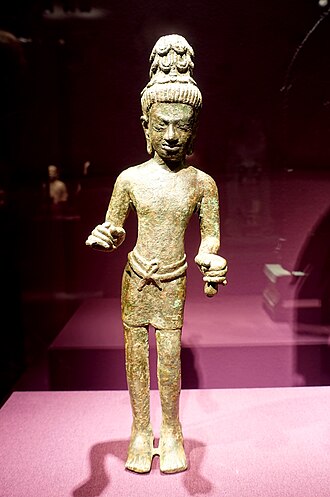
So when the temple builders arrived, Buriram already had religious sites, Buddhism and farming communities. The Khmer built on top of an existing world rather than an empty one.
Why There Are So Many Khmer Temples in Buriram
No single reason explains it. Several things lined up at once.
It sat on the main road north from Angkor. The Khmer capital at Angkor, in today’s Cambodia, was linked by a highway to Phimai, a great Buddhist temple-city in what is now Nakhon Ratchasima province. Phimai marks one end of that road and was built facing Angkor. The route crossed Buriram, and temples, rest houses and hospitals grew up along it. Phanom Rung and Mueang Tam both stand close to its line. Our guide to the Khmer ruins in Buriram follows the rest houses along the road in detail.
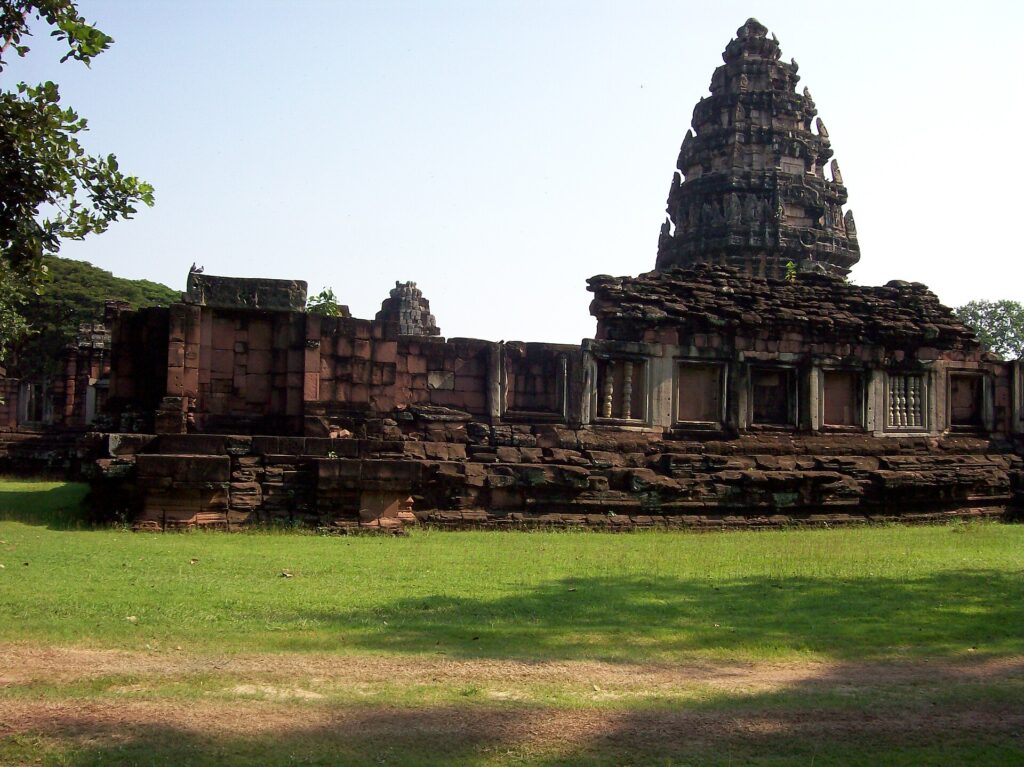

It had good rice land and the means to water it. A Khmer temple was rarely just a temple. It came with a reservoir (baray) and the fields and villages that the water kept going through the dry season. Mueang Tam still has its great reservoir to the north, between the temple and Phanom Rung.
It had sacred mountains. Khmer temples were built as models of Mount Meru, the mountain home of the gods, so a real hill made a powerful site. Southern Buriram is dotted with extinct volcanoes. Phanom Rung sits on the rim of one, about 200 metres above the surrounding plain, and the Plai Bat temples stand on the slopes of another. Khao Kradong, 6 km south of Buriram city, is a third, with a small Khmer ruin of its own.
It was a working region, not a frontier. Archaeologists have found more than 200 kiln mounds around Ban Kruat and Lahan Sai, where potters worked from the 10th to the 12th century. This was a productive, populated part of the Khmer world.
It had time. Building went on here for more than 300 years, under many kings and local rulers. Each one added something, and much of it is still standing.
A Timeline of Buriram’s Khmer Temples
| When | What happened |
|---|---|
| 7th–9th centuries | Dvaravati-era sema stones at Khao Angkhan. Buddhist bronzes buried at Khao Plai Bat II (found in 1964) |
| 10th century | The first brick sanctuaries at Phanom Rung. The temples at Khao Plai Bat |
| Late 10th–early 11th century | Prasat Mueang Tam built, dedicated to Shiva |
| 11th century | More sanctuaries across the province, including Prasat Wat Khok Ngio in Pakham |
| 12th century | Phanom Rung’s main sanctuary, in the reign of Suryavarman II, the king who built Angkor Wat |
| c. 1181–1218 | Jayavarman VII builds hospitals and rest houses along the roads, including Prasat Ban Bu below Phanom Rung |
| c. 1300 | Temple building and the kilns stop |
| 1807 | The town of Mueang Pae is founded, later renamed Buriram |
| 1971–1988 | The Fine Arts Department restores Phanom Rung. The historical park opens on 21 May 1988 |
| 1988 | Phanom Rung’s Vishnu lintel returns from the Art Institute of Chicago |
| 1997 | Mueang Tam reopens after restoration |
| 2019 | Phanom Rung, Mueang Tam and Plai Bat go on UNESCO’s Tentative List |

From Shiva to the Buddha
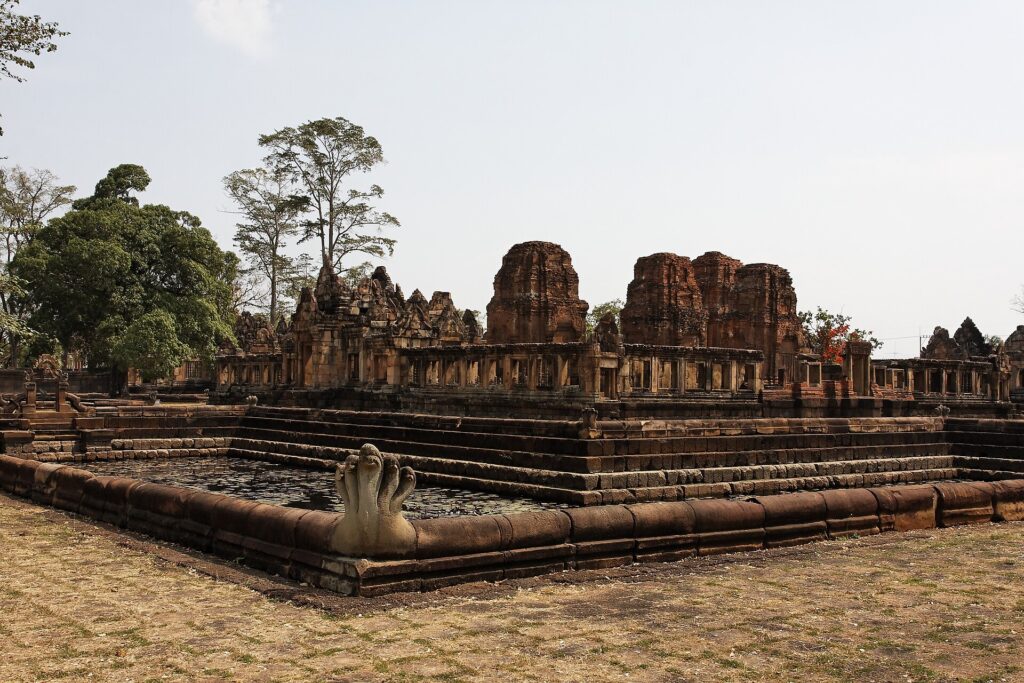
The big temples of Buriram were built for Hindu gods. Phanom Rung and Mueang Tam were Shiva temples, each with a linga, Shiva’s symbol, in its central sanctuary, and their carvings show Vishnu and Krishna as well. Phanom Rung’s most famous carving, the lintel of Vishnu reclining on a serpent, was stolen in the 1960s, spent two decades in a Chicago museum, and went back above the east door in 1988.
The religion shifted over the centuries. Jayavarman VII, the last great builder, was a Mahayana Buddhist, and Phimai was built as a Buddhist temple. Phanom Rung itself later became a Buddhist site.
Today Buriram is Theravada Buddhist, and the old and new sit side by side. Several Khmer ruins stand inside working village temples. Our guide to Buddhist temples in Buriram covers the living ones.
Who Lives Here Now
Khmer did not disappear when the empire did. Around 1.4 million people in Buriram, Surin and Sisaket speak Northern Khmer, mostly alongside Thai, and in the districts toward the Cambodian border you will hear it at home and in the villages.
Khmer has been spoken in this region since at least the time of the empire. How much of today’s population descends directly from the people who built Phanom Rung, and how much from people who moved back and forth across the border hills in the centuries since, is not something the sources we have read settle. Either way, the language and the temples share the same landscape.
The Kuy (also called Suay) are the other old community here. Some scholars think they were among the original inhabitants of this part of mainland Southeast Asia, and the Kuy of neighbouring Surin are famous elephant keepers. That tradition lives on at Ban Ta Klang.
Which Khmer Temples to See in Buriram
If you only have one day, start with the big two and add the small sites nearby. They are all in the south of the province, so stay near Nang Rong or Prakhon Chai rather than in the city if you can.
- Phanom Rung. The one not to miss: a 160-metre processional walkway, a sanctuary on top of a volcano, and four days a year when the sun lines up through all fifteen doorways. About 75 km from Buriram city, roughly 1¼ hours by road. Go early.
- Prasat Mueang Tam. Flat, quiet and beautiful, with four L-shaped ponds edged with stone serpents. A short drive below Phanom Rung, and covered by the combined ticket.
- Kuti Ruesi Ban Khok Mueang. One of Jayavarman VII’s hospitals, 3.5 km from Mueang Tam. Free, and usually empty.
- Kuti Ruesi Ban Nong Bua Rai and Prasat Ban Bu. Another hospital at the foot of Phanom Rung hill, and a rest house on the old road. Both take minutes and show the “infrastructure” side of the empire.
- Prasat Khao Plai Bat. On a second volcano in Lahan Sai district, where the bronzes were found. Worth it if you want the Tentative List set.
With more time, the three brick towers of Prasat Nong Hong in Non Din Daeng and the remote Prasat Wat Khok Ngio in Pakham are covered in our guide to the hidden Khmer ruins of Buriram. And to see where the road ended, Phimai in Nakhon Ratchasima province is a worthwhile detour if you are driving between Bangkok and Buriram.
Getting around: no public transport reaches these temples. For Phanom Rung you can take a bus to Nang Rong and a taxi from there, but the smaller sites need wheels. You need your own car, or a car with a driver (our transport guide explains both). Car hire is best arranged at the airport: compare car hire rates from Buriram Airport.
Khmer Temples in Buriram: FAQ
How many Khmer temples are there in Buriram?
Thai sources count more than 60 Khmer sanctuaries in Buriram province, in brick, laterite and sandstone. Most were built between the 10th and 13th centuries. Only a handful, led by Phanom Rung and Mueang Tam, are restored and staffed.
Why are there Khmer temples in Thailand?
From roughly the 10th to the 13th century, the Khmer empire based at Angkor controlled much of what is now northeast Thailand. Buriram lay on the main road from Angkor to Phimai, so temples, rest houses and hospitals were built along it.
Is Phanom Rung a UNESCO World Heritage Site?
No. Phanom Rung, Mueang Tam and Plai Bat were added to UNESCO’s Tentative List in 2019, which is the first step towards World Heritage status. They have not been inscribed.
Are Buriram’s Khmer temples Hindu or Buddhist?
Both, at different times. Phanom Rung and Mueang Tam were built as Hindu temples to Shiva. Later builders such as Jayavarman VII were Mahayana Buddhists, and Phanom Rung became a Buddhist site. Today the region is Theravada Buddhist.
Can you see the main Khmer temples in one day?
Yes, with a car. Phanom Rung, Mueang Tam and Kuti Ruesi Ban Khok Mueang fit comfortably into one day. Start at Phanom Rung early, before the heat and the coach groups.
Feature image: Benh LIEU SONG.jpg), CC BY-SA 2.0 via Wikimedia Commons.
Inline images: Philip Nalangan, CC BY 4.0; Ddalbiez, CC BY-SA 3.0, via Wikimedia Commons.
Buriram Live covers the real Buriram — temples, football, motorsport, rural life and practical information for visitors and those with deeper connections to the region. No fluff, no sponsored itineraries. Follow Buriram Live on Facebook for new articles and updates.
This article contains affiliate links. If you make a purchase through a link on this page, we may earn a small commission at no extra cost to you.
Get Buriram updates by email
Occasional emails when there is something worth knowing: new guides, festival and MotoGP dates, and Buriram United news. No spam, and you can unsubscribe at any time.
We will email you a link to confirm. See our privacy policy.