
One of the questions people contemplating a longer stay in rural Isaan ask, and rarely get a straight answer to, is: how good is the healthcare?
The honest answer for Buriram is: better than you probably expect. Significantly better.
Buriram does not appear in lists of Thailand’s medical tourism destinations. Those lists feature Bangkok and Chiang Mai. But Buriram Hospital — the main public facility — is a 900-bed A-level Regional Centre and a teaching hospital within Thailand’s national medical system. That classification places it among the better-resourced provincial hospitals in the country. For most things most people need, it is more than adequate.
This guide covers what visitors and expats can realistically expect: the public system, the private option, pharmacies, dental care, and what insurance actually makes sense for different kinds of stay.
The Thai Public Healthcare System
Thailand runs a near-universal healthcare system for its citizens, primarily through the Universal Coverage Scheme — a heavily subsidised programme covering most conditions at public hospitals for Thai nationals, widely known as the Gold Card scheme. Employed workers contribute through the Social Security Scheme, and civil servants have their own benefits programme.
As a foreign visitor, none of these apply. You will be treated as a fee-paying patient at any public hospital. This does not mean you are unwelcome — public hospitals treat foreign patients every day, and you will not be turned away in an emergency — but you pay the full unsubsidised rate for consultations, diagnostics, and treatment.
The good news: those rates are still very affordable by Western standards. An outpatient consultation and basic treatment at a Thai public hospital is a fraction of what equivalent care costs in the UK privately, and a small fraction of what it costs in the United States.
Healthcare Across the Province
Before focusing on the city hospitals, it is worth understanding how healthcare in Buriram actually works for the people who live here — because the network is far more distributed than visitors typically expect.
Every district (amphoe) in Buriram province has its own community hospital (โรงพยาบาลชุมชน). With roughly 23 districts across the province, that means more than 20 hospitals spread across the region — from Nang Rong and Prakhon Chai in the south to Lam Plai Mat and Phutthaisong in the north. These are not basic clinics. District hospitals in Thailand routinely handle emergency care, X-rays, laboratory work, minor surgery, and maternity services. Waiting times are often shorter than at the Regional Centre in the city, and the standard of care is generally good.
Below district hospitals, most sizeable villages and subdistricts have a primary care unit (สถานีอนามัย) or community health post — staffed by nurses and health officers, handling day-to-day primary care, vaccinations, wound treatment, and referrals upward when needed. For straightforward ailments, these are often the first and only stop needed.
In practice, this means that even if you are staying well outside Buriram city, you are unlikely to be far from some level of medical care. For anything serious, district hospitals can stabilise and refer to Buriram Hospital; for minor issues, local clinics handle them quickly and inexpensively.
Buriram Hospital
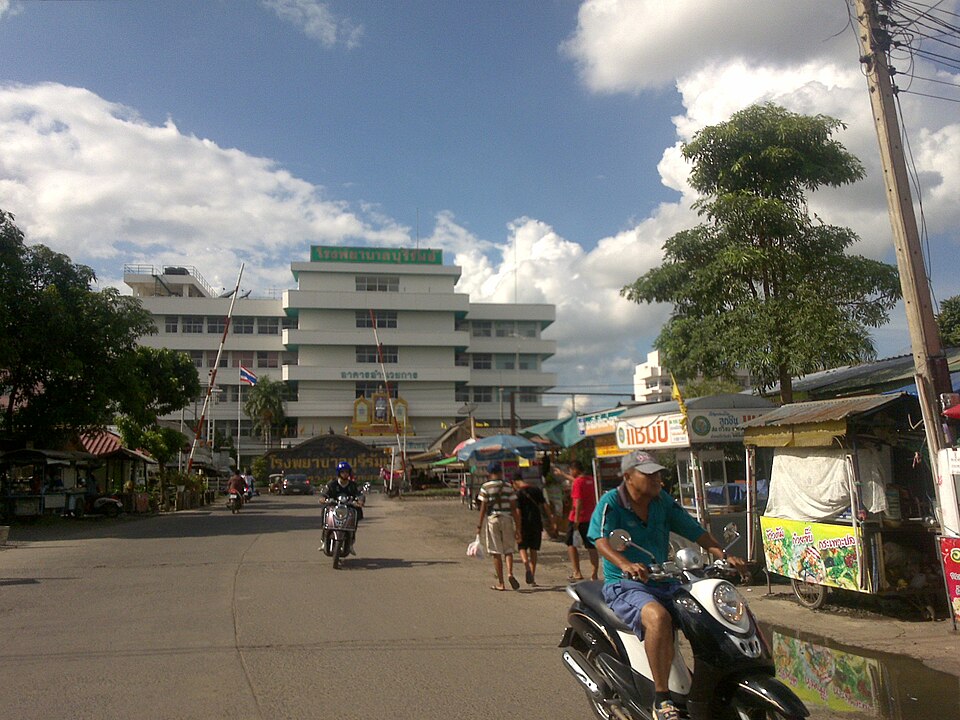
Buriram Hospital (โรงพยาบาลบุรีรัมย์) sits on Romburi Road in the heart of the city. It is the main public hospital for the province and functions as a Regional Centre serving communities across Buriram and the surrounding area.
With approximately 900 beds and A-level Regional Centre status — the highest classification for a provincial hospital in Thailand’s tiered public health system — it handles a wide range of acute and specialist care that smaller district hospitals refer upward. As a teaching hospital, it trains doctors and nurses within the facility, which typically means more specialist consultants and better diagnostic equipment than a standard district hospital.
For a visitor with a genuine medical need — a serious accident, a significant illness, an emergency — Buriram Hospital is a credible facility. It is not a private international hospital with English-language concierge service and a hotel-style patient wing. It is a busy regional public hospital. But it has the capability to handle serious cases without automatically sending patients to Korat or Bangkok.
Practicalities for foreign visitors:
- Emergency services: dial 1669 (national EMS)
- Out-of-hours emergencies: go directly to the emergency department (ห้องฉุกเฉิน — hong chuk chern)
- Expect waiting times for non-urgent outpatient consultations; the hospital serves a large catchment area
- English language: some doctors have workable English; nursing staff are often Thai-only. A Thai-speaking companion or phone translation helps significantly
- Payment: expected after treatment; bring cash or card

Private Healthcare: Buriram Ram Hospital
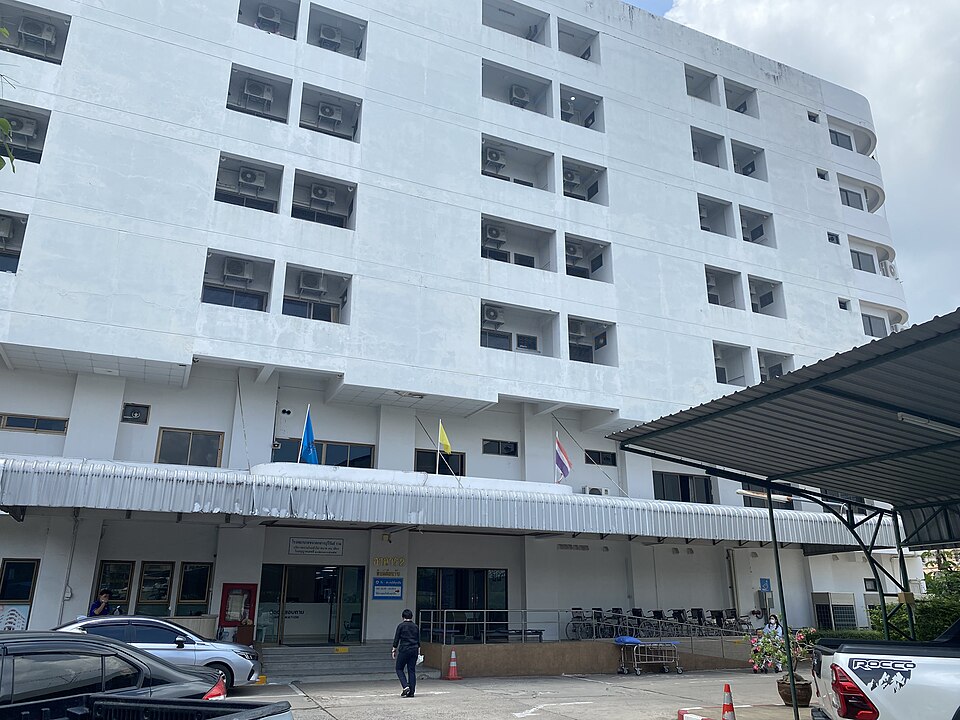
For faster access, more comfortable surroundings, and a higher likelihood of English-speaking staff, the private option in Buriram is Buriram Ram Hospital (โรงพยาบาลราม บุรีรัมย์).
At around 90 beds, it is considerably smaller than the public hospital — but that reflects its function rather than its quality. Private hospitals at this scale handle outpatient consultations, minor procedures, routine diagnostics, and planned care more efficiently than the large public system: shorter queues, a more individual focus, and typically a calmer environment.
The pattern common across provincial Thailand applies here: use the private hospital for routine needs and planned procedures; use the public Regional Centre for complex or emergency cases where scale and specialist capability matter most.

For the cost of living in Buriram context: private outpatient consultations in provincial Thailand typically run 300–600 baht for a standard GP visit. Blood tests, X-rays, and minor treatments add to this but remain very affordable by Western standards.
Pharmacies
Thailand has a well-developed pharmacy network, and Buriram city is well-served. National chains including Boots operate in the city alongside numerous independent pharmacies (ร้านขายยา — ran kai ya), which are found throughout the city and in most town centres across the province.
Thai pharmacies are notable for the breadth of what can be purchased without a prescription. Many antibiotics, antimalarials, and other medicines that require prescriptions in the UK or US are available over the counter. This can be genuinely useful for travellers; it should also be approached with care. If you are uncertain, ask the pharmacist rather than self-diagnosing.
Common OTC items — paracetamol, ibuprofen, antihistamines, antidiarrhoeals, oral rehydration salts, basic wound care — are widely available and inexpensive.
One practical note: if you take regular prescription medication, bring an adequate supply from home. Matching brand names may not always be available, and generics may use different dosing or formulations. Your GP can usually provide a longer prescription for travel purposes.
Dental Care
Dental care in Thailand is generally excellent by international standards and significantly cheaper than in the UK or US. Buriram has dental clinics available both as standalone practices and through the hospitals, handling routine check-ups, fillings, extractions, crowns, and basic cosmetic work.
If you are planning a longer stay, use your NHS entitlement before you leave home and then local clinics for anything straightforward that arises in Thailand. The quality is good; the cost is a pleasant surprise.
When Bangkok Is the Answer
Despite Buriram Hospital’s regional capability, there are situations where patients — Thai and foreign alike — travel to Bangkok. These typically involve highly specialised treatments: complex oncology, advanced cardiac procedures, certain neurosurgical cases, or situations where the private international hospitals in Bangkok offer services simply not available in Isaan at any price.
Bangkok is roughly 400km from Buriram — a four-hour drive or a short flight from Buriram Airport. For planned, non-emergency specialist consultations, the journey is entirely manageable and is a normal part of life for patients with complex needs across all of provincial Thailand. For genuine emergencies, Buriram Hospital is where you go.
Air evacuation services operate in Thailand for critical cases. This is one of the coverages a comprehensive travel or expat health insurance policy provides that basic plans sometimes do not — worth checking before you need it.
For Expats Living in Buriram
The expat community in Buriram is relatively small: largely people with Thai families who have settled in the province, a smaller number working in the city, and an increasing number spending extended periods here. What they do for healthcare varies.
Common approaches:
Uninsured and self-paying works for healthy, younger people who can absorb the cost of private outpatient care — which is cheap by Western standards — and are comfortable using the public hospital for anything serious.
SafetyWing Nomad Insurance is popular with digital nomads and longer-term travellers. Monthly billing with no annual commitment; covers hospitalisation and emergencies including evacuation. Not designed for permanent residents, but practical for people spending months at a time in Thailand and moving between countries. Get a Nomad Insurance quote — pricing is based on your age and home country, shown in real time in the widget below.
Local Thai health insurance — some long-term expats enrol in Thai private health insurance schemes through brokers in Bangkok. Lower cost than international expat policies; coverage is specific to Thai hospitals.
International expat health insurance (Cigna Global, AXA, BUPA International) — comprehensive but expensive. Typically in the range of £1,000–£3,000 per year depending on age and coverage level. Worth it for people who move regularly between Thailand and the UK and want consistent cover on both sides.
If you are navigating a longer stay in Thailand and thinking about the financial side of residency, the Thai retirement visa and Thai marriage visa guides both touch on the practical realities of long-term Buriram life.
Travel Insurance for Shorter Visits
For visitors coming to Buriram for a week or a month, standard travel insurance is the right tool. Before you buy, check that your policy covers:
- Medical treatment and hospitalisation (minimum £1m)
- Emergency evacuation and repatriation
- The specific activities you plan to do — motorbike riding, for example, is excluded from many standard policies and requires an add-on or a specialist policy
Get a travel insurance quote for Thailand — World Nomads is one of the few travel insurers that explicitly covers over 150 adventure and active travel activities and has a well-established claims record in Southeast Asia.

Feature image and body image: Conan likecartoon, CC BY-SA 3.0 via Wikimedia Commons.
Ram Hospital image: Reversemos.sapanaht, CC BY-SA 4.0 via Wikimedia Commons.
Buriram Live covers the real Buriram — temples, football, motorsport, rural life and practical information for visitors and those with deeper connections to the region. No fluff, no sponsored itineraries. Follow Buriram Live on Facebook for new articles and updates.
This article contains affiliate links. If you make a purchase through a link on this page, we may earn a small commission at no extra cost to you.
Get Buriram updates by email
Occasional emails when there is something worth knowing: new guides, festival and MotoGP dates, and Buriram United news. No spam, and you can unsubscribe at any time.
We will email you a link to confirm. See our privacy policy.