
The cost of living in Buriram is not lower because it is remote, or undeveloped, or lacking in things to do. It is lower because the prices are set for the people who live there — Thai people earning the provincial minimum wage of ฿330 a day. There is no tourist economy inflating the cost of a meal. There is no expat bubble pushing up rents. When you walk into a market or a noodle stall in Buriram, you pay what everyone else pays.
That single fact explains most of the numbers in this article. If you want to understand what Buriram is actually like, the economics are a big part of it.
Buriram vs Bangkok: how the cost of living compares
Bangkok is expensive for the same reason London is expensive — a large high-earning population has created a parallel economy where landlords, restaurants and service businesses charge what that market will pay. In Buriram, however, that market does not exist. Here is what the cost of living in Buriram looks like compared to Bangkok in practice, based on Numbeo data and active local listings.
| Item | Buriram | Bangkok |
|---|---|---|
| Street food meal | ฿40–60 | ฿120–200 |
| 1-bed apartment, decent quality | ฿4,000–8,000/month | ฿15,000–22,000/month |
| Motorbike fuel (monthly) | ฿500–900 | ฿600–1,200 + parking |
| Electricity (1 AC unit, moderate use) | ฿1,500–2,500/month | ฿1,500–3,000/month (often with landlord markup) |
| Comfortable expat monthly budget | ฿20,000–35,000 | ฿40,000–55,000 |
Overall, the cost of living in Buriram runs to roughly 40–60% of the equivalent in Bangkok. For someone with a Thai partner or family connections in the area, the savings go further still. For live GBP–THB rates, our tools page has a currency converter.
Food and drink
Street food and local markets
Food is where the cost of living in Buriram diverges most sharply from Bangkok. A plate of som tam at a market stall costs ฿40–60. A bowl of khao man gai is ฿40–50. Pad thai at a street stall runs ฿50–70. These prices exist because they are bought by people earning ฿10,000–15,000 a month — if they were higher, nobody local could afford them.
Eating well in Buriram on ฿3,000–5,000 a month is entirely realistic if you eat local food. Add home cooking from the market — fresh vegetables, rice, fish, chicken — and a household of two can eat extremely well for ฿6,000–8,000 a month. A rough comparison: the same shopping basket costs around 15–20% more in Bangkok, and that is before you factor in the temptation of the city’s wider restaurant market.
Home cooking, home growing
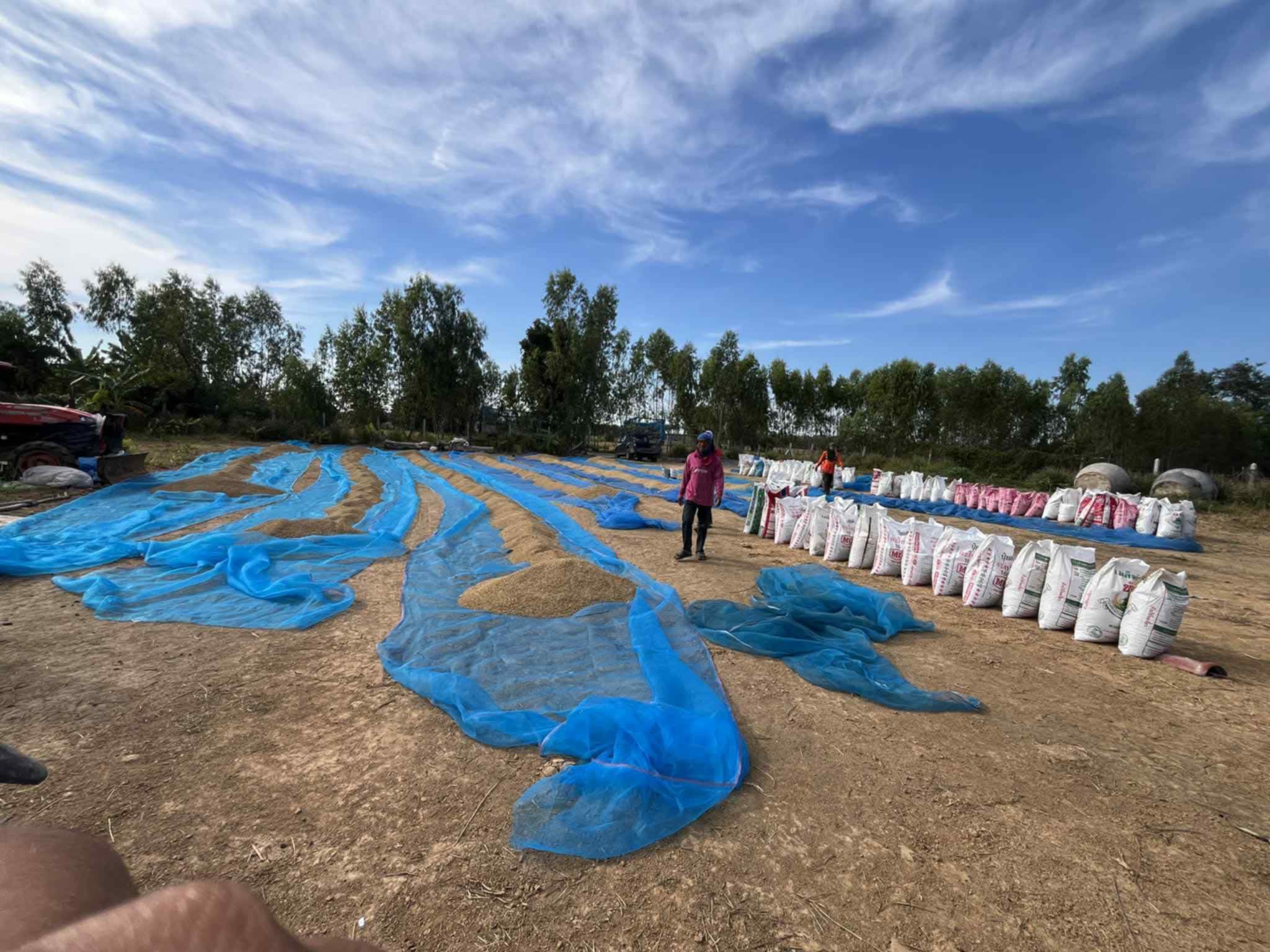
For people with land in the area, these figures drop further still. A mango tree, a papaya tree, banana plants, a vegetable patch, a small fish pond — the kind of thing that exists on most rural Isaan properties — contribute meaningfully to the food bill. Fruit that would cost ฿30–50 at a market stall costs nothing if you grew it yourself. This is not a romantic notion; it is how most rural Thai families actually live, and for a foreigner building a life alongside that, the practical benefit is real.
There is also a community dimension that no cost of living calculator captures. In rural Isaan, excess produce circulates through family and neighbour networks. Someone brings fish from their pond; someone else has more papaya than they can eat. If you are embedded in a village community — through a Thai partner or family connections — you will receive food as a matter of course. It is not charity; it is how things work.
For a deeper look at what is actually on the table, the Isaan food guide covers the regional dishes you will encounter daily.
Coffee is Café Amazon — the PTT petrol station chain that is everywhere in provincial Thailand. An iced coffee is ฿50–70. There is no Starbucks in Buriram town; the nearest is in Korat, 1.5–2 hours away. For most people this is not a hardship.
Beer at a local shop or 7-Eleven: ฿45–65. A draft beer at a local bar: around ฿60. Buriram does not have the nightlife infrastructure of Bangkok or Pattaya, but for the majority of people considering a longer stay here, that is not what they came for.
Getting around
Outside Bangkok, Thailand runs on motorbikes. In Buriram this is true of almost everyone — locals, expats with Thai families, and most long-stay visitors. A second-hand 125cc costs ฿15,000–30,000. A new Honda PCX 160, the common expat choice, is around ฿85,000. Monthly running costs — fuel, insurance, occasional servicing — come to roughly ฿800–1,500 a month.
Within Buriram town, shared songthaew (pickup truck taxis) connect the train station, bus terminal and town centre for a flat ฿20 per person. No app, no surge pricing.
A car makes practical sense in rural Buriram in a way it does not in Bangkok. Parking is free, roads are quiet, and if you are developing land or visiting family across the province you will use it constantly. Running costs vary considerably depending on how much you drive and whether you carry comprehensive insurance. For a typical rural driver covering 10,000–12,000km a year — fuel, compulsory insurance, road tax, basic maintenance — expect ฿27,000–42,000 a year (฿2,250–3,500/month). Add comprehensive insurance on a newer vehicle and that rises to ฿35,000–60,000. Many Thai car owners in the provinces run older paid-off vehicles without comprehensive insurance and keep annual costs well below ฿30,000. New cars start at around ฿400,000 for a small hatchback; a Toyota Corolla is around ฿894,000.
Travelling to Bangkok from Buriram: the overnight bus costs ฿400–700 and takes around six hours. The train is ฿200–900 depending on class. AirAsia flies the route from Buriram Airport (BFV) from around ฿1,400 one-way booked in advance. Full details in the transport guide.
Renting in Buriram
Accommodation is the single biggest line item in the cost of living in Buriram. Rental prices are set by the local market — students at Buriram Rajabhat University, hospital workers, government employees. This keeps rents at a level that reflects local incomes rather than what a foreign tenant might pay in a more touristed area.
A basic studio or room with air-conditioning and an en-suite: ฿2,500–4,000 a month. A decent one-bedroom apartment in town: ฿4,000–7,500. A two or three-bedroom townhouse: ฿4,000–10,000 depending on size, location and condition. A detached house with a garden: ฿8,000–15,000. For reference, Buriram’s better hotels — the Amari Buriram United and Modena by Fraser among them — charge ฿2,000–3,500 per night. Long-term rental is a fraction of that.
Rural rental outside Buriram town drops further still. A basic Thai house in a village: ฿2,000–4,000 a month. Informal arrangements through family connections can be significantly less — this is off-market Isaan, where relationships matter more than listings.
Compare this to Bangkok, where a decent one-bedroom apartment near the BTS or MRT runs ฿15,000–22,000 a month, and a three-bedroom in a decent area starts at ฿40,000–70,000. The gap is not marginal. For more on accommodation options in Buriram, the where to stay guide covers hotels, guesthouses and longer-term options.
Land and building: the bigger picture
For many people with a Thai partner or deep family connections to Buriram, the long-term question is not renting but building. The numbers here are striking.
Land prices
Agricultural and rural land in the Buriram-Surin border area — the Krasang district and similar rural zones — trades at roughly ฿200,000–700,000 per rai (1,600 sq m), depending on road access, the type of title deed, and whether utilities are connected. The wide range reflects real variation: a roadside plot with electricity and a Chanote title deed (the most secure form of ownership) commands a premium over land deeper off the road with a lesser title. For Bangkok suburban land, the equivalent starts at ฿6m–15m per rai, and that is on the fringes of the city.
One important caveat on those Buriram figures: the best land deals in rural Isaan never appear on property websites. They circulate through family networks and local contacts. An estate agent listing reflects the asking price of a landowner who has chosen to advertise; land sold between neighbours or through introductions from local families changes hands at lower prices and with better local knowledge about what you are buying. If you have connections in the area, use them.
Building costs
Building costs in Isaan are lower than in Bangkok, Chiang Mai or the resort areas of the south. Labour is cheaper: the daily construction wage in Buriram is ฿330 (minimum wage) against ฿370 in Bangkok, and in practice Isaan builder rates reflect the local economy. A basic Thai-style single-storey house runs ฿12,000–15,000 per square metre to build. A mid-range finish with good tiles, proper electrical work and air-conditioning in the bedrooms: ฿18,000–25,000/sq m. A western-style build with higher ceilings, a European kitchen and quality finish throughout: ฿25,000–40,000/sq m. A 120 sq m house at mid-range spec comes to roughly ฿2.2m–3.0m (£48,000–66,000) in build costs, before land, legal fees and utilities connection.
On ongoing costs: Thailand’s Land and Building Tax Act (in force since 2020) taxes agricultural land at 0.01–0.15% of appraised value per year. Vacant or unused land starts at 0.3% and escalates to as high as 3% if left uncultivated for more than three consecutive years. For land that is genuinely being farmed — rice, cassava, fruit trees, a fish pond — the agricultural rate applies as a matter of course and the annual tax bill on rural Buriram land is modest. The difference in rates has given rise to what the Thai press call the “banana tree loophole”: landowners planting token crops on otherwise idle urban plots to qualify for agricultural rates. In rural Isaan, where the land is actually farmed, this is a non-issue.
The legal structure for foreign involvement in land ownership is a separate question entirely — and a complex one. The complete guide to foreigners and land ownership in Thailand covers usufruct arrangements, 30-year leases, and the realities of building on a Thai partner’s land. It is worth reading before any decisions are made.
Utilities
Electricity is the utility that surprises most newcomers to Thailand. The tariff itself — set by the Provincial Electricity Authority (PEA) — is ฿3.95 per kWh including VAT. That sounds reasonable. The problem is air-conditioning.
Buriram averages 30–35°C from March through May, and stays above 28°C for most of the year. Running a single bedroom air-conditioning unit for eight hours a night adds roughly ฿1,500–2,000 to your monthly bill. Two units in regular use: ฿2,500–3,500. Heavy use across multiple rooms: ฿4,000–6,000. Most foreigners living in Buriram land somewhere in the ฿1,500–3,000 range depending on how they manage it.
One thing to watch: rental properties where the landlord charges a per-unit electricity rate above the PEA official tariff. This is technically illegal for buildings with three or more units, but it is common. Always ask whether you are billed directly by PEA or through the landlord, and what rate they charge. ฿6–8 per kWh on a sub-metered rental is not unusual, which roughly doubles your electricity bill.
If you are building, the single most effective investment against your electricity bill is good passive design: deep roof overhangs to shade the walls from direct sun, minimal glazing on south and west elevations where afternoon heat is strongest, solid insulation above the ceiling where most heat enters a building, and cross-ventilation through the house. Traditional Thai architecture incorporated all of these principles before cheap electricity made it easier to just add more AC units. A well-designed house in Buriram can stay meaningfully cooler than outside without running air conditioning at all.
Solar panels are an increasingly common sight on Isaan rooftops, and with good reason. Thailand’s solar irradiance is among the highest in Southeast Asia, and installation costs have fallen significantly. A system sized to cover the household’s AC load becomes, in effect, free air conditioning once the capital cost is recovered — typically within a few years in a climate where the sun is reliable for most of the year. For anyone planning a long-term build in Buriram, solar is worth factoring into the budget from the start rather than retrofitting later.
Water: ฿100–300 a month for a typical household. Internet: AIS Fibre at 100 Mbps is ฿399/month; 1 Gbps is ฿999/month. Fibre is available in Buriram town and along main roads. Rural coverage is patchier — a 4G home router on AIS or TRUE is the realistic option in more remote areas, at ฿399–899 for 100–500GB on 4G. Mobile data: a standard monthly plan runs ฿300–500 for unlimited data (throttled after the daily fair-use limit).
In total, utilities add roughly ฿2,500–4,000 a month (£55–88) to the cost of living in Buriram for a single person — a modest figure compared to most Western countries.
Healthcare costs in Buriram
Public hospitals
Healthcare is one area where the cost of living in Buriram compares particularly well — and where the quality is better than most foreigners expect. The province runs a full four-tier network: village health posts for basic primary care, district hospitals in each of the 23 districts for general inpatient care, and at the top, Buriram Hospital — a 900-bed, A-level Regional Centre with teaching hospital status, training doctors in partnership with Mahidol University’s Ramathibodi faculty. This is not a provincial outpost. It handles the vast majority of serious cases for the province’s 1.6 million people, with specialist departments covering surgery, cardiology, neurology, oncology, paediatrics, orthopaedics and more.
Private healthcare
For private care, Buriram Ram Hospital (โรงพยาบาลบุรีรัมย์ราม) offers 90 beds and a full range of specialists under the national Ram Hospital network. A private GP consultation runs ฿500–800; specialist consultations ฿1,000–2,500. Private care means no queues and English-speaking staff are more likely to be available.
District hospitals like Krasang Hospital (โรงพยาบาลกระสัง) handle the district level — general medicine, emergency stabilisation, X-rays, basic procedures. To put a number on it: a visit to Krasang Hospital including diagnostic radiology and medication came to ฿865 (under £20). That figure includes the X-ray.
Dental work is affordable throughout: a check-up and clean ฿1,000–2,000; a filling around ฿1,500. These are prices that make UK dentistry look absurd.
The one area where Buriram currently refers patients out is cancer radiotherapy — the province has chemotherapy but no radiotherapy facility yet. A new six-floor radiotherapy building was approved by Cabinet in January 2025 and is under construction. For radiotherapy and the most complex specialist procedures, Korat’s Maharat Hospital (about 1.5 hours away) remains the regional referral centre.
Health insurance is still worth having. Local Thai health insurance starts at around ฿20,000–40,000 a year. International expat cover runs ฿45,000–80,000. Get a Nomad Insurance quote — SafetyWing’s flexible month-by-month option that works well for people spending extended periods in Thailand without full-year residency commitment.
Monthly cost of living in Buriram: realistic budgets
Putting it all together, here are realistic monthly estimates for a single person — not theoretical minimums.
| Budget level | ฿/month | £/month | What it looks like |
|---|---|---|---|
| Integrated (local food, fan not AC, motorbike, minimal outgoings) | ฿12,000–18,000 | £264–396 | Possible if living with Thai family, eating entirely local. Not comfortable for most foreigners long-term. |
| Comfortable local lifestyle | ฿20,000–30,000 | £440–660 | Decent rental, AC in bedroom, local food plus occasional home cooking, motorbike, monthly night out. Realistic for someone with Thai family connections. |
| Comfortable expat lifestyle | ฿35,000–55,000 | £770–1,210 | Better apartment, mix of local and Western food, car, private healthcare, occasional Bangkok trip. |
| Comfortable expat with Bangkok trips and higher Western food expectations | ฿55,000–80,000 | £1,210–1,760 | Regular Bangkok visits, more imported goods, private health insurance, premium accommodation. |
For comparison: a comfortable Bangkok expat life — decent condo near the BTS, mix of local and Western food, gym, occasional Grab taxis — costs ฿40,000–55,000 a month as a baseline. The same standard of living in Buriram costs roughly half that. The trade-off is fewer options, a smaller international community, and a trip to Korat only for the most specialist procedures.
That trade-off suits some people very well. If your reason for being in Buriram is a Thai partner, family land, the football or the circuit — rather than Bangkok’s restaurants and nightlife — the numbers make a compelling case.
Sending money to Thailand
If you are funding life in Buriram from earnings or savings in the UK or elsewhere, how you transfer money matters. The gap between a bank transfer and a specialist service like Wise is not trivial: UK banks typically charge 3–5% in fees and exchange rate spread on an international transfer. Wise charges around 0.5%. On a monthly transfer of £600 (roughly ฿27,000), the difference is £15–25 every month — or £180–300 a year. Over time that adds up to a meaningful sum.
Wise transfers to Thai bank accounts arrive within minutes to a few hours. The mid-market exchange rate is used with the fee shown upfront. For anyone moving money regularly between the UK and Thailand, it is the obvious tool.
The bottom line
The cost of living in Buriram is low because it is a real place, not a destination. The infrastructure has improved dramatically over the past decade — Makro, Big C, Lotus’s, decent private clinics, fibre broadband, a functioning airport — but the prices have stayed anchored to what local people earn and spend. Nobody is marking things up for tourists, because the tourists come for MotoGP and football weekends and then leave. The rest of the time, Buriram carries on at Buriram prices.
For someone with genuine reasons to be here — a Thai partner from the region, land in the province, or simply a preference for a quieter life with easy access to one of the world’s great motorsport events and a serious football club — the economics are hard to argue with.
Buriram Live covers the real Buriram — temples, football, motorsport, rural life and practical information for visitors and those with deeper connections to the region. No fluff, no sponsored itineraries. Follow Buriram Live on Facebook for new articles and updates.
This article contains affiliate links. If you make a purchase through a link on this page, we may earn a small commission at no extra cost to you.
Get Buriram updates by email
Occasional emails when there is something worth knowing: new guides, festival and MotoGP dates, and Buriram United news. No spam, and you can unsubscribe at any time.
We will email you a link to confirm. See our privacy policy.