
Food culture in Northeast Thailand revolves around the family table — or more accurately, the mat on the floor. This is a guide to Isaan food in Buriram written from the inside: family meals in rural Buriram, woven mats with whoever turned up that day, tilapia caught from the family pond and on a charcoal grill within half an hour.
Not the restaurant version. The real thing.
Here’s what you need to know about eating in Buriram.
How Isaan People Actually Eat
Before the dishes: the how matters as much as the what.
In rural Isaan, eating is above all a communal act — not in the vague sense that gets written on restaurant menus, but genuinely. Meals are one of the primary ways families and communities maintain their bonds. When the family eat together, neighbours join. Extended family arrive. The meal expands to accommodate whoever turns up.
Food goes in the centre of a mat on the floor. Sticky rice arrives in kratip — small woven bamboo containers — pulled apart by hand, shaped into small balls, and pressed against the surrounding dishes to scoop them up. There are no courses, no service order. Everyone eats together from the same spread.
Moreover, this communal eating extends well beyond the immediate family. In rural Buriram, food is how people socialise — with neighbours, friends, and anyone passing through. If you have a connection to someone from this part of Thailand, this is likely how you’ll encounter Isaan food in Buriram at its best.
Sticky Rice: The Foundation of Everything
Khao niao (ข้าวเหนียว) — glutinous sticky rice — is the cornerstone of Isaan food across Buriram and the wider Northeast. Central Thais eat steamed jasmine rice; Isaan people eat sticky rice, and the distinction matters more than it might seem. Different texture, different technique, a different relationship to everything surrounding it.
In practice, you eat sticky rice with your hands. Take a small handful from the kratip, compress it slightly in the palm, and use it to scoop up the surrounding dishes. Almost everything else at the table builds around it.
The Dishes
These are the dishes that define Isaan food in Buriram — the ones you’ll encounter at family meals, market stalls, and roadside grills across the region.
Som Tam — Green Papaya Salad
Som tam (ส้มตำ) starts with shredded unripe papaya, which vendors pound to order in a clay mortar with garlic, chillies, lime, fish sauce, and palm sugar. The version most tourists encounter — som tam thai — includes peanuts and dried shrimp. However, the Isaan version is different.
In Isaan, som tam uses pla ra — fermented fish — in place of or alongside regular fish sauce. The result is sharper, more pungent, and more complex. In a rural household in Buriram, the pla ra version is the default. It comes with sticky rice and almost always alongside grilled chicken.
In practice, street vendors and market stalls make it to order using a portable clay mortar. Watching it being made — pounding, tasting, adjusting — is worth a few minutes of anyone’s time.
Gai Yang — Grilled Chicken
Gai yang (ไก่ย่าง) is split, marinated chicken that cooks slowly over charcoal. Roadside stalls sell it throughout Isaan — whole birds hanging above the grill, the smell reaching you from some distance. The marinade is lemongrass, garlic, coriander root, and fish sauce. The chicken arrives smoky, slightly charred at the edges, with jaew — a roasted chilli dipping sauce — on the side.
As a result, gai yang is one of the most approachable dishes in Isaan cooking. Mild enough for cautious eaters, deeply satisfying alongside sticky rice and som tam. The roadside gai yang stall is a fixture of daily life in rural Buriram.
Larb — Minced Meat Salad
Larb (ลาบ) is minced pork, chicken, or duck dressed with lime juice, fish sauce, chilli, fresh mint and coriander, and toasted rice powder. The powder — khao khua — comes from dry-roasting raw rice until golden, then grinding it fine. It adds a nutty, faintly smoky undertone that makes larb immediately distinctive.
Larb comes cooked (suk) or raw (dip). In most contexts, the cooked version is what you’ll encounter.
Tom Saep — Isaan Pork Rib Soup
Tom saep (ต้มแซบ) is a spicy, sour pork rib soup. “Saep” (แซบ) means delicious in the Isaan dialect — the word people reach for the way Central Thais say “aroy.” Galangal, lemongrass, kaffir lime leaves, fish sauce, and lime juice go in. The result is hot, sour, and deeply savoury.
Alongside sticky rice and three or four other shared dishes, it makes sense in a way it might not when you eat it alone.
Sai Krok Isaan — Fermented Pork Sausage
Sai krok Isaan (ไส้กรอกอีสาน) are small pork sausages that vendors ferment for several days before grilling. The fermentation gives them a distinctive sour note — intentional, not spoilage — and people eat them at breakfast alongside fresh ginger, chillies, and raw cabbage. The sharpness of the sausage, the heat of the chilli, and the cool of the ginger work together in a way that makes immediate sense.
At morning markets, you’ll find them in clusters on skewers. One of the better breakfasts in Northeast Thailand.
Tilapia and Freshwater Fish
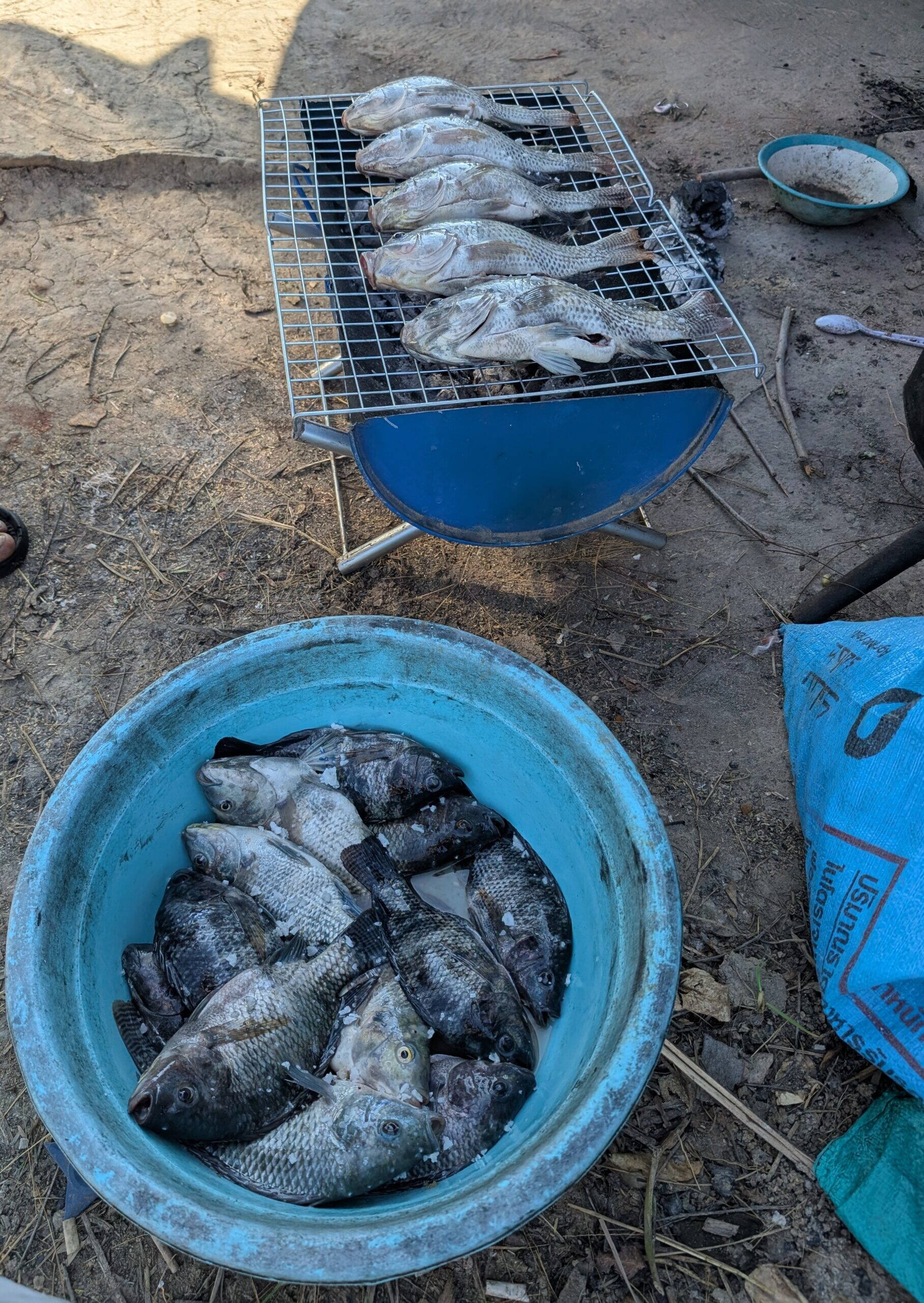
Rural Isaan families farm tilapia (pla nil/ปลานิล) throughout the region, often in ponds on their own land. The fish are mild and white-fleshed. The family cooks them simply — whole on coals, fried in oil, or added to a soup. Freshness does the work entirely.
The last time we were at the family land, we caught tilapia from the pond and had them on the fire within half an hour. In short, you don’t need a recipe when the fish is that fresh.
Furthermore, freshwater fish feature widely in Isaan cooking, both fresh and fermented. Pla ra — the fermented fish that goes into som tam and many other dishes — starts as whole small fish, salt-packed and allowed to ferment over time. It is the defining flavour of the cuisine and worth understanding even if you don’t eat it.
Moo Kata — Thai Barbecue
Moo kata (หมูกะทะ — literally “pork skillet”) deserves its own mention. In particular, it is a fixture of social life in rural Isaan — families set one up at home for gatherings, and most larger villages have dedicated venues that specialise in it.
A dome-shaped cast iron grill sits over a charcoal brazier in the centre of the table. Marinated pork, chicken, and other meats go on the dome to cook, while the heat warms a moat of broth around the base where the liquid slowly cooks vegetables, mushrooms, and glass noodles. Everyone cooks their own food, at their own pace, for as long as they like.
In effect, moo kata is communal eating taken a step further — you’re not just sharing dishes, you’re cooking together. Village venues are usually open-air or semi-open, busy on evenings and weekends, and consistently good value. If you’re in rural Buriram for any length of time, you will likely encounter one. If you don’t, seek one out.
Buriram’s Markets
Buriram’s markets are where Isaan food comes alive day to day. Morning markets (talat chao) open around 6am and wind down by 9. They offer a genuine cross-section of what people actually eat rather than what gets packaged for tourists.
Look for:
- Grilled items — gai yang, moo ping (sweet grilled pork skewers), sticky rice parcels wrapped in banana leaf (khao tom mat)
- Som tam stations — fresh to order, pounded in a clay mortar as you watch
- Sai krok Isaan — hanging in clusters from market stalls
- Fresh produce from local farms and gardens
- Ant eggs (kai mot daeng/ไข่มดแดง) in season — a local delicacy used in omelettes and soups, considered a treat rather than everyday food
Additionally, night markets near the town centre and Chang Circuit area are more accessible for visitors — more variety, easier to navigate, and open when the morning market is long gone.
If You’re a Cautious Eater
However, there are more options than you might expect.
You’ll find grilled meats almost everywhere. Gai yang and moo ping are mild, simple, and available at most morning market stalls — no adventurous palate required.
Furthermore, convenience stores and supermarkets are everywhere. 7-Eleven and CJ More appear on nearly every main street; Lotus’s and Big C carry a full range including imported and familiar food. Smaller unbranded local supermarkets fill in the gaps. Between them, you can find cheese, bread, cereals, pasta, snacks, and most of what you’d need for self-catering.
For a taste of home, Lawson’s on Anuwat Road is a specialist British expat food store — fresh and frozen meats, cheese, dairy, biscuits, sauces, and a solid range of British imports. They also deliver online across Thailand, which is particularly worth knowing for longer stays.
In addition, chain restaurants and fast food cluster around the shopping mall and Buriram Castle area near Chang International Circuit. KFC is well-established in the city, and there’s a McDonald’s near the stadium. Pizza is available from the chains — though venture away from them and the quality drops sharply.
Pubs and restaurants serving Western food also exist in Buriram, particularly near Chang Circuit where expats and race-weekend visitors gather.
The honest summary: you won’t go hungry, and you’ll eat better than you expect.
A Note on Pla Ra
Pla ra is the ingredient that divides visitors to Buriram most sharply. Its smell is strong; its flavour is deeply pungent and savoury. It goes into many authentic Isaan dishes, including the genuine version of som tam.
That said, if you’re sensitive to strong fermented flavours, it’s worth knowing what you’re ordering. In practice, restaurants often tone down Isaan food in Buriram compared to home cooking — the restaurant version is more approachable. The home version, when you eat from a shared mat with the family, is the real thing.
That difference runs in both directions. If you want the genuine article, you’ll find it in rural Buriram more readily than almost anywhere else in Thailand.

Planning a trip to Buriram? Getting to Buriram covers transport options from Bangkok and beyond. Where to Stay in Buriram covers everything from budget guesthouses to the Amari.
For travel insurance, SafetyWing Nomad Insurance covers most travellers’ needs at a competitive daily rate. For longer stays, World Nomads offers more comprehensive adventure cover.
Buriram Live covers the real Buriram — temples, football, motorsport, rural life and practical information for visitors and those with deeper connections to the region. No fluff, no sponsored itineraries. Follow Buriram Live on Facebook for new articles and updates.
This article contains affiliate links. If you make a purchase through a link on this page, we may earn a small commission at no extra cost to you.
Get Buriram updates by email
Occasional emails when there is something worth knowing: new guides, festival and MotoGP dates, and Buriram United news. No spam, and you can unsubscribe at any time.
We will email you a link to confirm. See our privacy policy.