
Buriram is well served with ATMs. Every major Thai bank has branches in the city — at Big C, at Robinson, and along the main streets in the centre — so finding an ATM in Buriram is never a problem. The question is how much it costs you to use one, and that depends almost entirely on which card you use.
This guide covers where to find ATMs in Buriram and exchange counters, what the fees look like, which cards work best, and — for those planning a longer stay — what you need to know about opening a Thai bank account. That last part has changed significantly in the last two years, and not in foreigners’ favour.
ATMs in Buriram: Where to Find Them
All the major Thai banks have branches in Buriram city, each with ATMs that accept foreign Visa and Mastercard. The most convenient clusters are:
Big C Buriram has branches of Bangkok Bank, Krungthai Bank, and SCB on the ground floor, all with ATMs. It’s the easiest one-stop option if you’re already shopping there.
Robinson Lifestyle Center (on the road toward the circuit) has Krungthai Bank and Krungsri branches inside, plus Government Savings Bank (GSB). The Krungsri branch on the second floor is open daily including weekends, 11:00–18:00 — useful if you need cash outside standard banking hours.
City centre has standalone branches of all the major banks: KBank (Kasikorn) on Sunthornthep Road, Bangkok Bank on Bu Lam Duan Road, KTB on Romburi Road, and SCB on Thani Road. In addition, if you’re near the train station, there’s a Bangkok Bank ATM on Na Sathani Rot Fai Road — the road that runs alongside the station.
All the ATMs in Buriram accept foreign cards without issue. However, the fee is the same wherever you go, which brings us to the part that surprises most visitors.
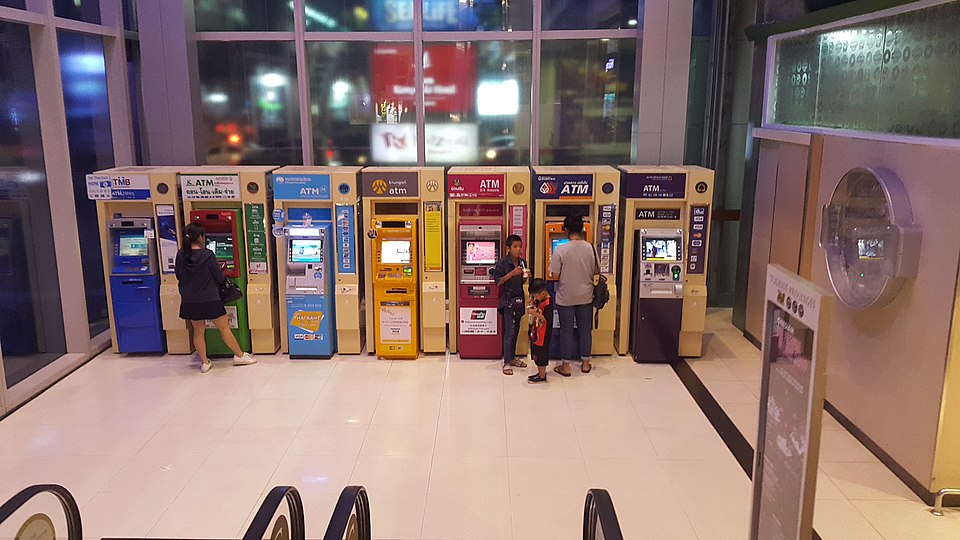

Using ATMs in Buriram: The 220 Baht Fee
Every ATM in Thailand charges foreign cards a flat fee per transaction: currently 220 baht at most banks (Krungsri charges 250 baht). This fee is charged by the Thai bank, not your home bank — so no card can make it disappear. At current exchange rates it’s roughly £5 each time, regardless of how much you withdraw.
The obvious implication: take out larger amounts less often. Withdrawing 10,000 baht costs exactly the same in ATM fees as 2,000 baht. Most ATMs allow up to 20,000–30,000 baht per transaction.
What you can control is whether your home bank adds its own charges on top of that 220 baht. Most do — and that’s where the right card makes a real difference.
The Best Cards for Thailand
The right card means the 220 baht Thai ATM charge is the only thing you pay. The wrong card adds a foreign transaction fee on top — typically 2–3% of the amount withdrawn — plus sometimes its own ATM charge. For a two-week trip, that adds up fast.
The specific recommendations below are for UK visitors. If you’re travelling from elsewhere, the principle is the same: look for a travel debit card in your home market that charges no foreign transaction fee and no ATM withdrawal fee. Wise, which features throughout this guide, operates in over 150 countries — the advice on using it for purchases and transfers applies wherever you’re from.
Cards That Work Well
Starling Bank is the best overall option. There are no foreign transaction fees on purchases, no ATM withdrawal fees from Starling’s side, and no monthly cash limit. You pay the 220 baht Thai ATM charge, nothing more. It uses the Mastercard exchange rate with no markup.
Chase UK is almost identical in practice — genuinely fee-free for purchases and ATM withdrawals, no monthly limit.
First Direct debit card has been fee-free for overseas spending and withdrawals since June 2023. There’s no monthly ATM limit and no markup on the exchange rate.
Cards That Come With Caveats
Halifax Clarity credit card is fee-free on both purchases and cash withdrawals abroad — but with one catch that most reviews gloss over. Cash withdrawals on a credit card have no grace period: interest starts accruing from the day of withdrawal, not at the end of the statement period. As a result, if you use the Clarity at an ATM, you need to log into your Halifax account and clear the balance the same day, or you’ll be charged interest. It’s effectively free if you’re disciplined, but there’s friction that simply doesn’t exist with a debit card. Worth carrying as a backup, however it’s not the most convenient first choice for cash.
Wise card is excellent for card purchases — it uses the mid-market exchange rate with no FX markup, and for spending in shops and restaurants it’s hard to beat. For ATM cash withdrawals, however, it’s a different story. UK-issued Wise cards include only £250 per month in free overseas ATM withdrawals (limits vary by country, but all are similarly restrictive for regular use). At current exchange rates, a single 10,000 baht withdrawal takes you close to the entire monthly UK limit — and you still pay the 220 baht Thai bank fee on top. Once you exceed the limit, Wise adds its own charges. Even for a two-week holiday, that’s inadequate as a cash strategy.
See our digital toolkit for Buriram for Wise and other money tools in one place.
Monzo has the same problem at an even lower threshold: £200 per month free before charges apply.
In summary: carry a fee-free debit card as your primary card for ATM cash, and use whichever card has the best rate for everyday purchases.
Currency Exchange in Buriram
There are no dedicated currency exchange booths in Buriram — no SuperRich, no private money changer. Therefore, if you want to exchange foreign notes to baht, you use the bank counters at the major branches. KBank’s main branch, Bangkok Bank on Bu Lam Duan Road, and SCB on Thani Road all offer foreign currency exchange. Rates will be standard Thai bank rates, not the exchange-specialist rates you’d get at a Bangkok bureau.
In Bangkok, SuperRich (both the green-label Superrich Thailand and orange-label Super Rich Currency Exchange 1965) is the place to go for better rates on major currencies. They have 10+ locations across the city and both have apps showing live rates. If you’re making a substantial exchange — ahead of a land transaction or a long stay — it’s worth doing it in Bangkok rather than at a Buriram bank counter. For everyday holiday amounts, however, the difference won’t be dramatic.
Bring your passport for any currency exchange in Thailand — it’s a legal requirement.
Opening a Thai Bank Account as a Foreigner
For short-stay visitors, a Thai bank account isn’t necessary. The right card handles everything without one. However, if you’re planning to live or retire in Thailand, receive a local salary, or make regular payments — including land purchases, if that’s your direction (see our guide to land ownership in Thailand) — a local account becomes genuinely useful, and harder to get than it used to be.
Why It Got Much Harder
Two changes hit Thai banking in quick succession.
International tax reporting. Thailand adopted the Common Reporting Standard (CRS) in 2023, which means Thai banks now automatically report foreign account holders’ financial data to their home country’s tax authorities. As a result, banks became significantly more selective about opening foreign accounts — and have been contacting existing customers for compliance documentation ever since.
Anti-money laundering crackdown. From late 2024, Thailand tightened its anti-fraud rules substantially, adding stricter monitoring requirements and, in many cases, closing accounts belonging to foreigners whose visa status didn’t meet the new criteria.
Bangkok Bank — once a reliable option for expats — began actively closing accounts held by foreigners without long-term visas in early 2025. The direction of travel across the industry has been the same.
The Visa Requirement
This is where most people fail. Since 2024, Thai banks will not open accounts for tourists or short-stay visitors.
You need a non-immigrant visa:
- Non-OA or Non-O (retirement, marriage, or family)
- Non-B (business or employment)
- Non-ED (education or study)
Tourist visas, visa on arrival, and visa-exempt entry no longer qualify at any major bank. Furthermore, if you’ve been visiting Thailand for years on tourist visas, that history counts for nothing under the new rules.
Which Bank to Try in Buriram
Kasikorn Bank (KBank) is currently the most foreigner-friendly option. It has maintained a consistent approach while others have tightened, and tends to have English-speaking staff at city branches. In Buriram, the main branch is on Sunthornthep Road.
Krungthai Bank (KTB) is the second-best option, and particularly well-represented in Buriram — with branches in the city centre, at Big C, and at Robinson. As a state-owned bank it has the most extensive branch network in Thailand, and it typically requires less documentation than the private banks.
Bangkok Bank should be avoided for new applications. It was once the go-to for expats and still has a visible presence in Buriram (including at Big C). However, it has become the most active in closing foreigner accounts rather than opening them.
SCB is a moderate option but has stricter requirements than KBank or KTB.
What Documents You’ll Need
Apply in person — there’s no online route. Bring:
- Original passport (not a photocopy or phone photo)
- Current non-immigrant visa page
- Certificate of Residence (TM.16) from Thai Immigration — 200 baht, takes about a week. This is the document that smooths the process most reliably. Banks universally accept it; alternatives such as lease agreements or utility bills are accepted inconsistently and at branch discretion.
- Thai phone number
- Initial deposit (500–2,000 baht)
- Work permit if on a Non-B visa
- Yellow house registration book (tabien baan) — bring it if you have one
The Branch Lottery
Even with everything above, success isn’t guaranteed. The same bank gives different answers at different branches — sometimes on the same day. Some branches handle foreign applications routinely; others refuse without any clear policy reason.
You may need to try more than one. In general, mall branches in busier locations tend to be more experienced with international customers. Go in the morning, bring everything, and expect a no before you get a yes.
If Your Existing Account Is Under Threat
If you already have a Thai bank account and receive a request for FATCA/CRS self-certification forms and certified passport copies, respond to it. Ignoring the request risks suspension or closure.
If your account is closed and you can’t reopen one, Wise handles most practical needs: receiving transfers, making card payments, and sending money to or from your home country or Thailand.
Wise: Better for Transfers Than ATMs in Buriram
The Wise card is worth carrying for purchases — the mid-market rate with no FX markup beats most bank cards for spending. For ATM cash it’s limited, as noted above. Where Wise genuinely earns its place, however, is moving money.
If you’re sending funds to Thailand regularly — for land payments, supporting family, or topping up a Thai account — Wise offers significantly better exchange rates than a standard bank wire. The mid-market rate with a small, transparent fee typically beats what banks charge by a meaningful margin. Wise operates in over 150 countries, so this applies wherever you’re based. For context on what regular costs in Buriram actually look like, see our cost of living guide.
The Short Version
- ATMs in Buriram: use a fee-free travel debit card. Withdraw larger amounts to minimise the 220 baht hit. ATMs are at Big C, Robinson, and all the city-centre bank branches.
- Currency exchange: bank counters at the main city branches. No dedicated exchange booths in Buriram — for a large exchange, do it at SuperRich in Bangkok.
- Opening a Thai account: you need a non-immigrant visa. Try KBank or Krungthai. Expect the branch lottery. Get a Certificate of Residence (TM.16) first.
- Sending money to Thailand: Wise — better rates than a bank wire, available in 150+ countries.
- Existing account at risk: respond to CRS/FATCA requests and keep visa documentation current.
Travel insurance for Thailand — World Nomads covers adventure activities and medical emergencies, including the kind of trip disruption that ruins an otherwise well-planned visit. Planning a longer stay? SafetyWing Nomad Insurance is designed for extended travel and remote workers — monthly rolling cover with no commitment to a fixed end date.
Feature image: Chainwit., CC BY-SA 4.0 via Wikimedia Commons
Buriram Live covers the real Buriram — temples, football, motorsport, rural life and practical information for visitors and those with deeper connections to the region. No fluff, no sponsored itineraries. Follow Buriram Live on Facebook for new articles and updates.
This article contains affiliate links. If you make a purchase through a link on this page, we may earn a small commission at no extra cost to you.
Get Buriram updates by email
Occasional emails when there is something worth knowing: new guides, festival and MotoGP dates, and Buriram United news. No spam, and you can unsubscribe at any time.
We will email you a link to confirm. See our privacy policy.