
Six kilometres south of Buriram city, an extinct volcano rises above the rice fields. On a clear morning you can see it from the city centre — a forested hill with a large golden Buddha at its summit, looking north over the urban grid below. Khao Kradong is one of the most significant landmarks in Buriram and yet it appears in almost no English-language travel writing. It costs nothing to visit, takes under two hours, and has more to it than most visitors realise.
A name from the Khmer
The hill’s original name is Phanom Kradong. Both words come from Khmer: phanom means mountain or hill, and kradong refers to a turtle’s shell — a reference to the hill’s distinctive rounded silhouette when seen from the plain below. The same word phanom appears in Phanom Rung, the great Khmer temple built on a dormant volcano 60km to the south. The name is a reminder that Khmer-speaking people inhabited and named this landscape for centuries. Northeast Thailand’s volcanic hills and its Khmer ruins are, in fact, part of the same story.
Khao Kradong Buriram: a genuine volcano
Khao Kradong is not a natural hill that happens to have a dramatic shape. It is a genuine extinct volcano, geologically dated to approximately one million years ago — placing it among the youngest extinct volcanoes in Thailand. Geologists classify it as an alkaline intraplate basalt. Deep continental rifting formed it, the same process that produced a line of similar volcanic features stretching across the Khorat Plateau into Laos.
The crater is still clearly visible. At most volcanic sites, erosion softens the evidence into a gentle depression. Here, however, the crater retains its shape — a proper bowl that typically holds water year-round, with a wooden boardwalk running along its edge and a suspension bridge crossing it. The hill rises to 265 metres above sea level — modest in absolute terms, but elevated enough above the flat plateau to give genuinely long views in every direction.
The Buddha at the summit
The most prominent feature of Khao Kradong is the Phra Suphattharabophit Buddha image — a seated figure more than 20 metres tall on a base 14 metres wide, built from brick and cement, facing north. The statue dates to 1969, built the same year as the naga staircase. Thai sources consistently describe it as the symbol of Buriram city. This is not hyperbole for tourist brochures. For Buriram residents, the Buddha on Khao Kradong carries the significance a great cathedral might in a European city — the most visible sacred landmark, always present on the southern horizon.
Tradition holds that Buddha relics are enshrined within the statue’s head. The terrace surrounding it gives an unobstructed panorama over Buriram city and the agricultural plain stretching out in every direction. In the early morning, when the air is still cool and the light is low, it is a genuinely striking place to stand.


The Khmer ruins and the bell tower
On the summit there are also the remains of a Khmer sanctuary — Prasat Khao Kradong — a stone structure that predates the Buddha image by many centuries. What makes it worth noting is that it sits neither as archaeological rubble nor behind a barrier. Instead, the ruins now form part of an active bell tower, housing a collection of antique bronze bells and a replica of the Buddha’s footprint. Old and new layer together without ceremony, both in active religious use. This is a very Thai arrangement and a more interesting one than the typical “ancient ruins” framing suggests.
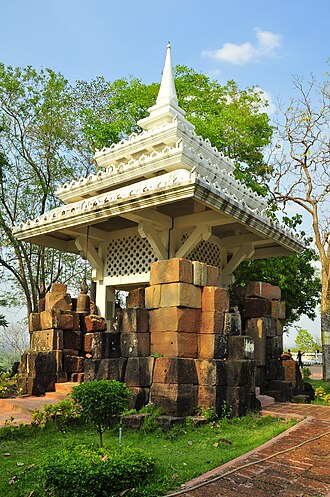

Getting to Khao Kradong
Khao Kradong is on Road 2445, roughly 6km south of Buriram city centre. By motorbike or car the drive takes around 10 minutes. Songthaews run in that direction from the city market, and tuk-tuks from Buriram train station make the trip for a negotiated fare. For visitors arriving by train or bus, a tuk-tuk is the most straightforward option. If you are planning to hire a car and explore several sites in the province, Khao Kradong is an easy addition to any itinerary — see our guide to getting around Buriram for transport options.
The classic way up is the naga staircase — 297 steps flanked by serpent balustrades, built alongside the Buddha in 1969. It is not a difficult climb but it is a proper staircase: allow ten to fifteen minutes and expect to arrive at the top slightly warm. Alternatively, the road up the back of the hill is open to vehicles from 8am to 6pm, and a shuttle operates for those who prefer not to climb on foot. Entry is completely free.
Two festivals
Khao Kradong hosts two distinct annual events, each drawing on a different aspect of the site’s character.
In April, on the full moon of the fifth lunar month, a religious procession climbs the 297 steps carrying a long length of saffron cloth. Worshippers wrap it around the Buddha image — an act of veneration specific to this site. The event draws significant numbers of local people yet remains almost entirely undocumented in English. It happens on Buriram’s own terms, with no particular attention to outside visitors. If the timing works, it is worth going out of your way to attend.
The December festival is the Buriram Volcano Festival, held in the week between Christmas and New Year. It takes a more celebratory approach and leans into the hill’s geological identity. Notably, Khao Kradong is one of the few places in Thailand where the extinct volcano beneath a Buddhist site forms an active part of the occasion, rather than serving as incidental scenery.
Wildlife and forest
The forest covering the hill is deciduous dipterocarp — a woodland type characteristic of the dry interior plateau and increasingly scarce in undisturbed form. The canopy includes Dipterocarpus obtusifolius and Shorea obtusa. The site carries a non-hunting area designation and supports bird populations large enough to attract migratory species during the winter months. Researchers have also recorded the white-bellied flying squirrel here, though as a nocturnal species it rarely appears on daytime visits. For birding, the crater boardwalk in the early morning is the best spot — the forest is quiet and the variety is good for a site this close to a city.
When to visit Khao Kradong
Early morning gives you the best combination of cool air, good light, and quiet. The terrace around the Buddha looks north over Buriram, which means the morning sun catches the city well. Midday in the dry season (November–April) can be hot on the exposed staircase. The road is formally open 8am–6pm but the staircase is accessible before that in practice.
Despite being free and prominently visible from Buriram city, Khao Kradong draws very little mass tourism. Outside the two annual festivals, it is a quiet and unhurried place. Most visitors come to pay respects at the Buddha; organised tour groups are rare. That will likely change as Buriram’s profile grows. For now, however, you can walk the crater boardwalk, stand at the viewpoint and look out over the city without any sense of being managed through an experience.
For everything else you need to plan a visit to Buriram — where to stay, how to get here, and what else to see — see our top places to visit in Buriram and our accommodation guide.
Practical information
| Location | Road 2445, 6km south of Buriram city centre |
| Entry | Free |
| Vehicle access | 8am–6pm |
| Getting there | Songthaew, tuk-tuk, motorbike or car. No direct public bus. |
| Time needed | 1–2 hours |
| Best time to visit | Early morning; November–February for cooler temperatures |
| Facilities | Parking, toilets, shuttle to summit |
Considering travel insurance for your Thailand trip? World Nomads covers adventure activities and medical emergencies across Southeast Asia. For flexible monthly cover suited to longer stays, SafetyWing Nomad Insurance is popular with visitors spending extended time in the region.
This article contains affiliate links. If you make a purchase through a link on this page, we may earn a small commission at no extra cost to you.
Feature image: Yakuzakorat, CC BY-SA 3.0 via Wikimedia Commons
Inline image 1: Yakuzakorat, CC BY-SA 3.0 via Wikimedia Commons
Inline image 2: Warawut Srisopark, CC BY-SA 3.0 via Wikimedia Commons
Buriram Live covers the real Buriram — temples, football, motorsport, rural life and practical information for visitors and those with deeper connections to the region. No fluff, no sponsored itineraries. Follow Buriram Live on Facebook for new articles and updates.
Get Buriram updates by email
Occasional emails when there is something worth knowing: new guides, festival and MotoGP dates, and Buriram United news. No spam, and you can unsubscribe at any time.
We will email you a link to confirm. See our privacy policy.