
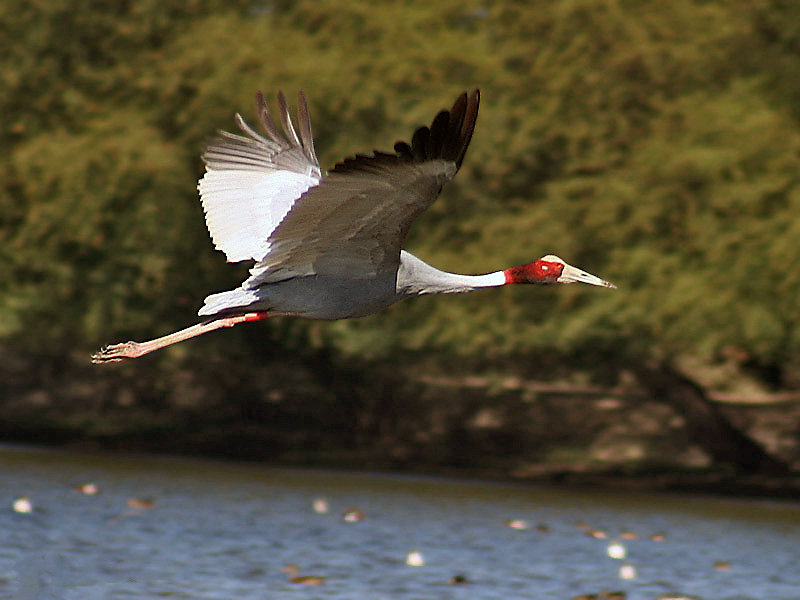
Twenty minutes south of Buriram city, where the rice paddies give way to open wetland and the sky opens wide, something extraordinary happens at dusk. They come in from the fields in pairs and loose groups — huge, smoke-grey birds with bare red heads that catch the last light. Their calls travel half a mile across the water: resonant, carrying trumpets that silence everything else. The Eastern Sarus Crane: the world’s tallest flying bird, and the undisputed star of the most remarkable Sarus Crane Thailand conservation story of the twenty-first century.
Until recently, the Sarus Crane had been entirely absent from Thailand for more than four decades. The last confirmed wild birds disappeared in the late 1960s — hunted, poisoned by agricultural chemicals, and ultimately dispossessed of the lowland wetlands they depended on. A generation of Thai people grew up never seeing them. A second generation did the same.
Then, in 2011, twelve captive-bred birds were released at a reservoir in Buriram Province, and the impossible began to happen.
This guide covers everything you need to visit Huai Chorakhe Mak and see wild Sarus Cranes — and tells the full story of how they came back.
The Bird Itself
Before the conservation story, a moment with the animal.
The Eastern Sarus Crane (Antigone antigone sharpii) belongs to a species found across India, Southeast Asia, and Australia. In the Southeast Asian subspecies found in Thailand, adult birds stand up to 1.8 metres tall. That is not a misprint. These birds look you in the eye. They are simultaneously prehistoric and improbably elegant. Pale grey body, long grey legs, a bare red head and upper neck that flushes deeper in breeding condition — and a long grey-green bill designed for probing shallow water and rice paddy mud.
The wingspan exceeds two metres. When a Sarus Crane spreads its wings and calls — a deep, resonant horn-blast produced by a windpipe that coils through the breastbone — the effect is primal. Indeed, it is among the most impressive sights in the natural world.
Mates for life
They are also famously devoted to their mates. Pairs are widely believed to bond for life. The unison calls of an established pair rank among the most spectacular avian performances in the world — both birds calling in precise alternation, timed to the split second. The nests they build together are equally remarkable — circular platforms of reeds and vegetation up to two metres in diameter and nearly a metre high. They construct them in the middle of flooded rice paddies during the monsoon season.
Moreover, in India, where the main global population lives, the Sarus Crane carries profound cultural weight. Legend holds that the Ramayana was composed after its author witnessed the killing of a crane and was moved to write. The crane was a close contender for India’s national bird. In Thailand, that familiarity had been lost for a generation — until now.
How Sarus Cranes Returned to Thailand
The reintroduction story begins in 1983. An international crane workshop in India — jointly hosted by the government and the International Crane Foundation — first put Thai reintroduction on the table. Eastern Sarus Cranes had been rediscovered in Cambodia and Vietnam by 1986, confirming that genetically appropriate source birds existed close enough to matter.
The foundation was captive breeding. Birds confiscated from animal traders went to breeding facilities across Thailand. Nakhon Ratchasima Zoo — Korat Zoo — became the primary breeding centre. The programme took time: the first chick hatched at Korat in 1997. Over the following decade, under the care of keeper Thanat Utrawiset (who has hand-raised crane chicks since 2010), the captive population grew steadily.
The partnership behind the programme is substantial. The Zoological Parks Organization provides breeding expertise. Mahidol University handles research. The Bird Conservation Society of Thailand (BCST), the Thai partner of BirdLife International, coordinates field monitoring. True Corporation has funded digital infrastructure at the learning centre and developed the Doo Nok birding app. Since 2016, the Global Environment Facility (GEF), UNDP, and IUCN have supported conservation of the crane’s habitat under a dedicated wildlife coexistence programme.
The First Sarus Crane Releases in Thailand
The first organised release came in March 2011: twelve captive-bred birds at Huai Chorakhe Mak Reservoir in Buriram Province. The survival rate was approximately 70% — considered strong for any reintroduction programme involving large, slow-reproducing birds. More releases followed, spread across three wetland complexes in Buriram Province: Huai Chorakhe Mak, Huai Talad, and Sanam Bin reservoirs.
Crucially, the programme understood from the start that cranes cannot survive without farmers. Sarus Cranes do not nest in remote wilderness — they nest in rice paddies, the same fields where families earn their living. A nest in a working field means the farmer must delay ploughing until the chicks fledge. To make this viable, participating farmers receive compensation for protecting nests and commit to chemical-free cultivation. They sell their harvest under the “Sarus rice” brand — a premium organic product whose commercial value ties directly to conservation. By the time of the 2024 release event, 148 farming households were managing 2,701 rai of crane-friendly paddies, with rice sales exceeding one million baht.
A world first — and what came next
Ultimately, the milestone that confirmed everything came in 2016. A wild-born chick — later named “Rice” — hatched at Huai Chorakhe Mak. The first wild-born Sarus Crane in Thailand since the 1960s. Three juveniles fledged that year. Nine the following year. Since 2016, wild-born cranes have hatched annually in Buriram.
The story of the crane’s return was covered by 10,000 Birds when Rice hatched in 2016 — one of the first English-language reports on this remarkable conservation milestone.
By February 2024, the wild population had exceeded 168 birds — nearly 50 of them wild-born. The twelfth official release event that month added ten more. The International Crane Foundation has described the Thailand programme as potentially “the first self-sustaining crane population created by releases of captive-reared birds.” That is a world-first in conservation history. It happened in Buriram Province.
Meanwhile, the story continues to spread. In April 2025, Thailand transferred six crane chicks to Dong Thap Province in Vietnam, beginning a parallel reintroduction programme in the Mekong Delta. The knowledge built at Huai Chorakhe Mak is now being applied across the region.

Huai Chorakhe Mak: The Site
The name means “crocodile reservoir” in Thai — a reference to the shape of the water body, not any reptilian residents. Huai Chorakhe Mak is a large, shallow reservoir in the open lowlands south of Buriram city, bordered by rice paddies, scrub, and small villages. The landscape is flat and wide — classic Isaan countryside. Moreover, the sky feels very large here, and the silence on a still morning is almost complete.
The Wetland and Eastern Sarus Crane Learning Centre sits on a 25-rai plot on the bank of the reservoir. It opened in 2019, ten years after the first release, as a permanent visitor facility marking the programme’s proven success.
Entry is free. Opening hours are 8am to 6pm daily.
Facilities and what to bring
The centrepiece is a four-storey observation tower overlooking the wetland — the best vantage point for scanning the water and surrounding paddies for cranes and other waterbirds. Inside, conservation exhibitions cover the reintroduction story — some panels are in English. Additionally, a gift shop sells Sarus rice and local produce. Loan binoculars are available for visitors without their own.
Traditional flat-bottomed boats — locally called e-pong — drift slowly across the reservoir, through lotus beds and aquatic vegetation. Hire one to watch waterbirds at close quarters from the water surface. Go at sunrise or sunset: the light is low and golden, crane activity is highest, and the reservoir feels completely different from the shore. To book in advance: call 094-284-8087.
Lotus season (July–October): during the rainy season, when the cranes are nesting in the surrounding paddies, the reservoir transforms into something else entirely. Sacred pink lotus flowers cover the water surface as far as you can see — a completely different spectacle from the winter crane counts. The Learning Centre runs dedicated lotus boat tours during this period: 200 baht per boat (seats 2), around 30–40 minutes. A lotus bouquet is provided as a photo prop. Best times for the lotus tours: 06:00–10:00 and 15:00–18:00. To book lotus tours in advance: 065-3170279 or 081-7605339.
The Doo Nok (“bird watch”) smartphone app was developed specifically for this site. It contains identification information and photographs for over 500 bird species recorded around the reservoir — a field guide worth downloading before you visit.
Ban Suay So: the farming community behind the cranes
The crane coexistence programme depends on farmers choosing to protect nests in their working rice paddies rather than plough them over. Ban Suay So — a village in Sakae Prong subdistrict, Mueang Buriram — is the model community at the heart of this arrangement, and now offers a full-day visitor experience promoted by TAT Buriram.
The Ban Suay So Organic Rice Community Enterprise operates a structured one-day programme that takes visitors from welcome to wetland:
- 08:30 — Arrival, traditional phakhaoma welcome cloth, cold herbal drink
- 09:30 — Craft workshop: embroider the community’s signature crane-pattern bag
- 10:45 — Make a crane figure from silk cocoon; learn how agriculture, environment and cultural identity connect
- 12:00 — Chef’s table lunch in the rice fields: organic Crane Jasmine Rice and seasonal local dishes
- 13:30 — Learn the “grow rice to save cranes” philosophy; organic certification standards
- 14:30 — Guided ecosystem walk; the crane reintroduction story told from the paddies where it happened
- 15:30 — Boat trip to see cranes in their natural habitat
- 16:30 — Community market: take home Crane Jasmine Rice and local products
Price from 850 baht per person. Contact Thongpoon on 062-3344365 or Pattana on 085-4943250.
In short, for those who want to understand the human side of the conservation story — not just see the birds — a day at Ban Suay So is the right choice.
What You’ll See
The Sarus Cranes are the main event — but they are not guaranteed on every visit, and honesty here matters.
The cranes range freely across the wetlands and surrounding rice paddies. Their location on any given day depends on the season, the water level in the paddies, and an element of chance. A WINGS Birding Tours group visiting in February 2026 recorded 31 cranes near dusk on arrival. The following morning they counted 21 on the south side of the reservoir — exceptional numbers by any standard. For a dedicated birdwatcher who times their visit well, counts in that range are realistic. For a casual half-day visitor, a smaller group at greater distance is more typical.
The best strategy is simple: go early morning (6am–9am) or late afternoon (3pm–6pm). These are the windows when cranes are actively feeding and moving. Midday is the least productive period — the birds rest in the heat. By contrast, dusk is the most atmospheric: birds return to preferred roost areas, calling as they come in, and the light on the reservoir can be extraordinary.
Maintain a minimum of 200 metres from any cranes you find. This is standard etiquette for protected species and keeps the birds relaxed and behaving naturally. Getting closer will cause them to move away, and risks disrupting any nearby nesting activity.
Check car hire availability for Buriram
A car is essential for the site — no public transport runs to Huai Chorakhe Mak from Buriram city. Hiring a car also opens up the full circuit of Buriram Province, from the crane site to Phanom Rung and Khao Kradong, making the most of your time in the region.
Other waterbirds at the reservoir
Beyond the cranes, the reservoir supports a varied wetland bird assemblage. Expect Cotton Pygmy-Goose, Garganey, Indian Spot-billed Duck, Purple Swamphen (นกอีโก้ง), multiple bittern species, shorebirds (especially during migration in October–November and February–March), and the occasional Watercock and crake. The Purple Swamphen — a large, vivid blue-violet bird with a red bill and shield, particularly at home in the lotus beds — has become one of the wetland’s most photographed residents. The site list runs to over 170 species in total.
Best Time to Visit
July to September (wet season): breeding season. The cranes are paired and territorial, defending nest sites in the surrounding paddies. This is the best chance of seeing chicks alongside adults. The landscape is green and full, waterbird diversity is at its highest, and the cranes are most active close to the water. Afternoon rain is normal but usually brief. The reservoir’s sacred lotus flowers are also at their most spectacular during this period — pink blooms covering the water surface, with dedicated lotus boat tours available from the Learning Centre (see above).
November to April (cool and dry season): crane numbers at the site tend to be higher, with non-breeding birds and any winter visitors supplementing the resident population. The weather is more comfortable for a full day of birding. December to February is the most pleasant time to be in Buriram, with cool mornings and blue skies. This is also peak season for migratory waterbirds, which add variety to the site. The WINGS Birding Tours group visits in February and reports reliable crane sightings; this window is the most established for international birdwatchers.
May to June (hot season): possible but harder going. Extreme heat, dropping water levels, and less active birds in the middle of the day. Early mornings are still productive, but the experience is more demanding.
November to March is the sweet spot for combining the crane site with Buriram’s wider highlights: comfortable weather, reliable cranes, and the possibility of Phanom Rung‘s solar alignment at the spring equinox. It is the natural window for a combined trip.
Get a travel insurance quote for Thailand — covering medical expenses and trip disruption wherever your birding takes you.

Getting There
There is no public transport to Huai Chorakhe Mak. A private vehicle is essential.
The reservoir is approximately 20 minutes south of Buriram city centre — a genuinely short drive to a site of global conservation significance. From Buriram, take Route 219 south toward Prakhon Chai. Then follow signs to the Wetland and Eastern Sarus Crane Learning Centre.
GPS coordinates: 14.9030418°N, 103.0168904°E
Compare car hire rates for Buriram
If you are travelling to Buriram from Bangkok, the overnight train is comfortable and arrives in time for an early morning at the site. Bangkok–Buriram trains depart from Krung Thep Aphiwat Central Terminal (Bang Sue Grand Station) — accessible by MRT Blue Line. Journey time is around five to six hours. Search trains and buses from Bangkok to Buriram
AirAsia flies to Buriram Airport from both Don Mueang and Suvarnabhumi. Check AirAsia flights to Buriram
For full transport options see the Getting to Buriram guide.
Where to Stay
Buriram city is the natural base. It sits 20 minutes from Huai Chorakhe Mak, has good transport links, and is within reach of all the province’s highlights.
Check hotel availability in Buriram
Modena by Fraser is the best all-round option for most visitors — spacious rooms from 28 to 67 square metres, a pool, 24-hour gym, steam room, and kitchenette. The kitchenette is useful if you want to eat early before a 6am crane start. It is well-reviewed, well-priced, and centrally located near the stadium complex.
Alternatively, the Amari Buriram United is the older football-themed option — owned by the same group as the club, with a pool, sports bar atmosphere, and a loyal following among Buriram United fans. Check availability at Amari Buriram United
For a full overview of Buriram’s accommodation options see the Where to Stay in Buriram guide.
There are no guesthouses near Huai Chorakhe Mak itself. Given the 20-minute drive, staying in Buriram and visiting morning and evening is entirely practical.
The Other Crane Sites in Buriram Province
Huai Chorakhe Mak is the most developed of the three wetland complexes targeted by the reintroduction programme. Nevertheless, the other two are genuine crane sites in their own right.
Huai Talat Reservoir lies approximately 10km south of Buriram city — closer to town than Huai Chorakhe Mak. Additionally, it doubles as Buriram’s official Bird Park, locally known as Suan Nok. Over 200 wild bird species have been recorded at the reservoir, with the November–April dry season bringing the highest diversity. An adjacent private aviary houses an extensive collection of captive birds. The combination of wild reservoir and managed aviary makes this a busier, more visitor-facing site. It works well as a secondary session or a natural dusk stop; food vendors are on site in the evenings. GPS: 14.888635°N, 103.079328°E.
Sanam Bin Reservoir lies around 40km south of Buriram city in Prakhon Chai district — further from the city than Huai Chorakhe Mak, along the same Route 219 corridor. The site is designated a No Hunting Area and managed by the Sanam Bin Wildlife Conservation Office. Cranes are present but there is no formal visitor infrastructure. GPS: 14.639614°N, 103.069381°E.
A Birdwatcher’s Isaan: Beyond the Cranes
The Sarus Crane is why most international birdwatchers come to Buriram — but northeast Thailand offers far more to a visiting birder than one iconic species. The Isaan region sits within one of mainland Southeast Asia’s most productive avian corridors, and the sites within a day’s drive of Buriram rank among the continent’s best.
Khao Kradong Forest Park (6km from Buriram city)
The nearest birding site to Buriram city is not a wetland but a forest. A compact patch of tropical vegetation on an extinct volcanic plug rises 265 metres above the surrounding rice plains. Khao Kradong is an IUCN Category V protected landscape. It cannot compete with Phu Khieo for forest specialist species, but it offers something the wetland sites do not: a completely different habitat within easy reach.
The forest on and around the crater holds bulbuls, flycatchers, barbets, and woodland birds absent from the open paddies and reservoirs. In addition, a reservoir at the foot of the hill adds waterbirds. The summit — reached by 297 steps or a short drive — is the best elevated vantage point near Buriram city, and a useful spot to scan for raptors riding the thermals above the plain. An hour here in early morning between wetland sessions is well spent, and the Khao Kradong guide covers the practical details.
Phu Khieo Wildlife Sanctuary (Chaiyaphum, ~2 hours west)
Among serious birdwatchers, Phu Khieo is spoken of in reverent terms. The sanctuary covers 1,560 square kilometres of primary mixed deciduous and semi-evergreen forest. In fact, that is more continuous primary forest than most accessible sites anywhere in Southeast Asia. Over 419 bird species appear on the reserve list.
The signature target is the White-winged Duck: globally endangered and rarely reliable anywhere. The lake at Phu Khieo is one of the few places in Thailand where you can look for one with a realistic chance of success — reach it via a 5km ranger-accompanied hike. Beyond the duck, Austen’s Brown Hornbill, Coral-billed Ground Cuckoo, Siamese Fireback, Sultan Tit, and Blue Pitta make 100-species days straightforward for competent birders.
The reserve also supports over 120 wild elephants, as well as tiger and clouded leopard. Remarkably, this is the kind of mammal list that has largely disappeared elsewhere in Southeast Asia. Entry is 200 baht for foreign visitors; no entry after 4pm; a rental car is essential. Mobile reception cuts out inside the reserve.
Best months: November to May (dry season). Phu Khieo is accessible from Buriram in about two hours. Consequently, it is best treated as an overnight extension rather than a day trip.
Nam Nao National Park (Phetchabun/Chaiyaphum border, ~2.5 hours north-west)
Adjoining Phu Khieo to the north, Nam Nao covers 966 square kilometres of mountainous forest with over 300 bird species recorded. Furthermore, the park is more accessible than Phu Khieo and better equipped for independent visitors. Silver Pheasant is the signature target — typically encountered along forest roads and trails in the early morning. Eared Pitta, Great Slaty Woodpecker, Red-headed Trogon, and a rich barbet and woodpecker community make 100-species days genuinely achievable. Nam Nao and Phu Khieo are best combined into a two-to-three-day extension to a Buriram base.
Khao Yai National Park (~150km west)
For visitors arriving or departing via Bangkok, Khao Yai sits roughly 150 kilometres west of Buriram. A UNESCO World Heritage Site and Important Bird Area with over 280 recorded species, it is Thailand’s most accessible major park for international visitors. All four of Thailand’s hornbill species occur here — Great, Wreathed, Oriental Pied, and Austen’s Brown — alongside Siamese Fireback, Blue-winged Pitta, and Coral-billed Ground Cuckoo. The park is significantly busier than the Isaan sites, but the forest quality is exceptional.
Combining With Other Buriram Highlights
The Sarus Crane site is 20 minutes from Buriram city. Buriram rewards a full week — the crane visits slot easily alongside other highlights, whether your travelling companion shares your enthusiasm for waterbirds or not.
A suggested five-day itinerary
Day 1 — Arrive Buriram. Late afternoon and dusk at Huai Chorakhe Mak (prime viewing time). Overnight Buriram city.
Day 2 — Early morning at Huai Chorakhe Mak (6–9am, best birding of the trip). Mid-morning: Khao Kradong Forest Park — the compact crater forest offers woodland species absent from the wetlands and the summit is a good raptor watch point. Late afternoon: Huai Talat Reservoir (Buriram Bird Park, 10km from town) — 200+ species recorded, Sarus Cranes present, food vendors on site for a relaxed dusk watch. The Khao Kradong guide has full practical details.
Day 3 — Drive south to Phanom Rung (50km). Thailand’s finest Khmer temple outside Angkor, built on top of a volcano, with a dramatic solar alignment at the spring equinox. Then 8km further to Prasat Mueang Tam — the most atmospheric of Buriram’s smaller Khmer ruins, almost always empty, surrounded by four ancient lotus ponds. Phanom Rung guide and Mueang Tam guide.
Day 4 — Phu Khieo Wildlife Sanctuary extension (2 hours west). Overnight near Phu Khieo or return to Buriram.
Day 5 — Buriram United home match if the fixture allows. Chang Arena is one of the finest football stadiums in Southeast Asia, and the atmosphere on a match day is something else entirely. Buriram United guide.
Everything here is covered in more detail in Places to Visit in Buriram: The Top 10.
Conservation Organisations Worth Knowing
The Sarus Crane recovery in Thailand is the product of sustained collaboration. If you want to understand the work more deeply, support it, or connect with the wider birdwatching community planning a visit:
Bird Conservation Society of Thailand (BCST) — bcst.or.th — the Thai partner of BirdLife International, and the organisation that coordinates field monitoring of the crane population. Additionally, their nest adoption programme allows supporters to fund the protection of a specific crane nest for a season — directly compensating the farmer who delays ploughing their field.
International Crane Foundation (ICF) — savingcranes.org — the global authority on crane conservation and the organisation that provided the original technical foundation for the Thai programme. Their “Travels with George” article series documents the work from the inside.
EAAF Partnership (EAAFP) — eaaflyway.net — the East Asian–Australasian Flyway Partnership, which coordinates conservation across the migratory route running from Siberia to Australia. Sarus Cranes in Isaan sit within this broader flyway system. Furthermore, EAAFP’s “Year of the Cranes” series is among the most accessible accounts of what crane conservation looks like on the ground.
Tour operators and guided visits
WINGS Birding Tours — wingsbirds.com — run an expert-led Thailand tour (February, limited to eight participants) that includes a two-day focus on Huai Chorakhe Mak. Their 2026 trip counted 31 cranes. For those who want professional guidance and maximum species efficiency, this is the most established overseas tour operator currently running dedicated Sarus Crane tours.
Thailand Bird Wildlife Tours — thailandbirdwildlifetours.com — offer a two-day, one-night Sarus Crane photography tour in Buriram, including visits to the local farmers who are protecting crane nests in their rice fields. The only specialist local operator currently offering a dedicated crane itinerary.
Further reading: We were proud to contribute a birding destination profile for Buriram to 10,000 Birds — one of the world’s leading ornithology publications — covering key species, best seasons and a suggested five-day birding circuit of the province.
Get a Nomad Insurance quote — SafetyWing covers Thailand for longer stays and extended travel in the region.
Feature image: KongkhamWichit, CC BY-SA 4.0 via Wikimedia Commons
Mid-article image: J.M.Garg, CC BY-SA 3.0 via Wikimedia Commons

Buriram Live covers the real Buriram — temples, football, motorsport, rural life and practical information for visitors and those with deeper connections to the region. No fluff, no sponsored itineraries. Follow Buriram Live on Facebook for new articles and updates.
This article contains affiliate links. If you make a purchase through a link on this page, we may earn a small commission at no extra cost to you.
Get Buriram updates by email
Occasional emails when there is something worth knowing: new guides, festival and MotoGP dates, and Buriram United news. No spam, and you can unsubscribe at any time.
We will email you a link to confirm. See our privacy policy.