
Eight kilometres from Phanom Rung, there’s a Khmer temple complex — Prasat Mueang Tam — that most visitors to Buriram never find.
No tour bus queues. No selfie sticks at the entrance gate. Just ancient stone, lotus-filled ponds and a silence that feels earned. Prasat Mueang Tam is one of the finest Khmer temple complexes in Thailand — and one of the least visited. That’s either a planning failure on the part of most tourists, or your good fortune. Probably both.
What Does “Mueang Tam” Mean?
The name tells the story. เมืองต่ำ (mueang tam) translates as “lower city” — a name given by settlers who returned to the area in the early twentieth century. It’s a direct reference to nearby Phanom Rung, the great Khmer temple visible from here, which sits on top of an extinct volcano. Phanom Rung is the upper temple, the celestial one — Shiva’s mountain sanctuary, built toward the sky. Mueang Tam temple is the earthly counterpart, down on the plain, connected to water, agriculture, and the living community below.
You’ll read in some travel guides that Mueang Tam is the “feminine” temple and Phanom Rung the “masculine” one. That’s a traveller’s poetic reading rather than a documented historical claim, but it captures something real about how the two places feel to visit. One is dramatic, elevated and theatrical. The other is intimate, water-bound and still.
Mueang Tam Temple: History and Origins
Prasat Mueang Tam was built in the late 10th to early 11th century CE — roughly a thousand years ago. The stonework carries features of two distinct architectural styles: Khleang (earlier, more austere) in the central sanctuary, and Baphuon (later, more ornate) in the surrounding galleries. This mixing of styles tells archaeologists the complex was built and extended over several decades, rather than completed in a single campaign.
Who commissioned it? The honest answer is that nobody knows. No inscription at the site names a royal patron — an unusual gap for a complex of this scale and quality. Scholars suggest it was built during the reigns of Jayavarman V or Suryavarman I, Khmer kings who consolidated control of the Mun Valley from Angkor during this period. However, this is reasoned inference, not recorded history.
What is clear is the religious purpose. Archaeologists found a Shiva linga on a yoni base in the central sanctuary — confirming this as a Shaivite Hindu temple. Yet the carved lintels throughout the complex depict Vishnu and Krishna scenes alongside Shiva iconography, suggesting a syncretic practice that went beyond the purely royal or ceremonial.
Mueang Tam temple was also part of a network of Khmer religious sites strung along the ancient royal road from Angkor to Phimai — the great trunk route of the empire through Northeast Thailand. The temple probably served pilgrims travelling between Angkor and Phimai, as well as the local agricultural population who depended on its water management systems.
Restoration and Recognition
When Khmer influence receded in the 13th century, the Khmer abandoned Mueang Tam temple, and jungle gradually consumed it. The site sat undisturbed for roughly seven hundred years before the Thai Fine Arts Department undertook its restoration. Specialists used anastylosis — every stone dismantled, numbered and rebuilt in its original position, the same technique used at Phanom Rung. HRH Princess Maha Chakri Sirindhorn officially inaugurated the restored temple in November 1997 as part of King Bhumibol’s Golden Jubilee celebrations.
Additionally, in 2019, UNESCO added the ensemble of Phanom Rung, Mueang Tam and the smaller nearby Prasat Plai Bat to its Tentative List for World Heritage inscription. Full inscription would put Mueang Tam temple on the international map in a way it has never been before.
The Four L-Shaped Ponds
This is Mueang Tam’s defining feature — and the reason it photographs so well.
Four L-shaped ponds fill the corners of the outer enclosure, one in each corner. Together they turn the central temple into an island, surrounded on all sides by water. This represents the classic Hindu cosmological image of Mount Meru rising from the cosmic ocean — the five central towers are the sacred mountain, the ponds are the primordial sea from which it emerges.
Notably, Mueang Tam temple is believed to be the only Khmer complex anywhere with this precise four-L-shaped-pond configuration. You find rectangular reservoirs at Angkor and elsewhere across the empire; only here do the ponds take this distinctive interlocking shape, framing the towers from every angle.
Laterite steps descend to the water on each side, and five-headed naga (serpent) balustrades carved in sandstone edge each pond. The great serpent’s body runs along the bank, with its five hooded heads rearing up dramatically at each corner. Water lilies and lotus flowers bloom in the pools seasonally, particularly in the months following the rainy season.
The reflections are extraordinary. At almost any time of day — but especially in the late afternoon light — the ponds mirror the brick towers, the carved stone doorways and the rearing naga heads in perfect symmetry. Indeed, it is one of the best photo compositions in all of Isan, and on most visits there will be almost no one standing in the way.
The Five Towers
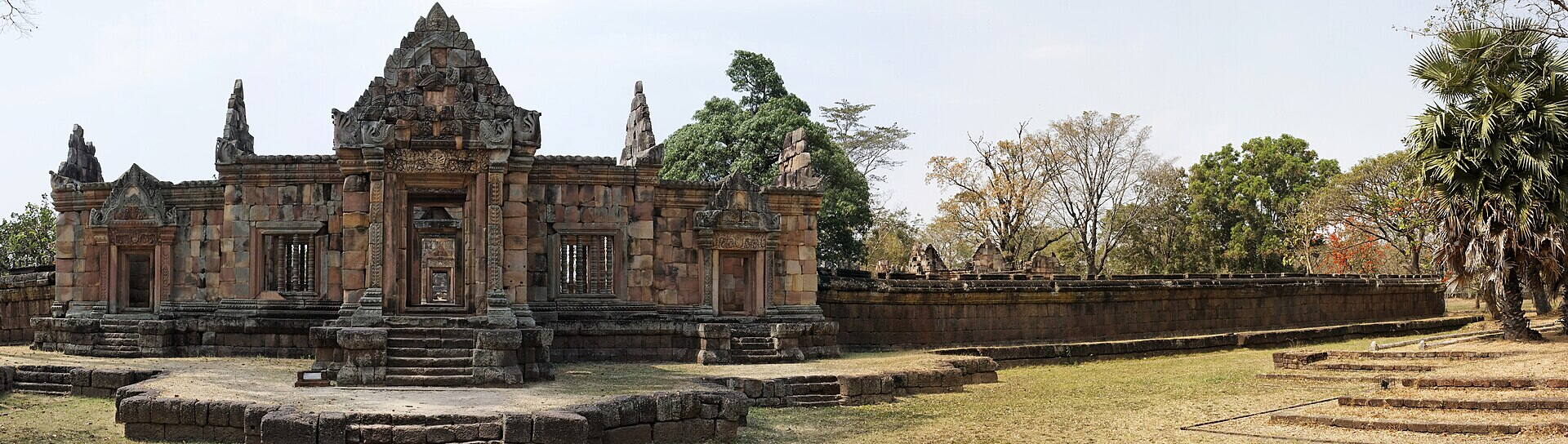
The heart of the complex is a quincunx of five brick prangs — towers arranged like the five dots on a die — set on a shared raised laterite platform. Three stand in a row on the eastern (front) side; two stand further back on the western side.
Khmer builders used sandstone for the doorframes, lintels, pediments and decorative stonework, while brick forms the tower bodies themselves. Originally the brick would have been finished in moulded lime plaster, giving the towers a smooth surface covered with fine Khmer ornamental detail. Remnants of that original stucco survive on some sections.
The central (main) prang has collapsed and survives only as its lower platform — inside which archaeologists found the Shiva linga and yoni base. The four surrounding towers still stand, though their upper portions and finials are largely lost. This is part of what gives Mueang Tam its particular character: it is a working ruin, not a fully reconstructed monument. The walls, gates, galleries and ponds are intact; above the lower tower bodies, however, there is open sky. The effect is serene rather than incomplete.
Two library buildings stand in front of the main tower group, one on each side of the central axis. These brick structures with sandstone lintels would have housed sacred texts and ritual objects. Furthermore, the inner and outer enclosures each have four gopuras (entrance pavilions), one on each side, with the east-facing main gopura the grandest.
The Carved Stone
The lintels are where Mueang Tam temple rewards a slow look.
On the north front prang, Shiva and his consort Uma ride together on Nandi the bull — an Uma Maheshvara composition, one of the defining images of Khleang-period Khmer carving. On the rear prangs you’ll find:
- Krishna dancing on the serpent Kaliya — the god subduing the great naga, his feet on its heads
- Krishna lifting Mount Govardhan on one finger to shelter cattle and villagers from Indra’s flood — a favourite Vaishnava scene, carved with evident care
- Varuna seated on his sacred swan — the ancient Vedic god of waters, here at a temple surrounded by water (an intentional pairing)
- Indra riding his three-headed elephant Airavata
The Kala face — the devouring time-demon whose open mouth appears above doorways across all Khmer architecture — repeats at every entrance. Scholars use the precise carving style of each site’s Kala to date construction phases.
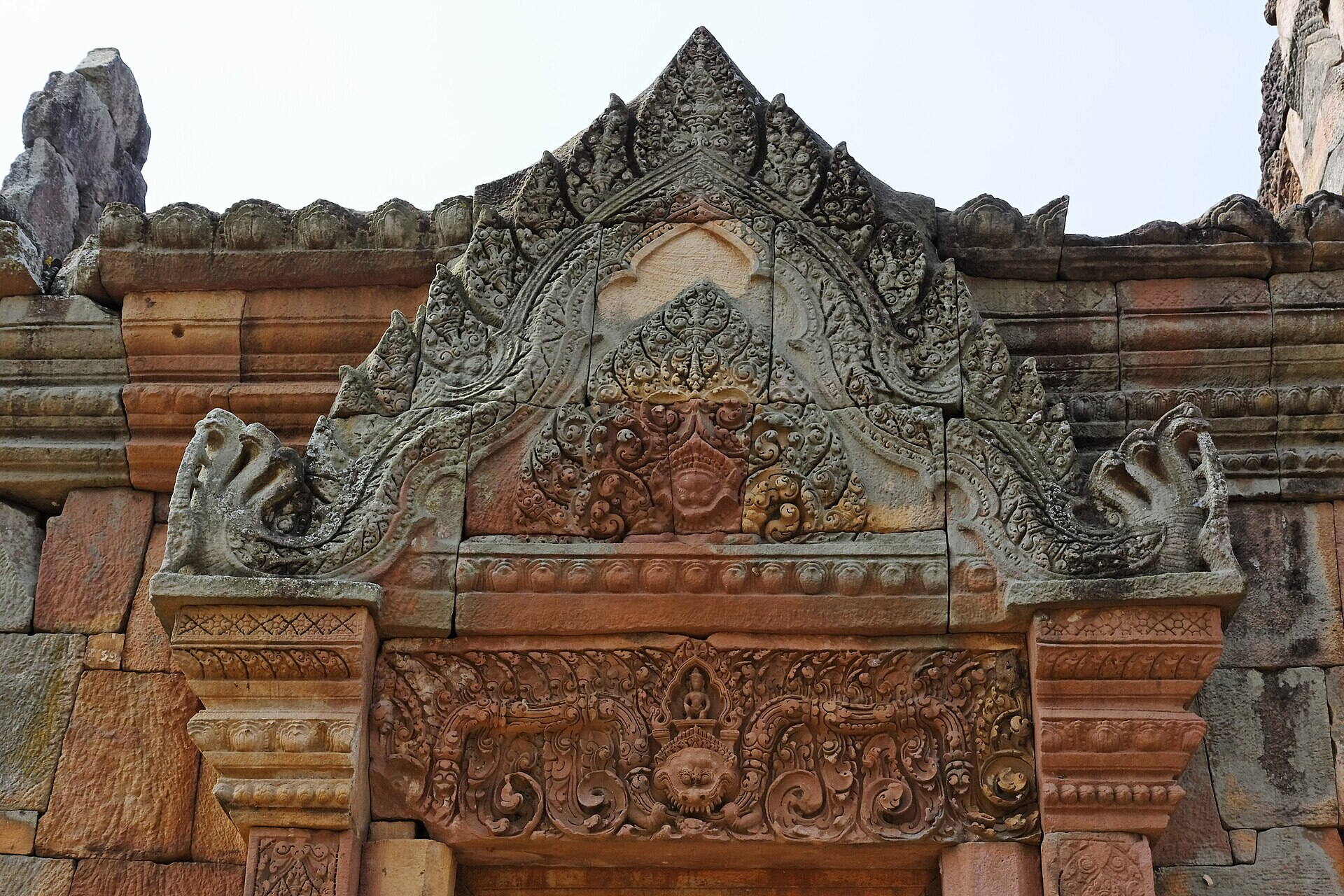
The mix of Shaivite and Vaishnavite iconography on what is formally a Shiva temple is one of the most interesting things about Mueang Tam. It suggests a religious life more fluid and inclusive than the neat categories of temple scholarship sometimes imply — or simply that different patrons added their own devotional preferences over the decades of construction.
In particular, the quality of this stonework is worth pausing over. Mueang Tam temple receives a fraction of Phanom Rung’s visitor numbers; the carving is comparable in ambition and execution.
The Great Reservoir
To the north of the temple complex lies the Thale Mueang Tam — “the sea of Mueang Tam” — a vast rectangular reservoir measuring roughly 1,090 metres by 510 metres, once three metres deep. Built in the same era as the temple, it supplied water for ritual use and sustained what was evidently a substantial settled community. Much of it has silted over the centuries, but it remains an impressive presence in the landscape north of the site.
Visiting Mueang Tam Temple: What to Expect
Mueang Tam temple is quiet. Not “quieter than Phanom Rung” quiet — genuinely, often entirely deserted, just you and the stonework quiet. On many visits, particularly midweek or outside Thai public holidays, you might share the complex with a handful of people at most.
Allow 90 minutes to two hours to explore it properly — longer if you’re photographing seriously or reading the lintels carefully.
The best light for photography is late afternoon, in the last two hours before the 6 pm closing. The sun drops toward the treeline, the light turns golden, and the towers cast long shadows across the ponds. Early morning, just after opening, works equally well. Harsh midday overhead light is the one time to avoid.
The November to February cool season is the most comfortable time to visit — good light, manageable temperatures, pleasant walking conditions. Additionally, the ponds are most reliably full in October and November, immediately after the rainy season.
There are food and souvenir stalls near the car park, free parking and toilets. There is no café or museum on site. The nearest substantial visitor facilities are at Phanom Rung, 8 km away.
Mueang Tam and Phanom Rung: The Perfect Pairing
These two temples are 8 kilometres apart and are best visited together in a single day. They offer completely different experiences that complement each other — and the combined ticket for both costs just 150 THB for foreign visitors.
Phanom Rung is the grand statement: a full pyramidal temple climbing a volcanic hill, built over four centuries, with a 200-metre processional causeway, dramatic elevated sanctuary, and a famous astronomical alignment at sunrise and sunset around the April and September equinoxes. Allow 2–3 hours.
Mueang Tam temple, by contrast, is the counterpoint: flat, intimate, water-bound. Its atmosphere is contemplative rather than theatrical. After Phanom Rung’s scale and drama, Mueang Tam feels like discovering someone’s secret.
A natural day plan: arrive at Phanom Rung at or just after opening, spend the morning there, then drive the 8 km to Mueang Tam after lunch. Spend the afternoon in the cooler later hours with the best light, and you’ll be back in Buriram city or your accommodation by early evening.
Both temples, alongside the smaller nearby Prasat Plai Bat, are on UNESCO’s Tentative List as the “Ensemble of Phanom Rung, Muang Tam and Plai Bat Sanctuaries.” A future World Heritage nomination would significantly raise Mueang Tam temple’s profile — get here while it’s still this quiet.
For a third site, Wat Khao Angkhan is 20 kilometres from Phanom Rung — a Buddhist hilltop temple with Dvaravati sema stones over 1,300 years old, a 29-metre reclining Buddha, and views across the plain. Free entry, almost never busy.Mueang Tam Temple: Practical Information
Address: Ban Khok Mueang, Prakhon Chai District, Buriram Province
Opening hours: Daily, 6:00 am – 6:00 pm
Entrance fees:
| Visitor | Fee |
|---|---|
| Foreign adults | 100 THB |
| Thai nationals | 20 THB |
| Combined ticket (Mueang Tam + Phanom Rung) — foreigners | 150 THB |
| Combined ticket — Thai nationals | 30 THB |
The combined ticket is strongly recommended if you’re visiting both sites, which you almost certainly should be.
Parking: Free, at the site entrance
Facilities: Toilets, food stalls and souvenir stalls at the car park. No on-site café or museum.
Getting There
There is no practical direct public transport to Prasat Mueang Tam. You need your own vehicle.
From Phanom Rung (8 km, ~10–15 minutes): Drive southeast from Phanom Rung’s base car park on well-signed local roads. Signs are in Thai and English. Easily done on a rented motorbike or with the same hired driver who brought you to Phanom Rung.
From Buriram city (~60 km, ~1 hour): Head south on Highway 24 toward Prakhon Chai and Nang Rong, then follow signs toward Ban Khok Mueang. Car hire is the most practical option for the day.
From Bangkok: Around 350–400 km by road. Fly to Buriram Airport (55 minutes from Bangkok Suvarnabhumi), take the overnight train to Buriram station, or travel to Nang Rong by bus from Bangkok’s Northern Bus Terminal. From any of those, you’ll need onward hire transport.
Day tours from Buriram covering both Phanom Rung and Mueang Tam temple are available through guesthouses and hotels for approximately 1,200–1,800 THB per person.
Hiring your own car gives you the flexibility to arrive at Phanom Rung at opening and Mueang Tam in the afternoon — the ideal combination. Compare car hire rates for your Buriram trip →
Staying nearby: if you are doing both temples, Nang Rong is the practical base. It is roughly 14 kilometres from Phanom Rung, and Mueang Tam is 8 kilometres from Phanom Rung. The Phanomrungpuri Hotel there arranges English-speaking day tours of both temples through its reception. For more options, see our guide to where to stay in Buriram.

- One base for Phanom Rung and Mueang Tam
- Reception arranges English-speaking tours of both temples
- Useful if you have no car
- Buriram city has far more choice of hotels
- You will still need transport to the temples
If you have time, Kuti Ruesi Ban Khok Mueang — a well-preserved Jayavarman VII hospital complex — is just 3.5 kilometres from here. It is the easiest introduction to the lesser-known Khmer ruins scattered across Buriram province.
Connectivity
Mobile coverage is reasonable in Prakhon Chai District on the main networks, but can be patchy on rural roads between sites. Loading an Airalo Thailand eSIM before you leave Buriram removes any navigation uncertainty on remote roads: Get a Thailand eSIM before you arrive →
Travel Insurance
Buriram province is safe and easy to navigate, but if you’re riding a motorbike between temple sites on rural Thai roads, having cover makes sense. Both of the options below are trusted and widely used by independent travellers in Southeast Asia:
Considering travel insurance for your trip? Get a travel insurance quote for Thailand — World Nomads covers more than 150 adventure activities as well as emergency medical, lost luggage, and trip cancellation.
For longer stays or digital nomad trips, Get a Nomad Insurance quote — SafetyWing offers flexible monthly cover with automatic renewal — a good fit if you’re travelling Southeast Asia for weeks or months at a time.
Feature image: Apichai Leelaryonkul, CC BY-SA 4.0 via Wikimedia Commons. Mid-article images: Ddalbiez, CC BY-SA 3.0 via Wikimedia Commons

Buriram Live covers the real Buriram — temples, football, motorsport, rural life and practical information for visitors and those with deeper connections to the region. No fluff, no sponsored itineraries. Follow Buriram Live on Facebook for new articles and updates.
This article contains affiliate links. If you make a purchase through a link on this page, we may earn a small commission at no extra cost to you.
Get Buriram updates by email
Occasional emails when there is something worth knowing: new guides, festival and MotoGP dates, and Buriram United news. No spam, and you can unsubscribe at any time.
We will email you a link to confirm. See our privacy policy.