
Wildlife in Buriram doesn’t come with a viewing platform. It turns up in the garden at 5am, disappears under the refrigerator, and calls from the ceiling at midnight. Rural Isaan is home to an extraordinary range of creatures — and the more time you spend here, the more wildlife in Buriram you’ll encounter, whether you’re looking for it or not.
This guide covers what you’re likely to find: the snakes worth knowing about, the reptiles that share your house uninvited, the mammals that emerge from the forest edges after dark, and what to do if something bites.
Snakes in Buriram: What You Need to Know
Most encounters with snakes in Buriram end the same way: the snake disappears faster than you do. Thailand has around 200 snake species, and the majority are harmless. However, the province is home to several species that are genuinely dangerous, and it’s worth knowing which ones.
The venomous species
Monocled cobra (Naja kaouthia) — The snake responsible for the most fatalities in Isaan. Identifiable by the monocle-shaped marking on the back of its hood when spread. Found throughout the province: rice paddies, garden borders, agricultural land, and occasionally inside houses — they follow rodents. Active day and night, though more active after dark. If it spreads its hood, back away slowly and give it a clear exit route. It will not pursue.
Blue krait / Malayan krait (Bungarus candidus) — Responsible for 70% of krait bites in northeast Thailand and the most dangerous snake in the region in terms of outcome. Slender, with clean black and white banding. Nocturnal, found in rice fields, gardens, and inside houses at night. Docile and slow-moving by day — which is precisely the danger. Its neurotoxic venom acts slowly, and victims have died because mild early symptoms were not taken seriously. If you find one indoors at night, do not approach or handle it. Keep others away and call for removal.
Banded krait (Bungarus fasciatus) — Bold alternating yellow and black bands, thicker-bodied than the blue krait. Found throughout the region near waterways, rice fields, and in termite mounds. Also highly neurotoxic; also nocturnal. Tends to be more passive than other species, which makes accidental contact more likely.
Indochinese spitting cobra (Naja siamensis) — Present across northeast Thailand. Colour varies from grey to brown to nearly black. Spits a fine mist of neurotoxic venom with accuracy up to two metres, aiming for the eyes. Venom contact causes intense burning pain and can cause permanent eye damage without prompt irrigation. If spat at, flush the eyes with large amounts of water immediately and go to hospital. The bite itself is also serious.
Malayan pit viper (Calloselasma rhodostoma) — Small (typically under 80cm), beautifully camouflaged in leaf litter, and motionless until struck. Found on forest floors, overgrown garden edges, and plantation land. Responsible for a significant proportion of bites across the region because it is simply not seen underfoot. Most active at night. Take care when walking in undergrowth after dark.
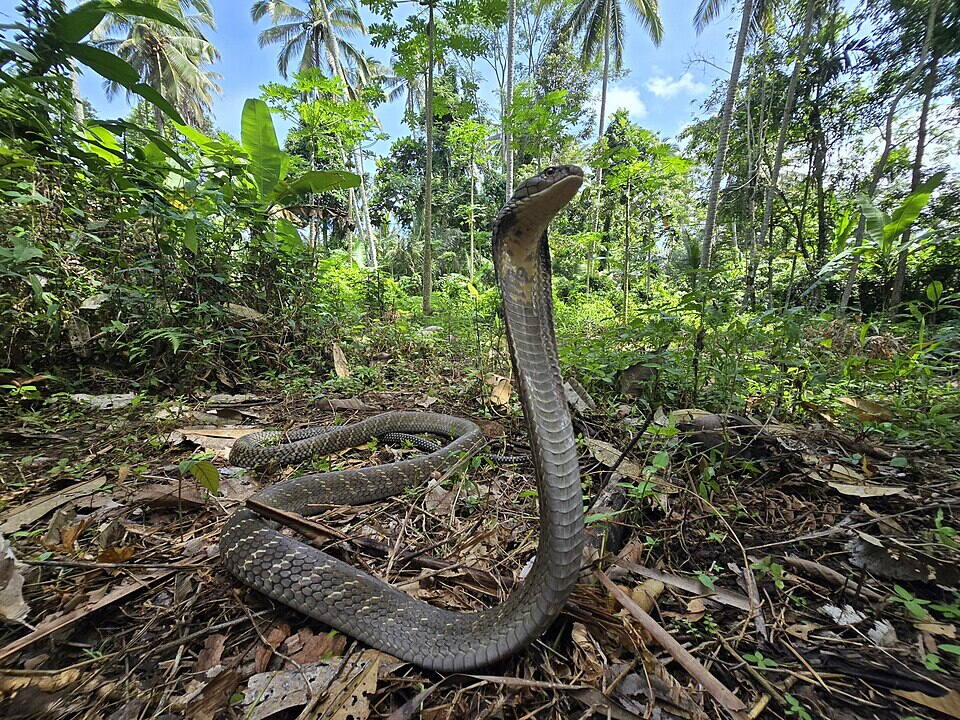
King cobra (Ophiophagus hannah) — Present in northeast Thailand, confirmed in the Sakaerat Biosphere Reserve near Korat. Rarely seen near villages — it prefers dense forest and stays away from people. The world’s longest venomous snake, reaching up to five metres. Protected under Thai wildlife law. If encountered in the wild, back away quietly. Do not attempt to catch, corner, or photograph it at close range.
Common harmless snakes — often mistaken for dangerous ones
The Oriental rat snake (Ptyas mucosa) and Indo-Chinese rat snake (Ptyas korros) are both large, fast, and alarming if unexpected. They are completely harmless. A large brown or olive snake moving quickly through a garden is almost certainly a rat snake — and it’s doing useful work, eating rodents.
The checkered keelback is another common harmless species found near water.
When snakes are most active
The rainy season (May–October) brings the highest encounter rates. Snakes become more active and sometimes seek shelter indoors during heavy rain. The hot season also sees increased activity. December and January are the quietest months. Most venomous species are more active after dark. In rural areas at night, use a torch and watch where you step.
If you encounter a snake
Stay still, give it space, and let it move away. Most bites in Thailand happen when someone tries to catch, kill, or move a snake. Do not use a stick to prod or flip it — several species strike faster than the eye can follow.
Do not attempt to kill it. Killing snakes is strongly discouraged — and for protected species such as the king cobra, it is illegal under Thai wildlife law. More practically, the attempt to kill a snake is the single most common cause of a serious bite. A snake that is left alone will leave. One that is cornered or attacked will defend itself.
If a snake is in your house: Keep people and pets away from the room, close doors to contain it, and call for help:
- In a rural village: ask a neighbour first — most long-established villages have someone with experience catching and relocating snakes, and they will often come quickly
- Fire and rescue (199): Buriram’s fire department handles snake removal calls
- Sawang Foundation: community-led volunteer rescue organisation operating in the province
- Snakes of Isaan (Thailand) Facebook Group: active community for connecting with local catchers — useful if you want to identify a species or find someone nearby
- Medical emergency (1669): if someone has been bitten
If you’re bitten
Get to hospital immediately — do not wait to see how symptoms develop. Antivenom is the only effective treatment, and delays cause serious complications.
What to do:
- Keep the bitten limb still and at or below heart level
- Remove rings, watches, or tight clothing near the bite
- Do not cut, suck, or apply a tourniquet — these cause more harm
- Take a photo of the snake if it is safe to do so — this helps doctors select the correct antivenom
Where to go: Buriram Hospital is a 900-bed regional centre with antivenom. Nang Rong Hospital in Nang Rong district has also confirmed antivenom capability and has treated serious krait bites. Thailand’s antivenom supply is centrally managed by the National Health Security Office — no patient in the public system is denied treatment due to stock shortages.
Water Monitors: The Dragon Next Door
The Asian water monitor (Varanus salvator) is the large reptile you’re most likely to see in Buriram. Adults grow up to two metres and have a deliberate, unhurried walk that draws attention. They turn up near canals, garden ponds, temple grounds, and anywhere food is available.
They are not aggressive. In fact, they are remarkably shy — a water monitor will usually retreat well before you get close. If cornered, it can scratch or bite, but unprovoked attacks on people are very rare. Give it space and it will go.
Their presence near water is a good sign: they hunt fish, frogs, and rodents, and indicate a functioning local ecosystem.
Geckos: The Noise in the Night
Two gecko species share most homes in Buriram.
The common house gecko (Hemidactylus frenatus) — small, pale, almost translucent — is the one running across ceilings at night. It is completely harmless. Thai households consider them good luck, and practically, they earn their place by eating mosquitoes, spiders, and other insects.
The tokay gecko (Gekko gecko) is larger, striking blue-grey with orange spots, and produces a loud two-note call that sounds exactly like its name. Tokays can deliver a firm bite if handled, but they will not seek you out. They are more often heard than seen.
Skinks and Lizards
Skinks are the small, fast lizards darting through leaf litter and across garden paths in daylight. Several species are common in Buriram, including the bright-sided common sun skink. All are insectivores and entirely harmless.
Frogs and Toads: The Rainy Season Explosion
From May onwards, as the monsoon arrives, Buriram’s frog population makes itself impossible to ignore. The sound from rice paddies and garden ponds on a wet evening is extraordinary — multiple species calling at once.
Common species include the green paddy frog (Hylarana erythraea) near ponds and fields, the banded bullfrog (Kaloula pulchra), and the large Asian giant toad (Phrynoidis asper), which can reach 20cm. Toads are harmless but produce a mild skin secretion — wash hands after handling one.
Amphibians do useful work: they consume insects, including mosquitoes, in large quantities.
Mammals: What Comes Out After Dark
Most of Buriram’s larger mammals are nocturnal and wary of people. Sightings are possible but require patience or luck.
Wild elephants (Elephas maximus) — Buriram has a genuine wild elephant presence. Herds from the Dong Phaya Yen–Khao Yai Forest Complex enter villages in the province’s forested northern and western districts, particularly near Dong Yai Wildlife Sanctuary. Reports of elephants entering communities to forage crops are regular, and human-elephant conflict in Buriram is an ongoing wildlife management issue.
This is not a tourist encounter. Wild elephants are large, fast, and unpredictable. If you encounter one — particularly at night, which is when most incidents occur — do not approach, do not use a torch or phone light toward it, move away quietly, and get indoors. Do not attempt to photograph it at close range. Village residents in affected areas are well aware of local elephant activity and are the best source of current information on safe movement after dark.
Wild boar (Sus scrofa) are present in forest-edge areas and more often heard crashing through undergrowth than seen. Give them distance if you encounter one with young.
Barking deer (Muntiacus muntjak) — Thailand’s most widespread deer — inhabit wooded parts of the province. You’re more likely to hear the sharp, loud bark that gives them their name than to see the animal.
Asian palm civets are common throughout Isaan but almost entirely nocturnal. They’re occasionally spotted near village gardens after dark.
Macaques are present near Khao Kradong, the forested volcanic hill on the edge of Buriram city. As with all wild primates, do not offer food — it habituates them to humans and leads to aggressive behaviour.
Soi Dogs
Stray and semi-feral dogs — soi dogs — are one of the most common animal encounters in Buriram, and the one most likely to cause a problem for visitors and residents alike. Temples in particular accumulate large numbers of them; what begins as local people feeding strays becomes an established pack with strong territorial behaviour. Cyclists and motorcyclists are frequent targets — the combination of movement and noise triggers a chase response.
Practical advice: If a dog charges, slow down rather than accelerate. Running or speeding up triggers pursuit. On foot, stop moving, avoid direct eye contact, and back away slowly. Picking up a stone — or simply making the gesture of doing so — often causes a dog to back off immediately. Do not try to pet unfamiliar dogs, even ones that appear friendly.
Rabies: Thailand has rabies. Any dog bite — however minor — requires medical attention and a course of post-exposure prophylaxis. Do not wait to see if symptoms develop; by the time rabies symptoms appear, treatment is no longer effective. Go to Buriram Hospital. The vaccination course is widely available and straightforward if started promptly.
Livestock on the Roads
Water buffalo (karabao) and cattle are a constant feature of rural Buriram. They are generally docile and not a threat to people on foot, but they are a serious road hazard — particularly at night, when animals wander onto unlit roads and are almost invisible until you’re very close. Accidents involving livestock are a significant cause of road injuries in Isaan. Slow down after dark on rural roads and expect animals at any point.
Free-range chickens are everywhere in village Buriram, and fighting cockerels — kept tethered outside houses on individual stakes — are one of the defining sights of rural Isaan. Cockfighting (kai chon) is deeply embedded in local culture. The practical implication for anyone sleeping in a village: cockerels begin crowing well before 4am and do not stop. Earplugs are not optional.
Freshwater Fish
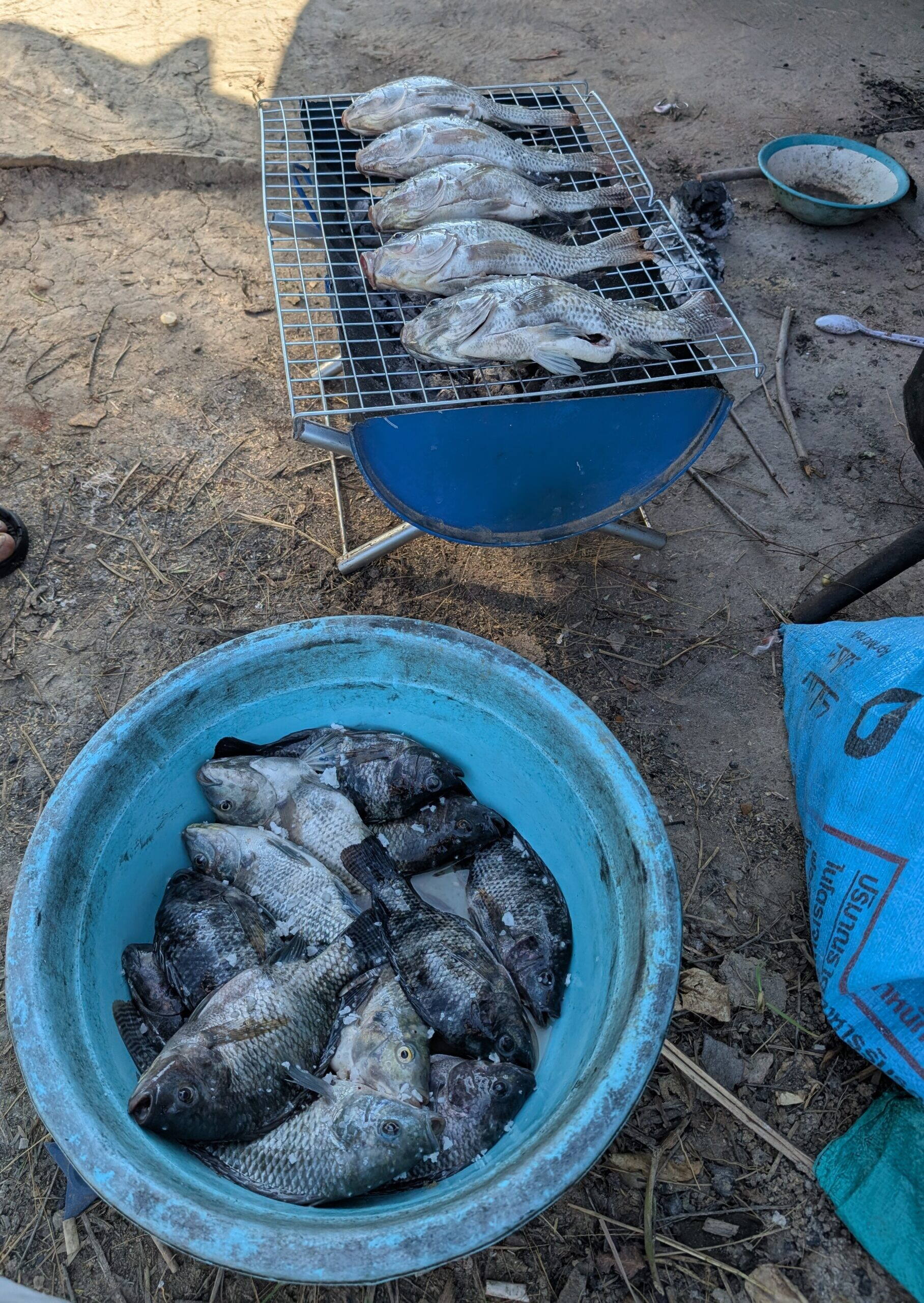
Buriram’s ponds, reservoirs, and irrigation channels hold a rich variety of freshwater fish. The most characteristic Isaan species is the snakehead (pla chon, Channa striata) — a muscular, surface-breathing predator found in almost every body of still water in the province, from large reservoirs to roadside drainage ponds. The larger giant snakehead (pla chon ngoo hao, Channa micropeltes) also occurs and reaches impressive sizes.
Catfish of several species are common, including the striped catfish (pla sawai), widely farmed and also found wild. Tilapia (pla nil) — an introduced species — dominates managed ponds throughout the province.
For anyone developing land or managing a pond in rural Buriram, snakehead and catfish are the species you’ll encounter most. Both are excellent eating, and both feature prominently in Isaan cooking — the connection between the pond and the grill is a short one here.
Invertebrates Worth Knowing
Giant centipedes (Scolopendra subspinipes) reach 25cm in Isaan. Their bite causes severe burning pain and swelling that can last several days. They are not fatal to healthy adults, but the pain is significant. They favour dark, damp places — drains, under rocks, occasionally in shoes left on the floor. Shake out footwear before putting it on.
Scorpions are present, primarily the black forest scorpion (Heterometrus species). Their sting is painful but not life-threatening to healthy adults. They’re mainly found in forest and scrub.
Asian giant hornets (Vespa mandarinia) are present in rural areas. They don’t attack without provocation, but disturbing a nest in scrubland or near tree roots is genuinely dangerous. Multiple stings can be serious. If you hear unusually loud buzzing from ground level or low vegetation, move away calmly.
Birds
Buriram is a quietly impressive birding destination. The wetlands at Huai Chorakhe Mak host one of Thailand’s most significant populations of Sarus cranes — the tallest flying birds in the world. The province also sits on migratory routes that bring considerable variety through the cool season (November–February).
Practical Notes
When wildlife is most active: The rainy season (May–October) is the peak period for most species. Snakes, frogs, and insects are at their most active. The cool dry season (November–February) is quieter but better for birds.
Safety: The Is Buriram Safe? guide covers the broader picture, including road safety and health facilities.
Photography and identification: iNaturalist Thailand is an excellent resource for identifying what you’ve found. Observations from Buriram are sparse in the database — any contributions help fill a genuine gap in regional data.
Travel insurance: If you’re spending time outdoors in rural Isaan — hiking, birdwatching, working on land — medical cover is sensible. Compare travel insurance options here.
More on Buriram’s natural world: Sarus Cranes at Huai Chorakhe Mak | Khao Kradong: Buriram’s Volcanic Hill | Is Buriram Safe? | Places to Visit in Buriram

Planning your trip to Buriram? Compare travel insurance options — World Nomads covers adventure activities, medical treatment, and the unexpected.
Feature image: Asian water monitor, Khao Yai National Park — © Chris Page / Wikimedia Commons / CC BY-SA 3.0
King cobra image: © Max Tibby / iNaturalist via Wikimedia Commons / CC0 Public Domain
buriram.live is an independent guide to Buriram province and northeast Thailand.
This article contains affiliate links. If you book or buy through them, we may earn a small commission at no extra cost to you.
Get Buriram updates by email
Occasional emails when there is something worth knowing: new guides, festival and MotoGP dates, and Buriram United news. No spam, and you can unsubscribe at any time.
We will email you a link to confirm. See our privacy policy.