
Every November, when the full moon rises over northeast Thailand, people gather for Loy Krathong. In Buriram, they head to the water carrying small hand-crafted boats made from banana leaves and lotus flowers, each holding a candle and three sticks of incense. They set the boats gently on the surface, watch the flame catch, and push them out into the dark.
If the light stays burning until the krathong drifts out of sight, the year ahead will bring good fortune.
Buriram celebrates Loy Krathong in a setting unlike anywhere else in Thailand.
What is Loy Krathong?
Loy Krathong falls on the full moon night of the twelfth month of the Thai lunar calendar, usually in November. The name translates simply: loy means to float, krathong is the vessel itself.
The festival honours Phra Mae Khongkha, the goddess of water and rivers, as a gesture of thanks for the water that sustained the rice harvest through the growing season. It is also a moment of spiritual release — the krathong carries away accumulated bad luck, anger, and regrets from the year. Some people snip a few hairs or nail clippings and place them on the krathong before releasing it, a physical act of letting go.
The classic krathong uses a cross-section of banana trunk as the base, folded banana leaves around the sides, and flowers, a candle, and three incense sticks for decoration. Vendors increasingly sell ready-made ones — but the handmade version carries more meaning, and making one with your family is part of the tradition.
The Khmer Connection: Why Buriram is Special
There is a detail about Loy Krathong that most guides miss, and it matters more in Buriram than anywhere else in Thailand.
The earliest known depiction of offerings floated on water is not Thai. In fact, the practice appears in bas-relief at the Bayon temple in Angkor — carved around 1208 under the Khmer king Jayavarman VII, the same civilisation that built Phanom Rung, Prasat Mueang Tam, and dozens of other temples across Buriram province. The tradition traces back through Khmer and Hindu-Brahmanical practice before Thai Buddhism absorbed it.
Buriram takes this connection seriously. The highlight of the region’s Loy Krathong calendar takes place not at a modern festival ground but at the ancient Khmer ponds of Prasat Mueang Tam — water that people have considered sacred for over a thousand years.
The Baray Satthat: Buriram’s Flagship Loy Krathong Event
Each year, Buriram province organises its main Loy Krathong celebration at Prasat Mueang Tam in Prakhon Chai district — roughly 40 kilometres south of Buriram city.
Buriram province calls the event บารายศรัทธา สมมาสายน้ำ ปราสาทเมืองต่ำ น้อมนำบูชา — roughly translated as “Faith in the Baray, Blessing the Water at Mueang Tam.” The baray are the ancient L-shaped sacred ponds that frame Prasat Mueang Tam on all four sides, built by the Khmers more than a thousand years ago as ritual water features integral to the temple’s cosmological design.
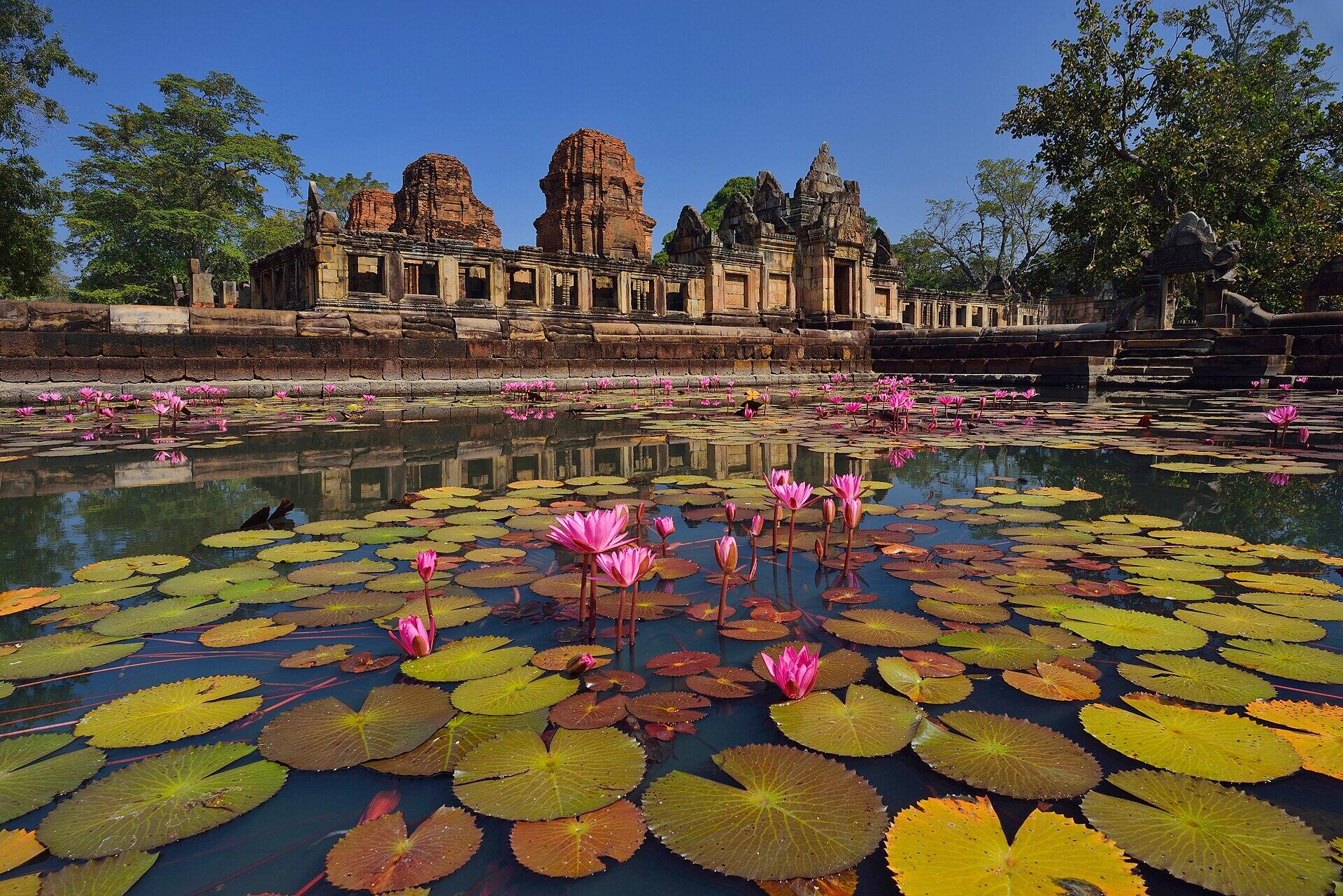

On Loy Krathong night, these ancient ponds become the centrepiece of a multi-day festival. Expect:
- A cultural procession through the temple grounds
- The Somma Nam ceremony — a traditional water-blessing ritual conducted at each of the four sacred ponds
- A Naga Devi beauty pageant (ประกวดนาคะเทวี) celebrating the spirit of the water goddess
- A light and sound show — the temple illuminated against the night sky
- An ancient-style market with local food and handicrafts
- Krathong floating on the baray itself — on water that has been sacred since the Khmer Empire
Buriram Province organises the event together with Prakhon Chai district and the Phanom Rung Historical Park authority. The Tourism Authority of Thailand (TAT) also lists it as an official provincial cultural event.
If you can only attend one Loy Krathong celebration in northeast Thailand, this is the one.
Loy Krathong in Buriram City
For those based in Buriram city, the municipality (เทศบาลนครบุรีรัมย์) organises its own annual Loy Krathong event along Khlong Lalom — the canal that runs through the city — and at the adjoining cultural square. The area around the Sao Mae Bua Loi shrine (ศาลเจ้าแม่บัวลอย) on Khlong Lalom is a traditional gathering point.
The city event is smaller and more neighbourhood-scale than the Mueang Tam celebration. However, it has the advantage of being easy to reach on foot from the town centre. Food stalls, local performances, and hundreds of candle-lit krathongs drifting along the canal make for a pleasant evening.
Loy Krathong and Yi Peng: Not the Same Thing
If you’ve seen photographs of thousands of paper lanterns rising into a dark sky and assumed this was Loy Krathong, you’ve encountered Yi Peng. This is the lantern festival of northern Thailand, centred on Chiang Mai and rooted in the Lanna culture of the north.
Yi Peng and Loy Krathong fall on the same full moon night, which is why photographers often pair them together. However, they are different traditions from different parts of Thailand.
In Isaan — northeast Thailand — sky lanterns are not a feature of Loy Krathong. In Buriram specifically, the municipality actively discourages fireworks and sky lanterns (โคมลอย) on safety and environmental grounds. What you will find instead is the water: candle-lit krathongs floating on the canal, the reservoir, and the ancient Khmer ponds.
The Isaan Variation: Lai Ruea Fai
Northeast Thailand has its own distinct variation of Loy Krathong: Lai Ruea Fai, or “floating fire boats.” Communities build large, elaborately decorated vessels strung with lights and release them onto rivers to drift downstream in glowing processions.
The most spectacular Lai Ruea Fai celebrations take place along the Mekong River in Nakhon Phanom. There, the scale of the boats and the sight of them crossing toward Laos makes it one of the most dramatic festival nights in Thailand. Ubon Ratchathani, Sakon Nakhon, and other Isaan river provinces hold similar events.
Buriram, being a landlocked province without a major river, celebrates at canals, reservoirs, and ancient Khmer ponds rather than a great waterway. But the spirit is identical — light on water, offerings to the river goddess, the release of what no longer serves you.
Practical Information
2026 date: Loy Krathong falls on the full moon, Tuesday 24 November 2026. It is not a public holiday. The festival at Mueang Tam usually runs for two to three nights around the full moon, but the province has not yet announced this year’s dates; we will add them here once they are published.
Mueang Tam after dark, before the festival: from 3 October to the end of December 2026, the Fine Arts Department is lighting up Prasat Mueang Tam and keeping it open into the evening every Friday, Saturday and Sunday, at the normal admission price. Loy Krathong itself falls on a Tuesday this year, so these weekend openings are separate from the festival, but they are a chance to see the temple lit at night on any November weekend. Evening hours have not been published, so check with the Phanom Rung Historical Park office (044 666 251) before you set off.
Getting to Mueang Tam from Buriram city: Prasat Mueang Tam is approximately 65 km from Buriram city by road, near the town of Prakhon Chai. By car or motorbike the drive takes around an hour and a quarter via Route 2445. There is no public transport to the site — renting a car or motorbike is the practical option. See our guide to getting to Buriram for all transport options.
Where to stay: Buriram city is the natural base — Prakhon Chai town has limited accommodation. See our Buriram accommodation guide.
What to bring: Light layers (November evenings can be cool by Isaan standards — around 20–24°C), comfortable walking shoes, cash for food stalls and krathongs, and a small torch. The Mueang Tam site has some uneven ground after dark.
Eco krathongs: Buriram municipality actively promotes natural-material krathongs — banana leaf and trunk, not styrofoam. If you buy one at the event, look for the traditional banana-leaf construction, which biodegrades in the water.
Travel insurance: Festival crowds, evening events, open water — it’s worth being covered. Compare travel insurance options here.
Loy Krathong and the Buriram Year
November is one of the best months to visit Buriram. The rains have stopped, the air is cool and clear, the rice harvest is at its peak, and the landscape is intensely green. Loy Krathong at the end of the month caps a season that also includes some of the best birdwatching of the year at Huai Chorakhe Mak.
It sits alongside Bun Bang Fai — the rocket festival each May — as one of the two great traditional festivals of Isaan. Both are rooted in the agricultural rhythms and relationship with water that have shaped this part of Thailand for a very long time.
Getting to Buriram: The Complete Transport Guide | Where to Stay: Buriram Accommodation Guide | The Khmer temples: Phanom Rung and Prasat Mueang Tam | More festivals: Bun Bang Fai — Isaan’s Rocket Festival
Feature image: © John Shedrick / Wikimedia Commons / CC BY 2.0
Mueang Tam image: © Leelaryonkul / Wikimedia Commons / CC BY-SA 4.0
buriram.live is an independent guide to Buriram province and northeast Thailand.
This article contains affiliate links. If you book or buy through them, we may earn a small commission at no extra cost to you.

Get Buriram updates by email
Occasional emails when there is something worth knowing: new guides, festival and MotoGP dates, and Buriram United news. No spam, and you can unsubscribe at any time.
We will email you a link to confirm. See our privacy policy.