
The first sound every morning at the house in Ban Lamduan was not an alarm clock. It was a cockerel, followed almost immediately by the village tannoy — a speaker bolted to the wall of our house, because my father-in-law was the headman for the main street. The broadcasts came before dawn: community notices, announcements, and the signal that it was time to prepare the offering for the monks. By the time most visitors to Thailand were thinking about breakfast, the women of the village had already been up for hours. This is how Buddhist temples in Buriram actually start the day.
This is what Buddhist temples in Buriram actually look like, once you get past the photographs of gilded spires. The wats of Buriram are not monuments. They are not places you visit on a Wednesday afternoon and tick off a list. They are the centre of everything: the place where children are named, elders are mourned, communities are organised, and the rhythm of daily life is set. Understanding them is understanding Buriram.
What the Wat Actually Is
Every Thai village has a wat, and the Buddhist temples in Buriram are no different — each one serves a function that no Western equivalent quite matches. Part church, part community hall, part school, part social services. The abbot is often one of the most influential people in a village. Young men traditionally spend time as monks — some for a few weeks, some for years — before returning to lay life. A man who has been ordained is considered to have matured; many Thai women will not marry a man who has not served as a monk at some point in his life.
The relationship between a village and its wat is continuous and practical, not ceremonial and occasional. Families bring food every day. Festivals are organised through the temple. When someone dies, the monks conduct the ceremonies and the community gathers. When someone needs guidance, they come here. The temple grounds are where children play after school and elders sit in the shade of the afternoon.
Alms-Giving: The Morning Ritual
Between around 5:30 and 8:00 every morning, monks leave their temples and walk a set route through the village, barefoot, carrying their alms bowls. Laypeople kneel by the road — or wait at their gate — and place food into the bowls as the monks pass. The monks do not speak, do not make prolonged eye contact, and do not thank the givers. This is not rudeness: it is the proper form of the ceremony, which is called tak bat. The merit flows from the act of giving, not from any exchange.
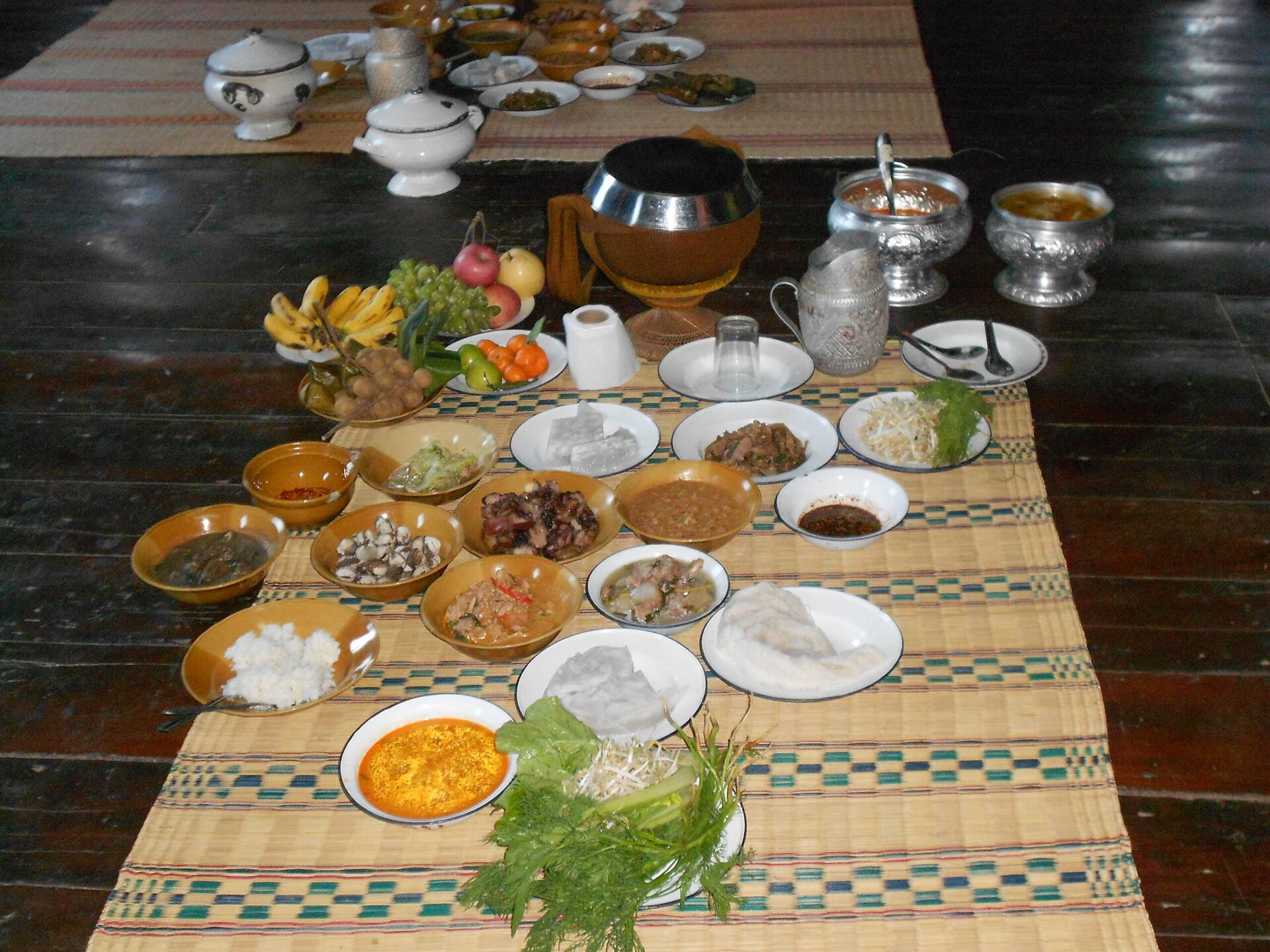
What people offer varies by occasion. On an ordinary morning it is sticky rice, fruit, perhaps packaged snacks. On a significant day — a death anniversary, a birthday ceremony, a merit-making occasion — the preparation is altogether different. The food spread that my wife’s family prepares for the monks at Wat Ban Lamduan on those days is something I have never seen matched anywhere: twenty or thirty small dishes arranged on a woven mat on the temple floor, covering everything from curried meats and soups to fresh vegetables, sticky rice wrapped in banana leaf, fruit, and silver teapots of water. The preparation starts in the dark.
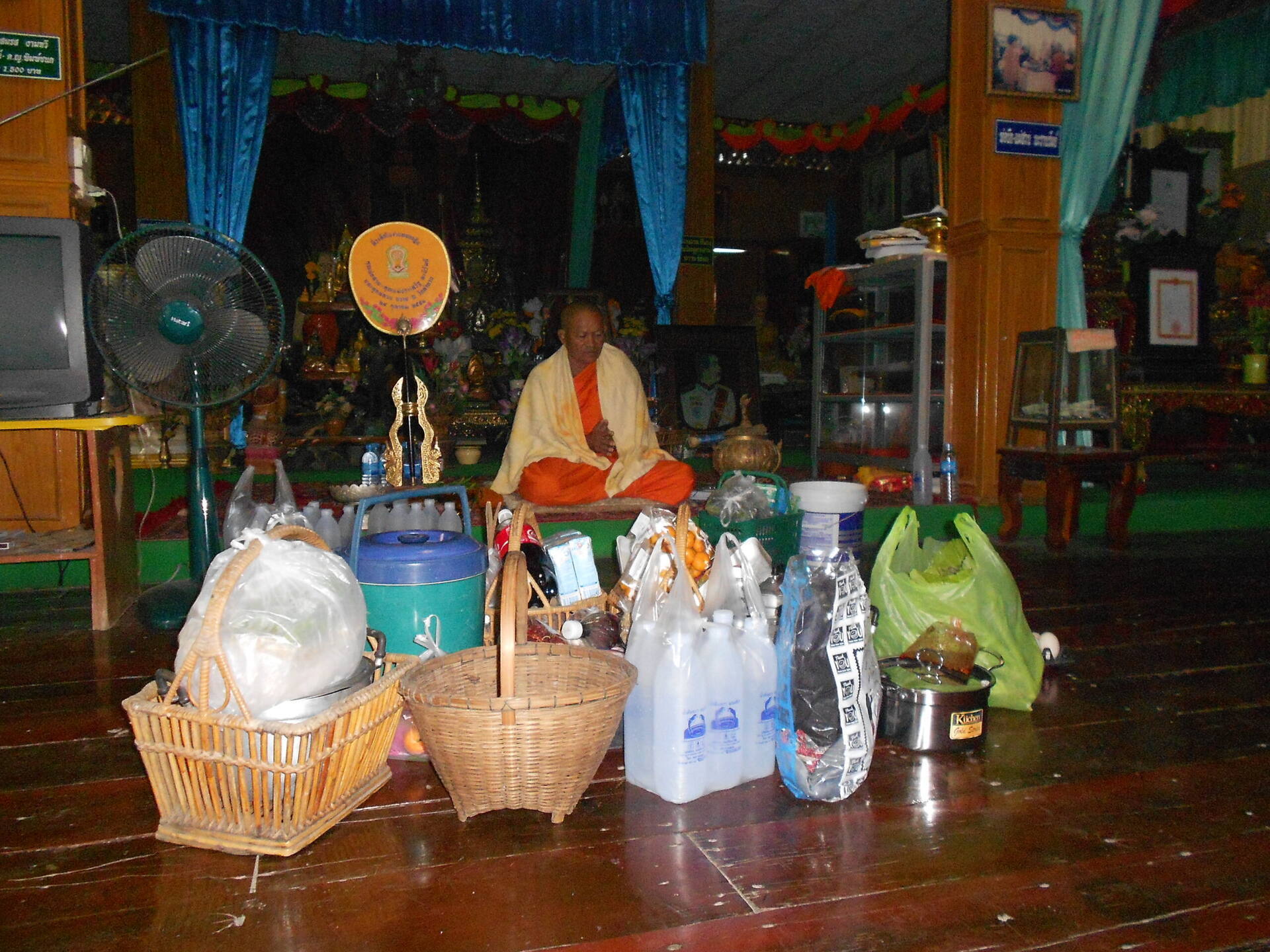
Visitors who want to take part respectfully should dress modestly — shoulders and knees covered — remove shoes before entering any temple building, and kneel or sit lower than the monks. Women should not hand anything directly to a monk; place the item on a cloth or the ground and let the monk take it. Do not point your feet towards the monks or the Buddha image.
The Temple Fair: The Other Side of the Wat
If alms-giving is the quiet daily rhythm of the wat, the temple fair is the other extreme. Ngan wat — temple fairs — happen throughout the year at different wats across Buriram province, tied to specific occasions in the Buddhist calendar or to each temple’s own commemorations. They are unapologetically exuberant.
Arrive in the evening at a Buriram village temple fair and the first thing you notice is the volume. Mor Lam music — the traditional folk music of Isaan — pumps from speakers tall enough to be visible from the road. Food stalls line every path: grilled meats, papaya salad, sticky rice, sweets, things on sticks. Children run everywhere. There are games, including the highly competitive and enormously entertaining pursuit of catching live chickens, which turns out to be considerably harder than it looks. Raffles are held, with prizes ranging from household goods up to, on at least one occasion, a cow.
Nobody is performing this for visitors. The fair is for the community and the community shows up — in numbers, across three generations at once. It is one of the best things you can stumble into in rural Buriram, and there is almost no chance of finding it in any guidebook.
The Buddhist Year in Buriram
The rhythm of village life in Buriram follows the Buddhist lunar calendar. Several dates bring particular activity to the wats:
Makha Bucha (February full moon) marks the occasion when 1,250 disciples gathered spontaneously to hear the Buddha speak. At wats across Buriram, monks and laypeople circle the temple three times by candlelight after dark in a ceremony called wien tian. The atmosphere is entirely different from the daylight bustle of a temple fair: quiet, deliberate, genuinely moving if you encounter it by chance.
Visakha Bucha (May full moon) is the most significant date in the Buddhist calendar — it marks the Buddha’s birth, enlightenment, and death, all traditionally on the same date. The candlelit procession is repeated. Many businesses close and the wats are busy throughout the day.
Lent, Robes and the Rains Retreat
Khao Phansa (July, the day after the full moon of the eighth lunar month) marks the beginning of Buddhist Lent — the three-month Rains Retreat during which monks remain at their home temples. Families bring robes, medicines, and essential items. Young men who plan to be ordained often do so at this time; their ordination ceremonies are large family occasions.
Ork Phansa (October full moon) ends the Rains Retreat and is one of the most festive dates in the Isaan calendar. It is followed by Tod Kathin — the ceremony of presenting new robes and offerings to monks — with processions, music, and community gatherings at wats across the province through November.
Underneath all of this runs a distinctly Isaan layer of tradition: the Heet Sip Song, twelve monthly merit-making customs that blend Buddhist practice with older beliefs about the land, the harvest, and the ancestors. They run throughout the year, connecting monks and community in a continuous cycle that long predates tourism and has no particular interest in it.
Buddhist Temples Worth Visiting in Buriram City
The Buddhist temples in Buriram city are accessible, welcoming of respectful visitors, and almost entirely ignored by tourists — which makes them more, not less, worth visiting.
Wat Klang is one of Buriram city’s established central temples — active, well-attended, and representative of the everyday Buddhist life the city has maintained for generations. It is not a showpiece temple, which is exactly the point.
Wat Tham Theeraram is located just beyond the railway tracks, close to Buriram Railway Station. It is notable for an ordination hall approached through an alley of seated Buddha images with monks holding alms bowls — an unusual and striking approach that makes it worth a short detour for anyone arriving in the city by train.
Buddhist Temples Worth Visiting in Buriram Province
Wat Khao Kradong sits on top of the extinct volcano six kilometres from Buriram city — a working temple on genuinely dramatic terrain, with views across the province from the terrace around the main Buddha image. In April, on the full moon of the fifth lunar month, a religious procession climbs the 297 steps carrying saffron cloth to wrap around the Buddha. It is one of the most distinctively local ceremonies in the province, almost entirely unobserved by anyone outside the community. See the complete guide to Khao Kradong for visiting details.
Wat Khao Angkhan stands on another extinct volcanic plug in Chaloem Phra Kiat district, about ten kilometres south of Highway 24. The temple is built around ruins dating to the Dvaravati era — the 8th or 9th century — and features a 29-metre golden reclining Buddha visible from a considerable distance. It receives almost no foreign visitors, despite combining genuine antiquity, active Buddhist practice, and panoramic views that few places in the region can match. Full guide to Wat Khao Angkhan.
Beyond these, the honest advice is simply to explore. Buriram province is full of temples that appear without warning on rural roads — often with golden chedis, large Buddha statues, and ornate ubosots reflected in ponds — in villages so small they don’t appear on tourist maps and have no English presence online whatsoever. Five minutes on Google Maps in any district of Buriram turns up places like Wat Ban Yang Lon, a multi-storey temple with golden standing Buddhas and a naga staircase leading down to a lake, sitting in a village most visitors to Thailand will never hear of. It is not exceptional by Buriram standards. It is typical.
The best way to find these temples is to hire a car, pick a direction, and drive slowly. They reward that approach in a way that no itinerary can replicate.
Practical Notes for Visitors
- Remove shoes before entering any temple building
- Dress modestly — shoulders and knees covered for both men and women
- Do not point feet towards the Buddha image or towards monks
- Sit cross-legged or with feet tucked to the side
- Women should not touch monks or hand items directly to them
- Keep voices low inside temple buildings
- Photography is generally welcomed in temple grounds; check before photographing inside the ordination hall or during active ceremonies
- Spirit houses — the small shrines on posts found near almost every building in Thailand — are separate from the wat but part of the same spiritual landscape; treat them with the same respect
Buddhist temples in Buriram are not curated experiences. Nobody will hand you a leaflet or suggest the best angle for a photograph. You are a guest in a place of active worship, and behaving accordingly is both the right thing to do and, in practice, what makes the visit worth having.
Getting Around Buriram’s Temples
The city wats are within walking or tuk-tuk distance of central Buriram. Wat Khao Kradong is six kilometres out — a short drive or negotiated ride. Wat Khao Angkhan and the province’s more remote temples require a car. Hiring one for a day gives you the flexibility to combine two or three sites without depending on shared transport.
Car hire is available from Buriram Airport and gives you the flexibility to explore the province’s rural temples at your own pace. Search for car hire from Buriram Airport here.
For getting to Buriram from Bangkok or elsewhere in Thailand, see our complete transport guide, including trains, buses, and flights.
Getting to Buriram: AirAsia flies direct to Buriram Airport from Don Mueang (DMK) up to 14 times a week. Check flights and book here.
Travelling by train or bus? Search and book trains and buses across Thailand.

For where to stay in Buriram, see our accommodation guide — including options close to the city centre for exploring the wats on foot.
Travel insurance for Thailand
If you’re planning a trip to Buriram, make sure you’re covered. World Nomads offers flexible travel insurance for independent travellers — covering medical expenses, trip cancellation, and adventure activities.
For longer stays or expat life in Buriram, SafetyWing Nomad Insurance offers rolling monthly coverage designed for people living abroad.
Feature image: Mr.BuriramCN, CC BY-SA 3.0 via Wikimedia Commons.
Monk and food offering photographs: own photographs, Wat Ban Lamduan, Buriram province.

Buriram Live covers the real Buriram — temples, football, motorsport, rural life and practical information for visitors and those with deeper connections to the region. No fluff, no sponsored itineraries. Follow Buriram Live on Facebook for new articles and updates.
This article contains affiliate links. If you make a purchase through a link on this page, we may earn a small commission at no extra cost to you.
Get Buriram updates by email
Occasional emails when there is something worth knowing: new guides, festival and MotoGP dates, and Buriram United news. No spam, and you can unsubscribe at any time.
We will email you a link to confirm. See our privacy policy.