
Buriram does not appear on any list of Asian wellness destinations. Search for yoga retreats in Thailand and the results are Chiang Mai, Koh Samui, Koh Phangan; for Muay Thai training, Phuket and Bangkok; for health tourism, the same short circuit of familiar names. That may be about to change — and if it does, wellness in Buriram will have been visible long before anyone else noticed it.
In 2021, Newin Chidchob — the man who built Buriram United from a struggling provincial club into Thailand’s most dominant football dynasty, who constructed Chang International Circuit to MotoGP standard and put this quiet northeastern province on the international sporting map — stated his next ambition plainly: “My ultimate goal is to build the city into a hub of football, motor sport and finally a centre for health and wellness.”
When Newin announces something, it tends to happen. This guide covers what Buriram offers for health and wellness right now — assessed honestly — and why this is a destination worth knowing before the rest of the world catches on.
Muay Thai: the real thing, at a fraction of the tourist price
If you have trained Muay Thai at a gym in Phuket or Bangkok, you will recognise the experience: comfortable equipment, sessions calibrated for foreign beginners, and prices that reflect the demand of a tourist economy. That is a legitimate introduction to the sport. It is not, however, how Muay Thai is actually done.
The province’s most famous gym — Kiatmoo9, widely regarded for 34 years as one of the greatest Muay Thai camps in the world — has closed. Its closure is part of a broader pattern: as the sport globalises, the great provincial camps that defined authentic Isaan Muay Thai face pressures that commercial tourist gyms do not. What is left in Buriram is rarer and more valuable than what most visitors to Thailand’s tourist gyms ever encounter.
Lookchaomaesaitong Sit Namkabuan Gym
Founded in 1960, Lookchaomaesaitong is one of the oldest Muay Thai gyms in Buriram. Its most famous product is Coban Lookchaomaesaitong — one of the most celebrated Thai fighters of the 1990s, who trained here as a teenager and adopted the gym’s name as his own. After a period of closure, the gym reopened in 2010 under Kru Namkabuan Ratchapuekcafe, a five-Panang champion who also works as a referee and judge in provincial competitions.
The gym itself is clear about what it is: “Hey, this is not a resort. Lookchaomaesaitong is NOT A RESORT — it is a TRAINING CAMP. This place is for motivated fighters eager to LEARN and SWEAT.” The gym welcomes all levels, provided the motivation is genuine. A more beginner-accessible operation under the same family, Buriram Be Boxing, runs alongside at the same address. Stay-and-train accommodation with private rooms and a pool is available on-site. Day and monthly rates exist — confirm current pricing directly before booking. Located at 92/7 Na Sathani Road, Buriram city. Confirmed operating as of early 2025.
Samingnoom: training with a living legend
The most remarkable Muay Thai experience in Buriram is harder to find and harder to categorise. Samingnoom Sithiboontham — known in fighting circles simply as Samingnoom — was born in Mueang Buriram district in 1959. He represented Thailand in boxing at the 1988 Seoul Olympics and holds two Rajadamnern Stadium titles. Training engagements have since taken him to New Zealand and Finland. The femeu (technical counter-fighting) style he teaches is described by authorities on the sport as having “nearly vanished from Muay Thai.”
His ring stands beside a small house in rural Buriram — built by hand. He trains local children and, occasionally, foreign visitors serious enough to seek him out. Morning sessions reportedly include 5:30am runs up Khao Kradong, the extinct volcano six kilometres from the city. In the words of one experienced fighter who trained with him: “Training with Samingnoom is incredibly valuable. You learn a lot from him.”
There is no website, no booking platform, no published price. The gym does not advertise its location — the most reliable route is to DM Sylvie von Duuglas-Ittu (@8limbsUs) on any of her socials; she has a Google Maps pin for the gym and has been helping visitors make contact as recently as early 2026. This is as far from a tourist gym as it is possible to get. Samingnoom was born in 1959 — this opportunity will not exist indefinitely. If accessing the genuine article matters to you, it is worth the effort of making contact.
Massage and traditional bodywork in Buriram
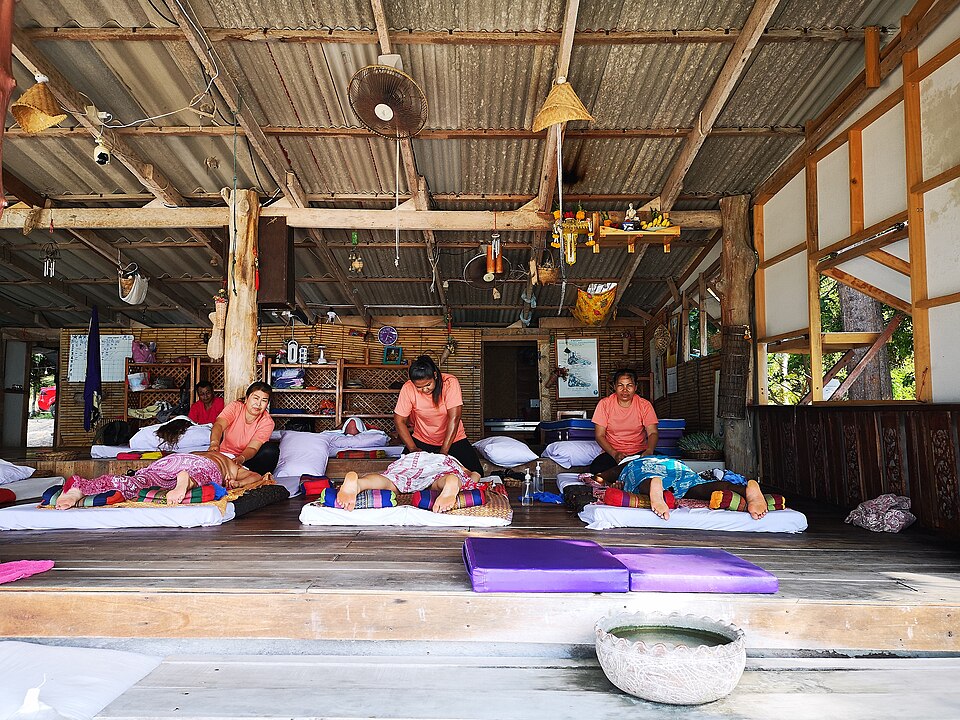
Buriram has a considerably larger massage and traditional bodywork scene than its English-language web presence suggests. TripAdvisor lists fewer than five venues for the entire province. Thai-language review sites tell a different story.
In Buriram city, established massage shops include ชวนชม นวดแผนไทย แอนด์ สปา — the only Buriram spa with an official listing in the TAT’s Thailand Tourism Directory — and เบญจา สปา, a Thai health massage chain branch that specialises in office syndrome, migraine and frozen shoulder. เรือนขวัญ นวดเพื่อสุขภาพ on Santhipracha Road offers Thai massage, foot massage, oil massage, line-release massage and home visits, open daily from 9am. For a visitor wanting a straightforward starting point, Lilly Hair Spa & Massage inside Robinson Lifestyle Centre is probably the most accessible option before you know the city — centrally located and easy to find.

Get a travel insurance quote for Thailand — worth having for any active training. World Nomads covers Muay Thai and martial arts.

Standard Thai massage in Buriram runs at roughly 200–250 baht per hour. At a mid-range spa in Chiang Mai you would pay 400–600 baht for the same. At an established wellness resort elsewhere in Thailand or Southeast Asia, considerably more.
A regional tradition: sen-based massage
The Lower Northeast — Buriram, Surin, Si Sa Ket and Ubon Ratchathani — has its own traditional massage lineage distinct from standard Thai massage. นวดขิดเส้น (nuat khid sen) is a folk technique documented in peer-reviewed Thai academic literature and covered by Thai public broadcaster PBS: a manual line-flicking and line-pushing method working along the body’s sen (energy pathways) using the thumbs, heel of the hand, elbow tip and heel of the foot. Practitioners use it to treat migraine, frozen shoulder, sacroiliac problems and various musculoskeletal conditions. UNESCO recognised traditional Thai massage — including regional variants — in December 2019.
No Buriram spa currently markets itself to visitors under the Khid Sen name. However, several massage shops in the city offer the closely related รีดเส้น (line-pressing) and ตอกเส้น (line-tapping) techniques — the same family of bodywork under local naming conventions. These are not tourist products. They are genuine regional folk therapies still actively practised by trained practitioners in the area, and largely unknown to the English-speaking world.
Hotel wellness facilities in Buriram
Ray Hotel Buriram has the most comprehensive wellness offer of any hotel in this category in Buriram. The hotel claims the largest outdoor saltwater pool in the city (24m × 8m, open 07:00–21:00 daily), a gym with more than 30 pieces of equipment and certified instructors, and — notably — yoga classes. It is the only hotel in Buriram outside the luxury tier where yoga is confirmed. Additionally, massage services are available at extra cost.
Modena by Fraser Buriram offers indoor and outdoor pools, a steam room and massage services. Guest reviews are consistently positive about the quality of the massage staff. It is a practical, well-maintained option for visitors who want reliable wellness facilities in a central location.
Amari Buriram United — the hotel closest to Chang Arena — has a gym, outdoor pool, tennis courts and a jogging track. There is no spa at the Buriram property (Amari’s Breeze Spa brand operates at other group hotels; it is not present here). The gym and pool are well maintained and appropriate for a four-star property.
Check hotel availability in Buriram
Yoga and meditation in Buriram
Formal yoga infrastructure in Buriram is currently limited: Ray Hotel is the only confirmed venue offering yoga classes. There are no dedicated yoga studios in the city, and the booking platforms that list yoga retreats across Thailand return nothing for Buriram.
For meditation, the picture is more interesting — and more authentic — than anything a purpose-built retreat centre could provide.
Phanom Rung, built over several centuries from the tenth century onwards on the rim of an extinct volcano, receives a fraction of the visitors of Angkor Wat despite being comparable in craftsmanship. On a weekday morning outside peak season you may have the site to yourself for long stretches. The scale of the place, the precision of the stone carving, the famous solar alignment through thirteen doorways at sunrise on the equinoxes — it functions as a genuinely contemplative environment, and an ancient one. The site requires no guided programme.
Mueang Tam, in the rice fields below Phanom Rung, is older and visited by almost nobody. Its four lotus-filled ponds have surrounded the central sanctuary for roughly a thousand years. Khao Kradong — the extinct volcano six kilometres from the city centre — has a large Buddha at its summit, long views in every direction, and is quiet on most mornings. These are real places that exist right now. In a well-resourced wellness destination, they would be central to the offer. In Buriram today, most visitors still walk past them without knowing what they are standing in.
Natural spaces and active life
Buriram’s main public park — Suan Satharan Chaloem Phra Kiat Rama IX — has a public fitness area and a municipal swimming pool. It is a genuine wellness amenity for residents and visitors that appears on no English-language travel site.
Beyond the city, the Huai Chorakhe Mak wetlands and the forested trails of Khao Kradong park offer walking and cycling in a landscape that tourism has not yet reached. For visitors who find wellness in natural environments rather than retreat centres, Buriram offers this without the infrastructure cost — or the other visitors — of more established destinations.
For runners, the Buriram Marathon — a World Athletics Gold Label night race starting and finishing at Chang Circuit, held each January — draws international competitors to the province. It falls squarely in the best window for a wellness visit, and the combination of a major race and everything else Buriram offers makes January one of the most rewarding times to come.
The pace of provincial Buriram itself is a consideration. There is no traffic noise at Bangkok scale, no resort strip calibrated for tourist spending, no overlay of an international tourism industry on a city that still goes about its ordinary life. For some visitors, that is exactly the point.
The cost of wellness in Buriram
A Thai massage in Buriram costs roughly 200–250 baht per hour. At a mid-range Chiang Mai spa, 400–600 baht. At an established wellness resort on Koh Samui, considerably more still — and that is before accommodation and flights to the island.
Authentic Muay Thai training with genuine pedigree in Buriram costs significantly less than tourist-facing camps in the south. Hotel rooms at properties with pool and gym access are priced well below equivalent-quality accommodation in resort areas. The daily cost of living in Buriram — food, transport, accommodation — is among the lowest of any Thai city.
A wellness-focused week in Buriram — accommodation, daily massage, Muay Thai training, good food — comes in at a fraction of what a comparable week would cost in established Thai wellness destinations, or in wellness resort destinations anywhere in the world. Part of this is because Buriram is not yet a wellness destination. That may not last.
The vision: where wellness in Buriram is heading
The track record matters here. Buriram United — under Newin’s direction from a province with no professional football history — became Thailand’s most successful football club, winning 11 Thai league titles, more than any other club in the country’s history, including five consecutive championships. Chang International Circuit was built to a standard that brought MotoGP to Buriram. Chang Arena is among the best football-specific venues in Southeast Asia. These were not modest ambitions. They required sustained investment, political will and long-term vision in a province that most of Thailand had not thought about.
The wellness vision is currently a stated direction, not a construction timeline. No specific projects have come to light as of 2026. But the pattern with Newin and Buriram is consistent: when a direction is announced, things tend to get built.
The foundations are already there — world-class Muay Thai, a documented regional massage tradition, ancient contemplative spaces, hotels with genuine wellness facilities, and a cost structure that undercuts every established wellness destination in the region. Whether a broader wellness infrastructure emerges over the next five to ten years depends on decisions that remain unannounced. It is worth paying attention to Buriram before those decisions are announced.
When to visit: air quality and season
Buriram’s most significant practical caveat for a wellness-focused visit is air quality during the burning season. Agricultural burning — primarily sugarcane fields, a major industry across Buriram and Surin — intensifies from December and peaks sharply between February and April. March is typically the worst month. The air quality during this period is a real issue. Field burning is illegal under Thai law, and national pressure on enforcement has increased in recent years. However, the problem extends well beyond Buriram’s borders: smoke from neighbouring provinces and cross-border drift from Myanmar, Laos and Cambodia affects air quality across the region regardless of what happens locally. This is a regional problem, not one that can be resolved by any single province acting alone.
For a wellness visit, the best months are:
- June–October — rainy season, good air quality, lush landscape, few visitors
- November–January — cool and dry, clear air, comfortable temperatures before burning begins in earnest
February through April is the most comfortable temperature-wise but the worst for air. Plan accordingly. Full seasonal detail is in the Buriram weather guide.
Planning your visit
Compare car hire rates for Buriram — the camps, temples and wetlands are spread across the province. A car makes the difference between visiting one or two sites and seeing everything properly.
Get a Thailand eSIM before you arrive — coverage in Buriram is good and having data from the moment you land saves the airport SIM queue.
Getting to Buriram by air, train and bus: The Complete Transport Guide. Where to stay: Where to Stay in Buriram.
Get a Nomad Insurance quote — for longer stays and expat-style visits, SafetyWing covers Thailand including medical treatment.
Feature image: Dmitri Markine, CC BY 3.0 via Wikimedia Commons
Inline image: Garonzi Stefania, CC BY-SA 4.0 via Wikimedia Commons

Buriram Live covers the real Buriram — temples, football, motorsport, rural life and practical information for visitors and those with deeper connections to the region. No fluff, no sponsored itineraries. Follow Buriram Live on Facebook for new articles and updates.
This article contains affiliate links. If you make a purchase through a link on this page, we may earn a small commission at no extra cost to you.
Get Buriram updates by email
Occasional emails when there is something worth knowing: new guides, festival and MotoGP dates, and Buriram United news. No spam, and you can unsubscribe at any time.
We will email you a link to confirm. See our privacy policy.